






 Portuguese
  Spanish


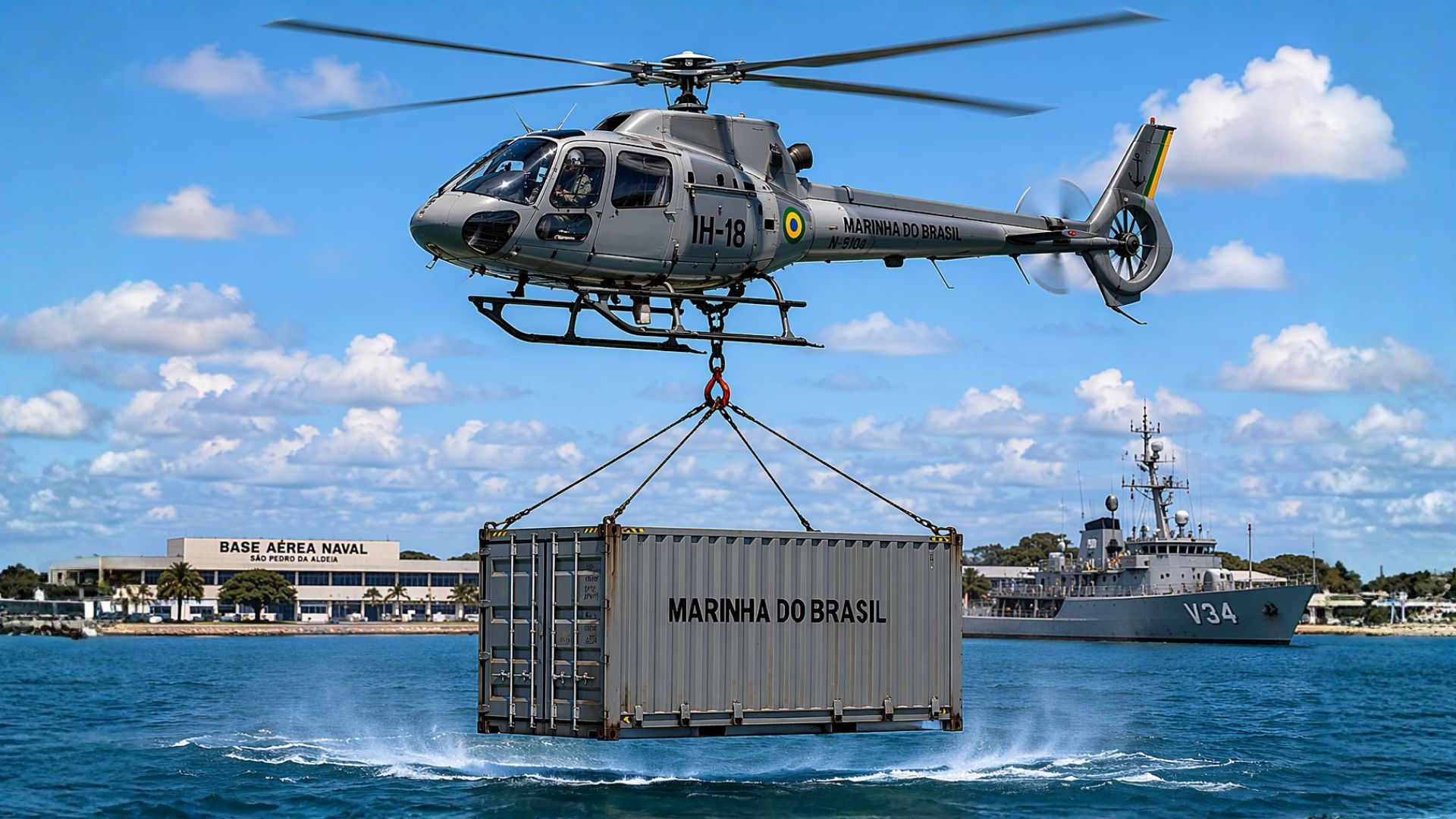

Tests with helicopter IH-18 expand operational capabilities of the Navy by integrating external cargo and rescue systems, strengthening the TH-X Project and the modernization of Naval Aviation focusing on embarked missions, vertical logistics, and search and rescue in different scenarios.
The Airbus H125 N-5104, designated IH-18 in the Brazilian Navy, has advanced to a new stage of testing by operating with cargo hook and rescue winch, two pieces of equipment intended to enhance the aircraft’s use in logistical and rescue missions.
The evaluation reinforces the progress of the TH-X Project, a program created to renew the training fleet of Naval Aviation and expand the operational capacity of helicopters that will begin to operate from embarked means and the Naval Air Base of São Pedro da Aldeia, in Rio de Janeiro.
Tests with hook and winch expand missions of the IH-18
According to information from the portal Defesa Aérea e Naval, the tests conducted with the H125 focused on two systems that have direct application in routine missions of the force.
-
Billionaire says the most valuable skill will help overcome job elimination caused by AI, following Bill Gates’ fears

-
A Dutchman created a ‘box’ that makes trees grow in the desert almost without water and without irrigation: the invention has already brought seedlings to dozens of countries and achieves up to 90% survival where common planting did not exceed 10%.

-
Abandoned warehouse hid a giant collection of rare computers, with over 2,000 artifacts from the 1930s to the 1980s.
-
Scientists warn that melting ice is triggering an alarming chemical transformation in preserved areas, and the first signs are already concerning researchers worldwide.




The hook, known in the sector as Cargo Hook, is used in VERTREP tasks, an acronym used for vertical replenishment between naval units.
The winch, referred to as Hoist, is primarily aimed at search and rescue actions, in scenarios where rescue requires lifting personnel or retrieving loads in hard-to-access areas.

The completion of this flight phase indicates that the Navy does not view the IH-18 merely as a basic training helicopter, but also as a platform with broader employment possibilities.
Although the program was designed to replace older training aircraft, the requirements defined for the new fleet include features that increase operational flexibility, especially in embarked operations, logistical support, and rescue tasks.
TH-X Project and modernization of Naval Aviation
The TH-X Project provides for the incorporation of 15 H125 aircraft by the Brazilian Navy, as part of a larger order shared with the Brazilian Air Force.
In the case of Naval Aviation, the priority is to replace the veteran IH-6B Jet Ranger III, helicopters that have been used for decades in the training of naval aviators and are nearing the end of their operational cycle in this role.
The modernization involves not just the replacement of the airframe or engine.
According to official information released by the Navy, eight of the 15 aircraft destined for the force will be allocated to the 1st Helicopter Instruction Squadron, a unit based in São Pedro da Aldeia, responsible for training pilots for Naval Aviation.
This distribution shows that the IH-18 has been incorporated with a central focus on training, while preserving room for general employment tasks in a maritime environment.

In practice, the arrival of the H125 raises the technological standard of instruction.
The Navy and the Institute of Research and Flight Testing have already highlighted, in previous stages of the program, that the new aircraft adds more modern avionics, greater power, and features that bring initial training closer to the demands found in more recent generations of military helicopters.
This leap reduces the gap between the learning phase and future operation in frontline squadrons.
VERTREP operations and search and rescue in the naval environment
The installation of equipment such as floats, hook, winch, and stretcher shows that the naval configuration of the H125 was designed beyond the classic school use.
On board, the hook increases the external transport capacity of materials, supplies, and small loads between ships or between ship and shore, a relevant function in logistical support scenarios, force sustainment, and vertical replenishment.
In the case of the winch, the operational gain is more evident in SAR missions, especially when landing is not viable or when rescue needs to be done quickly over water, deck, or restricted areas.
For aviation focused on the maritime environment, this versatility is significant as it broadens the range of responses available in emergencies, training, and support tasks for ships on commission.
The choice of the H125 for this mission package is also related to the model’s history in the Brazilian civil and parapublic market, where the Ecureuil family has built a reputation for robustness, ease of maintenance, and wide versatility.
By adapting the platform to the requirements of Naval Aviation, the Navy seeks to combine in a single aircraft the requirements of instruction, safety, performance, and complementary operational task capabilities that often require flexibility.
As the tests progress, the 1st Helicopter Instruction Squadron is also conducting the qualification of pilots and crews for the new vector.
In phases already officially disclosed, squadron personnel participated in theoretical training and procedures related to the IH-18, in preparation for the progressive incorporation of the aircraft.
This parallel work is crucial because the fleet transition does not depend solely on the physical delivery of the helicopters, but on the training of personnel capable of operating and maintaining them safely.


The receipt of the first aircraft, formalized in 2025 at Helibras facilities, was treated by the Navy as a milestone for the modernization of means dedicated to air instruction.
Since then, the program has begun to combine inspections, technical flights, crew qualifications, and operational evaluation stages, forming a gradual process of model absorption by the force.
The tests with the N-5104 are part of this movement towards maturing the future fleet.
By incorporating features aimed at vertical refueling and rescue, the IH-18 reinforces a trend in Brazilian Naval Aviation to seek instructional means that also address concrete demands of onboard employment.
Instead of limiting the new helicopter to basic training, the Navy expands the possibilities of using an aircraft that should accompany pilot training and, at the same time, support practical missions related to the operational daily life of the force at sea and on land.





