Portuguese
  Spanish


While modern elevators have been fully automatic for years, federal public agencies continued allocating millions of reais to maintain professionals responsible for operating equipment that any user can use alone, raising a debate on efficiency, public spending, and state modernization.
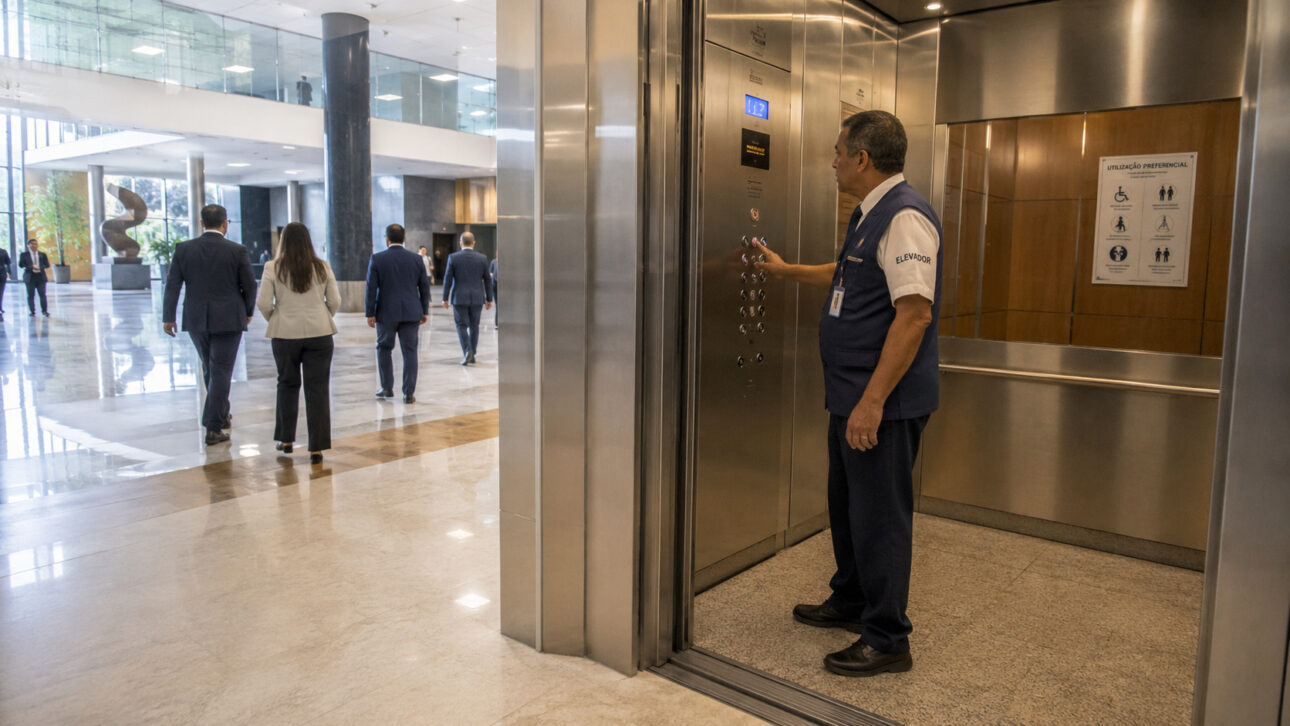
For decades, entering an elevator and finding a professional responsible for pressing the buttons was part of the routine in commercial buildings, hotels, and public offices. What many Brazilians do not know is that, even in the 21st century, the federal government still maintained million-dollar contracts for hiring elevator operators, a profession that the State itself officially classified as obsolete.
The information gained prominence after the release of studies and surveys presented by Canal Elementar, which analyzed public data on the permanence of these professionals in federal agencies. The debate resurfaced especially after measures announced by the government in April 2025 to eliminate thousands of positions considered outdated within the public administration.
A profession created when elevators still required manual operation
To understand why elevator operators existed for so long, it is necessary to go back to the late 19th and early 20th centuries.
-
Orphaned Youth Turns Dismissed Idea into Global Prestige with Innovative Wristwatch

-
English Skills Boost Career Opportunities in the Oil and Gas Industry

-
Brazil Secures Second Place at WorldSkills 2024 in Lyon, with 64 Young Professionals and 8 Medals, Including Gold from a Rio de Janeiro Hairdresser

-
3,000 Military Personnel from 10 Countries, Including US and Chinese Marines, Train Together in Brazil’s Savanna: Operation Formosa Becomes Largest Naval Ground Exercise Before First Cancellation Since 1988



During that period, elevators were very different from today’s equipment. Operation required technical knowledge, as the operator needed to manually control the cabin’s movement and make precise stops on floors. A mistake could cause accidents during passenger boarding or disembarking.
It was in this context that the profession emerged.
In Brazil, the activity was regulated in 1957 by then-President Juscelino Kubitschek, through Law No. 3,270. The legislation established specific rules for the category of elevator operators, including a six-hour daily work shift.
The regulation remained in effect over the decades and continued to be used as a reference in public contracts even after technological advances completely transformed the operation of elevators.
Over the years, the equipment began to feature automatic systems, safety sensors, scheduled stops, and extremely simple operation panels.
In other words, the technical justification for the existence of the profession practically disappeared.
Even so, the position continued to exist in various public structures.
The private sector abandoned elevator operators, but the government continued hiring
While technology made the presence of operators in elevators unnecessary, private companies gradually dispensed with these professionals.
Hotels, business centers, and commercial buildings were the first to adopt fully automated systems.
According to representatives of the hotel sector cited by Canal Elementar, it is currently rare to find establishments that still maintain elevator operators in activity.
In Rio de Janeiro, a state law approved in 1991 made it mandatory to hire these professionals in commercial buildings with five or more floors. The measure maintained thousands of jobs for years.
Later, however, the courts overturned the requirement after understanding that the obligation created unnecessary costs for property owners and companies.
Even in this scenario, the profession continued to be present in various public institutions.
In 2015, according to a report published by the newspaper O Globo through the Access to Information Law, 48 federal agencies were questioned about the existence of elevator operators in their staff.
Of these, 21 confirmed the maintenance of the function.
In total, there were 232 professionals spread across different federal departments.
The justifications presented included controlling the flow of people, transporting cargo, attending to authorities, and reinforcing passenger safety.
R$ 8 million per year to press buttons


The numbers are striking.
In 2021, the Chamber of Deputies, Federal Senate, and Superior Court of Justice (STJ) together maintained 110 professionals linked to elevator operation through outsourced contracts.
The combined expenses reached approximately R$ 8 million annually.
Of this total:
- R$ 3.8 million were allocated to the Chamber of Deputies;
- R$ 3 million to the Superior Court of Justice;
- R$ 1.33 million to the Federal Senate.
The institutions justified maintaining the contracts by citing issues related to the intense flow of visitors, parliamentarians, staff, and authorities.
The Chamber of Deputies, for example, stated that the professionals contributed to ensuring the proper and safe operation of the equipment.
The argument, however, began to be questioned by experts and parliamentarians.
This is because the Supreme Federal Court (STF), which also receives authorities, ministers, visitors, and staff daily, operated normally without any elevator operators.
The comparison intensified the debate about the real necessity of the function.
Another noteworthy fact is in the Brazilian Classification of Occupations (CBO), an official document used by the government to evaluate professions.
The position of elevator operator received a score of 1 on a scale of 1 to 8 in the criteria of knowledge, skill, and attitude.
This is the lowest possible score within the official classification.
In other words, the State itself recognized that it was an occupation of minimal complexity.
The bill that tried to expand a declining profession
Even in the face of the advancement of automation, there were attempts to increase the presence of elevator operators in the country.
Bill No. 2637/11, presented by Deputy Laércio Oliveira, proposed making it mandatory to hire these professionals in public and commercial buildings equipped with elevators.
The proposal remained under consideration for more than a decade in the Chamber of Deputies.
During the discussions, parliamentarians from different ideological backgrounds showed resistance to the idea.
Reports prepared throughout the process indicated that the operation of modern elevators does not require specialized training and that the obligation would generate costs without proportional benefits.
In the end, the project was rejected.
The episode ended up symbolizing a broader discussion about bureaucracy, administrative modernization, and the efficiency of public spending.
The change announced by the government in 2025
The most significant step occurred in April 2025.
On the occasion, the Ministry of Management and Innovation in Public Services (MGI) announced an administrative restructuring involving approximately 30,000 positions considered obsolete.
The list included roles such as:
- Elevator operator;
- Typist;
- Telex operator;
- Cowboy.
According to the ministry, about 29,700 old positions would be transformed into 28,400 new roles more aligned with the current needs of public administration.
Among them were administrative and technical roles compatible with the reality of modern public service.
The government stated that the measure would not generate additional budgetary impact, as the financial resources were already included in the federal budget.
In practice, the proposal aimed to redirect existing funds to areas considered more strategic.
The human side behind an extinct profession
Despite the criticisms of maintaining the position, the history of elevator operators also involves thousands of workers who built their lives through this activity.
One of the stories presented by Canal Elementar is that of Roselia da Conceição, who worked in a commercial building in downtown Rio de Janeiro.
In 2018, at the age of 53, she already recognized that the profession was coming to an end.
Even so, her goal was to remain in the role until reaching retirement.
Another example is Francisco Rodrigues Lima, who arrived in Brasília more than four decades ago and found in the work as an elevator operator an opportunity to support his family, buy a house, and finance his daughter’s university education.
Stories like these show that the discussion goes beyond the practical utility of the profession.
The debate also involves the transition of workers who dedicated decades of their lives to an activity that ended up being surpassed by technology.
A symbol of the State’s difficulty in abandoning old structures
The case of elevator operators became an emblematic example of how certain structures continue to function even after losing their original reason for existence.
While the private sector quickly adapted to technological changes, the public sector took decades to begin a process of reviewing these roles.
The restructuring announced in 2025 represents an important step in this direction.
Even so, experts point out that the change occurred long after the practical need for the position had disappeared.
More than discussing the usefulness of a specific profession, the episode raises a bigger question: how many public resources continue to be allocated to maintaining structures that no longer meet the demands of today’s society?
The answer to this question can directly influence the next chapters of the modernization of the Brazilian public service.
Source: Canal Elementar.
References: Law No. 3,270/1957; data obtained via the Access to Information Law; information from the Ministry of Management and Innovation in Public Services (MGI); report from the newspaper O Globo; survey presented by Canal Elementar.
And you, do you believe that the position of elevator operator still makes sense in some places, or do you agree that this profession has become obsolete? Leave your opinion in the comments.