





 Portuguese
  English
  Spanish
  5 min of reading
  0 comments


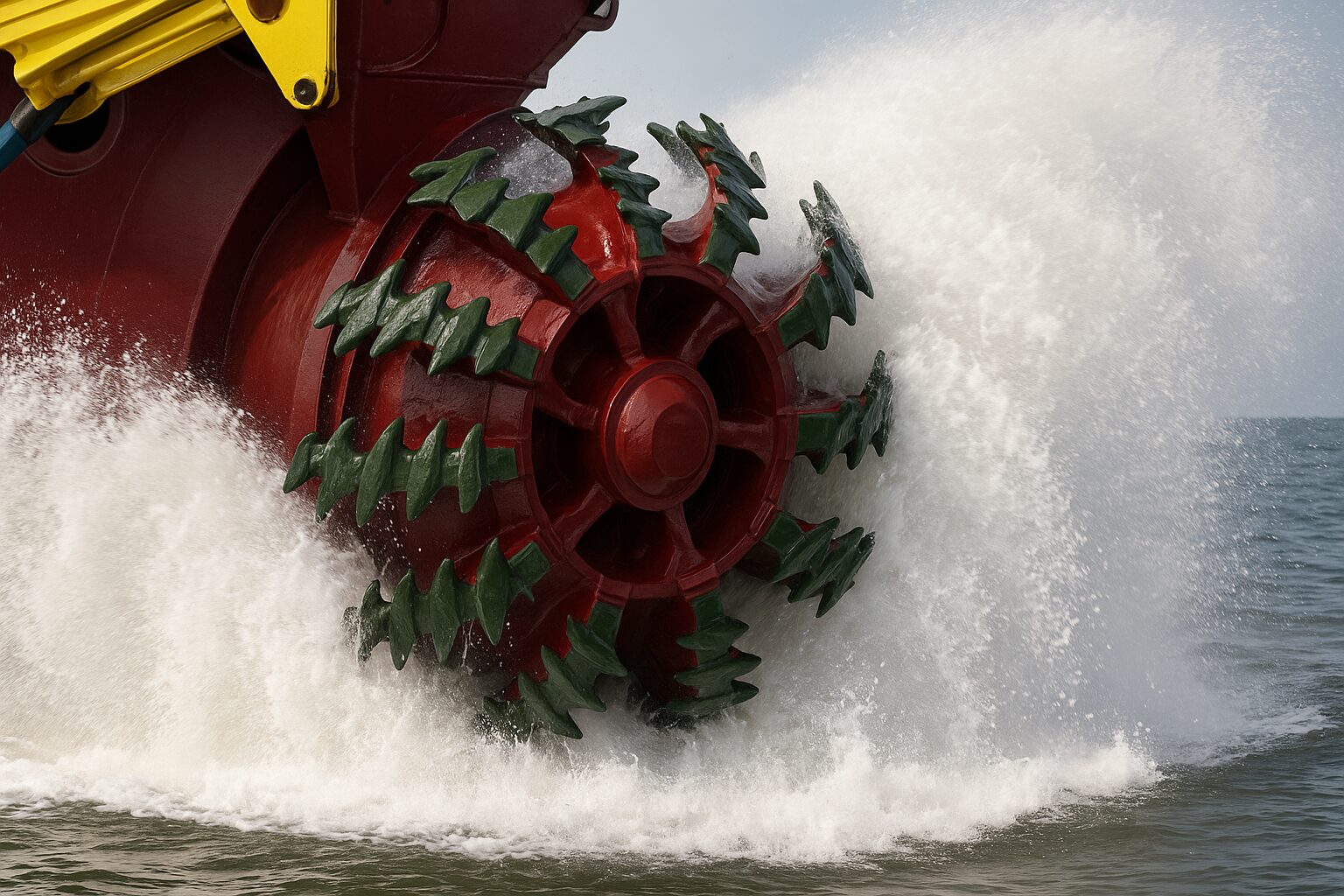
Capable of Digging the Equivalent of Three Olympic-Sized Swimming Pools Per Hour and Transporting the Material Up to 15 Km, the Tian Kun Hao Is the Largest Cutter Suction Dredge in Asia — and the Symbol of a New Geopolitical and Technological Era in the South China Sea.
Named after a mythical Chinese creature, the Tian Kun Hao is more than just a ship — it is a powerful engineering tool and a strategic asset in the competition for maritime influence. With a length of 140 meters, the vessel is designed to excavate, suction, and transport large volumes of sand and rock from the seabed for the creation of artificial islands, ports, and coastal infrastructure. Dubbed by state media as the “magical island creator,” or the ship that “digs” the sea, the Tian Kun Hao represents the most advanced technology in cutter suction dredging, capable of working at depths of up to 35 meters and moving up to 6,000 cubic meters of material per hour.
What Is a Cutter Suction Dredge?
The Tian Kun Hao is classified as a cutter suction dredger (CSD), a type of vessel that uses a rotating cutter head to break up solid sediments on the seabed, sucking the material through suction pipes and transporting it over long distances via pipelines or direct discharge.
In the case of the Tian Kun Hao, this system allows the ship to excavate earth, sand, mud, gravel, coral rock, and consolidated sediments, making it ideal for both civil engineering and military use.
-
Around 7,000 jobs are expected to emerge in Navegantes with a new billion-dollar order from Petrobras, which closed R$ 11 billion in contracts to build four hybrid propulsion vessels equipped with underwater robots for the pre-salt layer at the Santa Catarina shipyard.

-
Uncrewed and over 1,000 tons, new warship targets future naval operations

-
Ship that departed from China on March 30 arrives in Salvador with 44 containers, 1,550 metal pieces, and over 800 tons of equipment, marking the beginning of the largest bridge over the sea in Latin America, a mega-project of 12.4 km that will use unprecedented technology on the continent.

-
While modern pilots respect a minimum altitude of 300 meters, a P-51 flew under the Eiffel Tower chasing a Bf 109 in 1944.


Its distinguishing feature is the ability to move material up to 15 km away, making it perfect for creating new islands, expanding coastal areas, or building ports without the need for additional equipment.
Main Features of the Tian Kun Hao
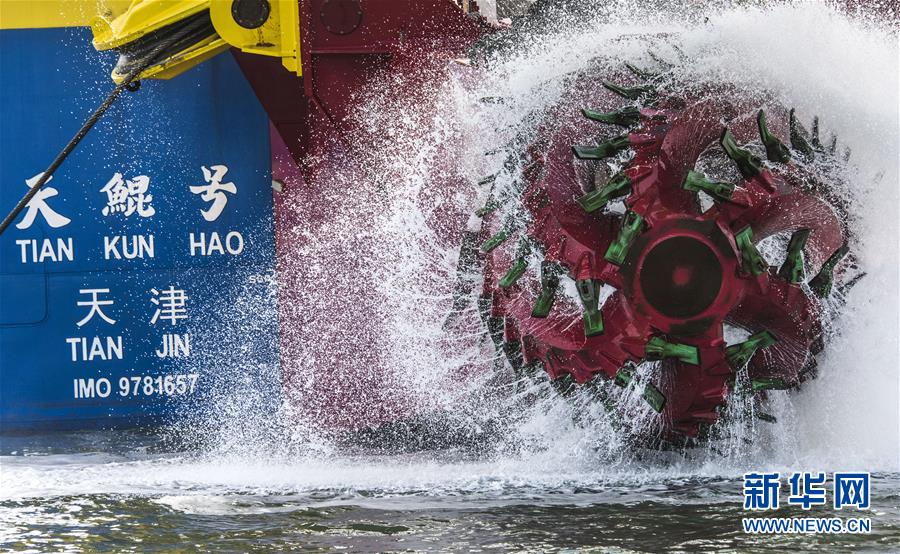
| Specification | Detail |
|---|---|
| Name | Tian Kun Hao |
| Meaning | Mythological Name (Fish That Becomes a Bird) |
| Type of Vessel | Cutter Suction Dredger |
| Length | 140 Meters |
| Dredging Capacity | 6,000 m³ per Hour |
| Dredging Depth | Up to 35 Meters Below Sea Level |
| Transportation Range | Up to 15 Km Away |
| Materials It Can Dredge | Sand, Mud, Rock, Coral, Gravel |
| Place of Construction | Shanghai Maritime Institute |
| Operating Company | China Harbour Engineering Company (CHEC) |
This vessel represents the pinnacle of Chinese Maritime Engineering and has one of the largest cutters in the world, reinforcing China’s position as a powerhouse in offshore infrastructure.
From Engineering to Geopolitics: A Dredge That Irritates
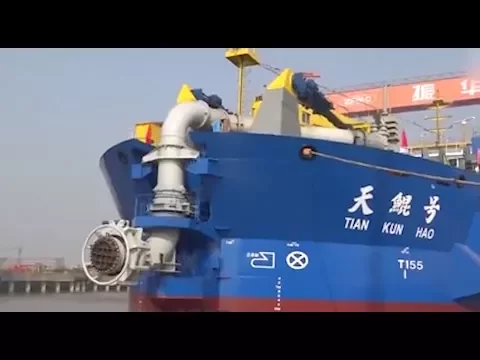

The official presentation of the Tian Kun Hao occurred strategically on the eve of then-US President Donald Trump’s visit to China, at a time when the territorial tensions in the South China Sea were high.
The vessel attracted worldwide attention due to its potential military application. Countries such as the Philippines, Vietnam, Malaysia, Brunei, and Taiwan accuse Beijing of using dredgers like the Tian Kun Hao to transform reefs into artificial bases — a means to expand presence in disputed maritime areas.
The main concern lies over the Scarborough Reef, a highly sensitive zone in the region. According to analysts, using the ship to build infrastructure there would be seen by many as a “red line” in diplomatic terms, potentially generating a strong international reaction.
How Does the Ship “Create” an Artificial Island?
The technology of the Tian Kun Hao literally allows it to sculpt and relocate the seabed. The process follows these steps:
- Cutting the seabed with the rotating cutter at the end of the vessel.
- Suctioning sediments, rock fragments, and sand.
- Hydraulic transportation via pipelines extending up to 15 km from the vessel.
- Controlled deposition of the material in a predetermined location, creating volume and mass.
- Compaction and stabilization, usually with the use of land machinery or auxiliary vessels.
This process enables the increase of usable territory, expands ports, builds coastal industrial zones, and — as in the Chinese case — establishes physical presence in contested maritime areas.
The Tian Kun Hao in the United Arab Emirates
In 2024, the Chinese dredger was sent to Abu Dhabi, in the United Arab Emirates, where it participates in a recovery and dredging project for Hudayriyat Island.
The aim is to transform the island into a high-end tourist and residential hub, with marinas, resorts, and expanded access roads. The presence of the Tian Kun Hao in the Persian Gulf reinforces global interest in its technical capacity and its significance as a tool of China’s influence abroad.
The name Tian Kun Hao carries significant symbolism. It refers to the Chinese mythological figure of the “Kun,” a gigantic fish that transforms into the legendary bird “Peng,” capable of flying thousands of kilometers.
In practice, the name represents the idea of transformation and domination over space, both natural and territorial. It is an ideal metaphor for a vessel that literally moves oceanic land to create new sovereign spaces.
Why Does the Tian Kun Hao Generate Tension in the South China Sea?
The South China Sea is one of the most contested regions in the world. Rich in natural resources and vital for global trade routes, it is claimed by several Asian countries — but China asserts sovereignty over nearly 90% of the area, based on historical maps.
The construction of artificial islands is central to this dispute. Since 2014, China has been transforming reefs and atolls into military installations with runways, radar, and missile systems. And vessels like the Tian Kun Hao are the tools that make this possible.
According to international analysts, the public launch of the vessel with pomp and propaganda was not merely a display of technology but a political statement of intentions.
Advanced Technology, but with Environmental Risks
Despite its efficiency, the extensive use of dredgers like the Tian Kun Hao raises serious environmental concerns:
- Destruction of coral reefs, essential for marine biodiversity
- Water turbidity, which affects the photosynthesis of underwater organisms
- Impact on artisanal fishing, especially in coastal regions
- Increased erosion, due to changes in sediment dynamics
Environmental NGOs and research groups warn that the creation of artificial islands can generate irreversible ecological imbalances, especially if done on a large scale, as in the Chinese case.
The Difference Between Civil and Military Dredging
Civil dredging is widely used worldwide to expand ports, deepen channels, and combat the silting of rivers. In contrast, dredging for military or geopolitical purposes, such as in the South China Sea, shifts the strategic balance in contested areas.
The Tian Kun Hao can be used in both contexts, but its capacity and range make the vessel highly sensitive in politically unstable regions.
The Tian Kun Hao, the ship that “digs” the sea, is a symbol of China’s ambition in maritime dominance and the country’s technological capability to build where there was once only ocean.
With performance that impresses — excavating up to 6,000 cubic meters per hour and displacing this volume up to 15 km away — the vessel represents the pinnacle of modern dredging naval engineering.
However, beyond engineering, it raises debates about sovereignty, environmental preservation, military balance, and territorial expansion. A single ship, therefore, has the power to redraw the map — literally and politically.






-

-

-

3 people reacted to this.