






 Portuguese
  Spanish


In June 2026, near Gerstewitz, in Saxony-Anhalt, archaeologists found the skeleton of a man about 25 years old inside an oven used by the Corded Ware Culture. The skull injury and the unusual location raise hypotheses of murder, war, or ritual.
The skeleton of a man approximately 25 years old, found inside an ancient structure used as an oven about 4,500 years ago, intrigues archaeologists in eastern Germany. The discovery was announced in June 2026 and occurred near the town of Gerstewitz, in the state of Saxony-Anhalt, during preventive excavations carried out before the construction of a power transmission line. The skull shows signs of injury, and the burial site is considered unusual for the time, which has opened up a series of unanswered questions.
What makes the case even more unsettling is the history of similar discoveries. Ovens of the same type, linked to the same prehistoric culture, have already appeared containing whole oxen and partially dismembered dogs, interpreted by some experts as ritual offerings. In light of this, researchers do not rule out that the young man buried in Gerstewitz may have been part of some dark ceremonial context. The information was released by g1, based on the State Office for Heritage Management and Archaeology of Saxony-Anhalt.
Where and how the body was found
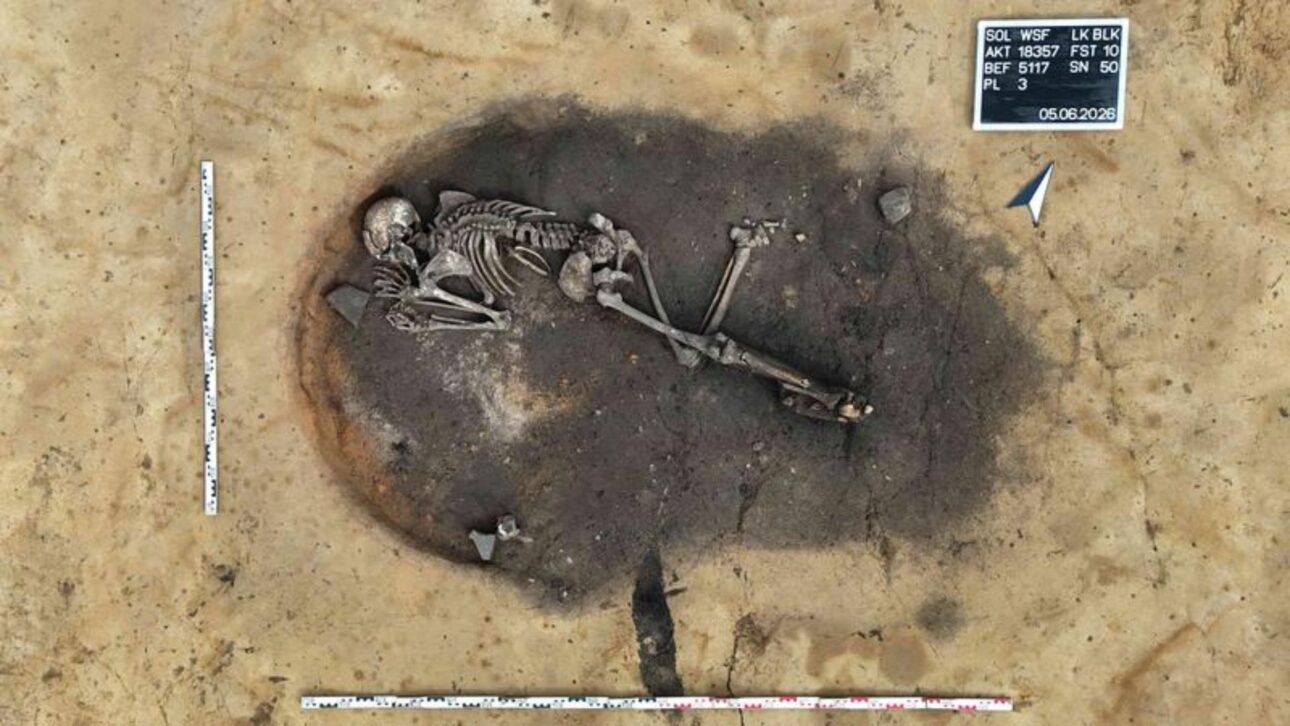
The man was buried in an underground cavity formed by two interconnected chambers, which originally served as an oven. The structure is attributed to the so-called Corded Ware Culture, a group that occupied parts of Europe between 2900 BC and 2050 BC.
-
Xiaomi 18 Pro and 18 Pro Max May Debut with Snapdragon 8 Elite Gen 6 Pro, Featuring Dual 200 MP Cameras and 8,500 mAh Battery, Ahead of Competitors

-
ispace Pays SpaceX $50 Million to Hitch a Ride on Starship, Aiming for a Shared Commercial Route to the Moon by 2030

-
Solar-Powered Cell Tower to Connect 10,000 Residents on Remote Brazilian Island, Reducing Diesel Dependence
-
Snowman-shaped asteroid captured by Hayabusa2 probe during flyby just 10 km away


The skeleton was in a fetal position, lying on the right side and facing south, a typical characteristic of male burials from that cultural group. The detail that caught the researchers’ attention was not the position of the body, but the chosen burial site, as structures of this type normally do not contain human remains. The combination of an apparently careful burial and such an unusual place is a central part of the enigma.
The skull injury and hypotheses about the death
Initial examinations identified an injury on the man’s skull, and this is one of the points that most fuels doubts. A head wound can have various origins, from intentional violence to an accident or the consequences of a confrontation, and for now, nothing is ruled out. It is from this data that archaeologists build their lines of investigation.
The first hypothesis is that the young man was a victim of murder. Another possibility is that he died in some type of conflict and was hastily buried in an existing structure at the site. There is also a third line, perhaps the most disturbing, that connects the burial to some ritual practiced by the community of the time. None of them, so far, can be confirmed or safely eliminated.
The ovens with animals and the suspicion of ritual
The ritual hypothesis gains weight precisely when looking at other similar discoveries. Ovens associated with the Corded Ware Culture have been found containing complete skeletons of cattle or partially dismembered dog remains. For some specialists, these deposits represent possible offerings, suggesting that these structures had a use beyond the practical.
It is this pattern that makes scientists look at the Gerstewitz case with increased attention. If whole and dismembered animals were placed in these ovens as part of ceremonies, the presence of a human body in the same type of structure raises the possibility of a ritual significance. Even so, the researchers themselves emphasize that there is not enough evidence to claim that the man participated in any ceremonial context. The suspicion exists but remains as suspicion.
A region that holds 6,000 years of history
The archaeological site where the body appeared is a particularly rich area for science. It has revealed traces of human occupation that span about 6,000 years, making that part of Germany a true archive of the past. Each new excavation has the potential to add a piece to this historical puzzle.
Among the previous discoveries are a large burial mound erected between 4000 B.C. and 3400 B.C., as well as ditch and wall systems associated with collective ceremonies. Researchers have also found remains of burned houses and human and animal bones deposited in deep pits, signs of an intense and ritual-filled occupation. This accumulation of evidence helps to understand why such an unusual burial cannot be interpreted in isolation.
What is still to be discovered
For now, the skeleton of Gerstewitz remains shrouded in mystery. The most concrete answers are expected to come from the laboratory, where analyses will help clarify the man’s identity and the exact circumstances of his death. Modern techniques can reveal age, health conditions, diet, and even clues about how he died, helping to separate the hypotheses that currently coexist.
This is one of those rare cases where a prehistoric burial raises more questions than answers. Was it a murder, a death in combat, or a ritual sacrifice? For now, no one can say for sure. Science will have the final word, but the waiting time only increases the fascination around the man who rested for millennia inside an oven.
And you, which hypothesis do you think is more likely: murder, death in conflict, or ritual sacrifice? Leave your theory in the comments about the man found inside the 4,500-year-old oven.


