






 Portuguese
  Spanish


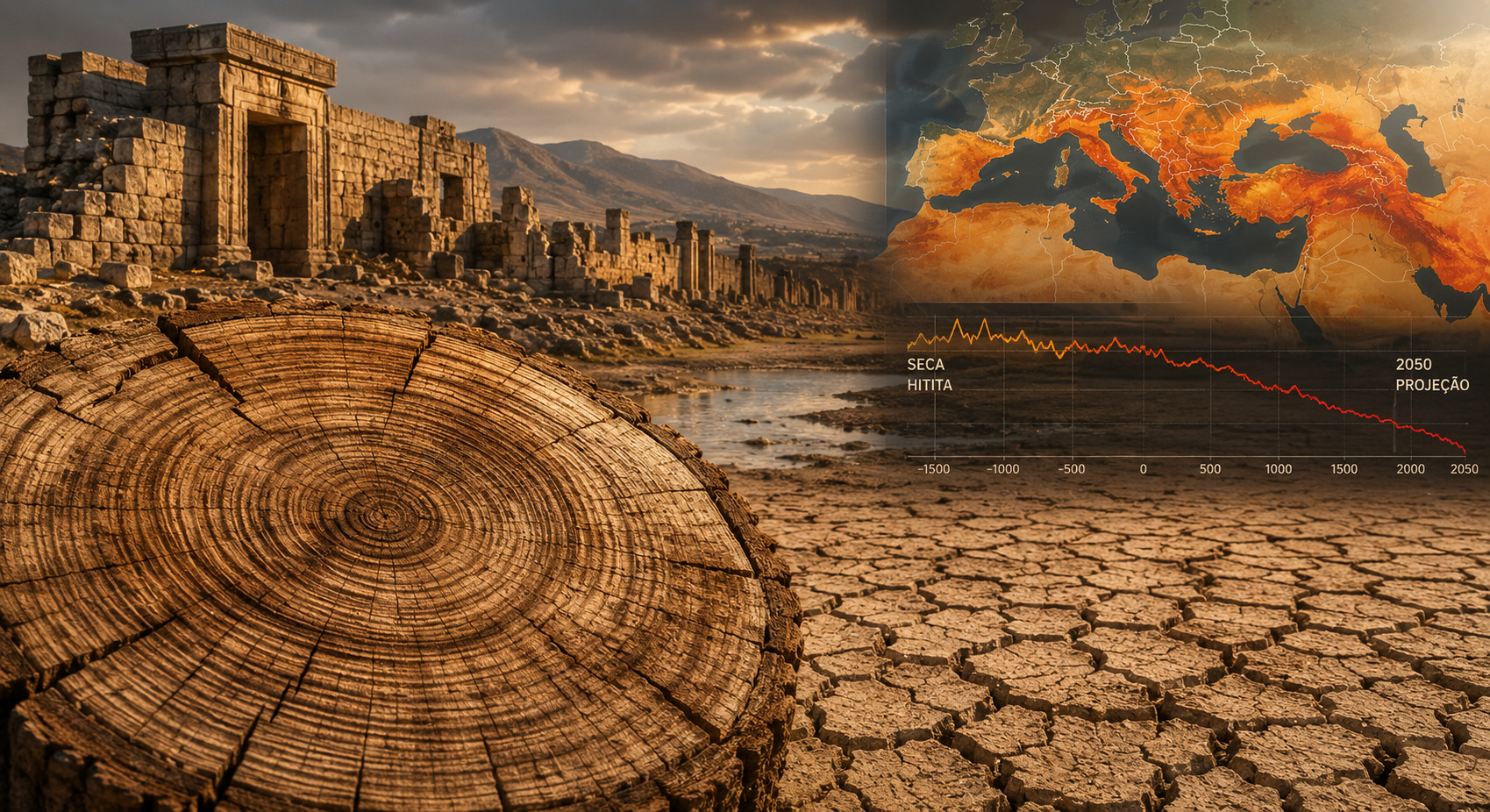

Study in Nature linked the collapse of the Hittite Empire to three consecutive years of extreme drought between 1198 and 1196 BC, recorded in tree rings from Anatolia.
According to Nature, a study led by Professor Sturt Manning from Cornell University, published on February 8, 2023, used tree rings and stable isotopes from junipers in central Anatolia to identify a severe and continuous drought between approximately 1198 and 1196 BC. The period coincides with the collapse of the Hittite Empire, one of the great powers of the ancient world, which dominated the Near East for about five centuries.
The data shows that these three years were among the 6.25% driest of the entire historical series of more than seven centuries preserved in the tree rings. It was not a common drought, but an extreme drought in the statistical tail of the climate distribution, capable of compromising crops, food reserves, and political stability.
The Hittite Empire emerged around 1650 BC in central Anatolia, a region that corresponds to part of modern Turkey. Around 1200 BC, its capital, Hattusa, was abandoned, and the empire ceased to exist. For 3,200 years, the reason was debated; now, part of the answer appears preserved in trees used in a monumental tomb west of Ankara.
-
ChatGPT Alerts FBI to Prevent Planned Murder of 8-Year-Old in Brazil’s Espírito Santo

-
Scientists Discover 125-Million-Year-Old “Pregnant Fossil” with Preserved Embryos and Microscopic Larvae Inside Mollusk in England

-
17-Year-Old Justin Bernstein Develops Bacteria to Produce Glass on Arctic Ice to Reflect Sunlight, Wins $50,000 U.S. Scholarship

-
The 19-Meter Rocket-Helicopter: A Private Industry Prototype That Challenged Space Race Logic



Extreme drought in Anatolia may have accelerated the collapse of the Hittite Empire
The Hittite collapse was not an isolated event. It occurred within the so-called Bronze Age Collapse, a period between 1200 and 1150 BC when several civilizations of the Eastern Mediterranean and the Near East disappeared or went into deep decline.
The Hittite Empire was abolished, the Mycenaean Empire collapsed, city-states in Cyprus were destroyed, Ugarit was burned, and Egypt survived weakened. In a few decades, a network of trade, diplomacy, and political dependency that had functioned for centuries unraveled.
The theories include invasions by the Sea Peoples, earthquakes, internal revolts, and trade disruption. Manning’s study does not eliminate these factors but shows that they all occurred against a backdrop of extreme agricultural failure for three consecutive years.
Bronze Age Collapse involved famine, disrupted trade, and political crisis
The drought recorded between 1198 and 1196 BC helps explain why so many different pressures became difficult to absorb at the same time. A civilization can survive war, internal instability, or a trade crisis when it still maintains food stocks.


The problem changes when the agricultural base collapses for consecutive years. John Marston, co-author of the study and expert in ancient agriculture, stated that populations likely had reserves to get through one year of drought, but not three.
This reading makes drought a crisis multiplier. Famine reduced the Hittite state’s ability to sustain cities, armies, bureaucracy, trade, and supply networks during a time of regional instability.
Tree rings from Anatolia preserved 700 years of ancient climate
The study’s methodology combines dendrochronology and isotopic analysis. Dendrochronology observes the growth rings of trees, where wide rings indicate favorable years and narrow rings point to difficult conditions, such as drought or extreme cold.
In semi-arid environments like central Anatolia, ring width is strongly influenced by available water. Therefore, dry years leave visible marks on tree growth, recording environmental conditions with annual precision.

The junipers analyzed came from the Midas Mound Tumulus in Gordion, a funerary structure 53 meters high west of Ankara. The wood preserved in the tomb provided a continuous climate series between 1497 and 797 BC.
Oxygen isotopes confirmed the intensity of the drought that hit the Hittites
In addition to ring width, researchers analyzed stable oxygen isotopes, especially oxygen-18. The proportion of these isotopes in the wood tissue reflects temperature and humidity at the time each ring was formed.
This second line of evidence made the study more robust. The narrow rings already indicated water stress; the isotopes confirmed that the critical years were marked by abnormally dry conditions.
The combination of the two techniques showed that 1198, 1197, and 1196 BC formed an exceptional climatic sequence, rare even in a region accustomed to natural rainfall variability.
Three years among the 6.25% driest of the series reveal extreme climatic event
The strongest data from the study is statistical. The three years between 1198 and 1196 BC were among the 6.25% driest of the entire 700-year series, something very different from an ordinary drought.
Manning stated that the narrow rings indicate trees struggling to survive. In a semi-arid environment, the plausible explanation for this pattern is a lack of water, and the severity increases when the phenomenon repeats for three consecutive years.
The analysis also indicated that the window between 1198 and 1187 BC had six or seven years among the driest 20% of the series. The extreme drought occurred within an entire decade of climatic deterioration.
Ancient letters about grain shortages reinforce evidence of Hittite famine
Environmental data connect to historical textual records. Letters exchanged between Hittite, Egyptian, and Cypriot rulers of the period make references to grain shortages and urgent requests for food.

A letter from the last Hittite king to the Egyptian pharaoh mentions an urgent need for grains and describes a situation associated with famine. This convergence between ancient documents and tree rings strengthens the climatic interpretation.
The strength of the study lies precisely in this intersection. The rings indicate extreme drought, while the texts show that the food crisis was politically perceived by the rulers of the time.
What the Hittite drought has to do with the climate projected for 2050
The comparison with the present does not mean that the Hittite collapse will literally repeat. The central point is that the region of Anatolia, the Eastern Mediterranean, the Middle East, and Southern Europe appears today in climate projections as a vulnerable area to aridification.
IPCC climate models for intermediate and high emission scenarios project an increase in temperature and a reduction in precipitation in parts of these regions throughout the 21st century. The modern mechanism is different from the Bronze Age event, but the direction is similar: more heat and less water in already semi-arid areas.
Jason Ur, a researcher from Harvard cited in the base text, relates the problem to the capacity for social adaptation. For him, ancient societies often failed not only due to climate change but due to inflexibility in the face of increasingly dry environmental conditions.
Hittites had technology, warehouses, and diplomacy, but did not withstand three years without harvests
The Hittites were not a simple society. They had writing, a code of laws, international diplomacy, long-distance trade, state administration, and grain warehouses for periods of scarcity.
This structure worked to deal with normal climate variability. The system was probably capable of absorbing a bad year by importing food and using reserves.
The problem was the sequence. Two consecutive years would already press the reserves, but three years of agricultural failure could consume the remaining stock before the recovery of the next harvest, pushing the State to its operational limit.
The modern world has more technology, but still depends on institutions capable of responding to the climate crisis
Comparison with the present requires caution. Ancient civilizations did not have industrial irrigation, global food trade, satellites, weather forecasting, modern transportation, or international supply chains.
The same three-year drought that destroyed the Hittite agricultural base would not automatically destroy a modern state like Turkey. Today there are imports, stocks, logistics, agricultural insurance, and financial instruments capable of cushioning shocks.
The question raised by the study is different. The modern risk is not only in the technical ability to respond, but in the political, economic, and institutional ability to act quickly when climate crises deviate from the historical pattern.
Juniper rings show that the Hittite collapse was a climate warning preserved for 3,200 years
The study published in Nature does not reduce the end of the Hittite Empire to a single cause. Wars, migrations, trade tensions, and political crises continued to be part of the process.
What the research adds is a precise climatic basis to understand why these shocks became so destructive at that moment. The drought from 1198 to 1196 BC hit a sophisticated civilization, but one dependent on vulnerable harvests, reserves, and supply routes.
The wood preserved in the Midas Mound Tumulus kept, for over three millennia, the record of a crisis that crosses archaeology, climate, and politics. The Hittite fall shows that complex societies can collapse when their systems are designed for common crises but face consecutive extremes.


