






 Portuguese
  Spanish


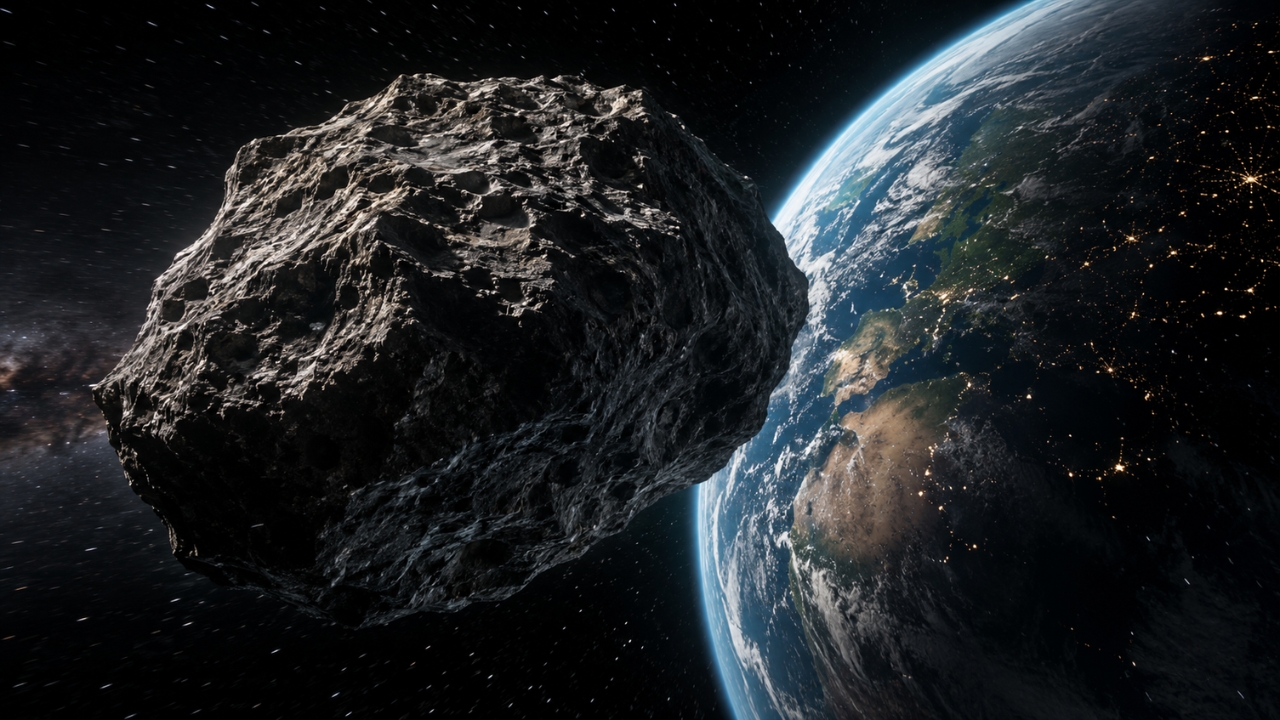

Newly discovered asteroid will pass very close to Earth and reignites doubts about the ability to detect space threats before it’s too late
A newly discovered asteroid will pass extremely close to Earth, raising an alert among astronomers. Named 2026 JH2, the space object is large enough to cause urban-scale destruction if it were to enter a collision course with the planet.
The good news is that, according to current calculations, there is no risk of impact. The bad news is that the space rock was detected just a few days ago, reigniting fears about how many other dangerous celestial bodies might still be “hidden” in space. According to information published by IFLScience, the asteroid is expected to pass about 90 thousand kilometers from Earth.
In astronomical terms, this distance is frighteningly small. For comparison, it is equivalent to only about 24% of the average distance between Earth and the Moon. In other words: it will not hit the planet, but it will pass close enough to become a topic of discussion among scientists and curious people worldwide.
-
How to Prevent Brown Recluse Spider Bites: Common Hiding Spots and Free Tips to Reduce Risks

-
Natto: The Unusual Japanese Superfood Gaining Popularity on Social Media and Driving Record Exports
-
Brazilian Mayor Goes Undercover as Homeless for 24 Hours to Assess Public Services

-
15-Year-Old Entrepreneur Malu Lira Publishes 20 Children’s Books on Financial Education, Earns $500,000, and Expands Her Project to the Amazon Rainforest




A “cosmic close shave” that impresses even specialists
The 2026 JH2 is expected to make its closest approach on May 18, 2026. The estimate is that it will pass approximately 56 thousand miles, or 90 thousand kilometers, from our planet.
It may seem like a huge distance to those looking from Earth, but in space, this is considered an extremely close encounter. Astronomers usually monitor objects that pass millions of kilometers away, so an approach of this kind draws a lot of attention.
Astrophysicist Mark Norris, from the University of Lancashire, described the case as something as close as possible “without hitting” Earth. He also stated that an object of this type could efficiently ruin a city if it actually collided with the planet.

Image credit: NASA/JPL Small-Body Database.
Size could reach 35 meters in diameter
Estimates indicate that the asteroid measures between 16 and 35 meters in diameter. This means it could be up to four times the size of a London bus, depending on its composition and ability to reflect light.
This detail is important because the size of an asteroid cannot always be measured with immediate precision. Scientists calculate its dimensions by analyzing the brightness reflected by the surface.
If the object is darker and reflects little light, it may be larger than it appears. Therefore, even with current data, there is still a margin of uncertainty about the actual size of 2026 JH2.
If it hit Earth, the damage could be brutal
Although the asteroid does not pose a direct threat, its size places it in a category that concerns planetary defense experts. Objects in this range may not destroy the planet, but they are capable of causing devastating damage in a populated region.
The most remembered comparison is the Chelyabinsk meteor, which exploded over Russia in 2013. The object was about 18 meters and released an estimated energy 30 times greater than the Hiroshima bomb.
In that episode, the explosion in the sky generated a powerful shock wave, which shattered windows, damaged thousands of buildings, and left about 1,500 people injured. The most frightening part is that only a small portion of the original rock reached the ground.

Recent discovery reignites concern
One of the most unsettling points about 2026 JH2 is the fact that it was discovered just a few days before the approach. This shows that, even with advanced monitoring systems, there are still gaps in sky surveillance.
NASA and other international networks monitor thousands of near-Earth objects, known as NEOs. However, scientists have already warned that there are still many medium-sized asteroids that remain unidentified.
These objects are especially concerning because they may be too small to be seen well in advance, but large enough to cause serious regional damage in the event of an impact.
Asteroid can be observed with telescopes
The 2026 JH2 is not expected to be visible to the naked eye, but it can be tracked by telescopes under suitable conditions. Observers in locations with dark skies may have a better chance of recording the passage.
According to astronomical data, the object is located in the direction of the Ursa Major constellation. Its approach offers a valuable opportunity for scientists to better study its orbit, speed, and physical characteristics.
This type of observation is essential to improve prediction models and understand how small asteroids behave when they pass close to Earth.


Could Earth defend itself from a real threat?
The DART mission, conducted by NASA in 2022, showed that it is possible to alter the trajectory of an asteroid. On that occasion, a spacecraft was launched against the small moon Dimorphos to test a deflection technique.
The test was considered a success and paved the way for new planetary defense strategies. Even so, experts warn that humanity still does not have an immediate solution for any threat discovered at the last minute.
In other words, if a dangerous asteroid were detected too late, the response time could be a serious problem. Therefore, finding these objects in advance is as important as knowing how to deflect them.
A silent warning from space
The asteroid 2026 JH2 will pass safely, without hitting Earth. But its extreme approach serves as a disquieting reminder: space remains full of unknown objects silently crossing our path.
For scientists, the event is a rare chance for study. For the public, it is breathtaking news. After all, when a rock capable of devastating a city passes so close to the planet, it’s impossible not to look at the sky with different eyes.








