Portuguese
  Spanish


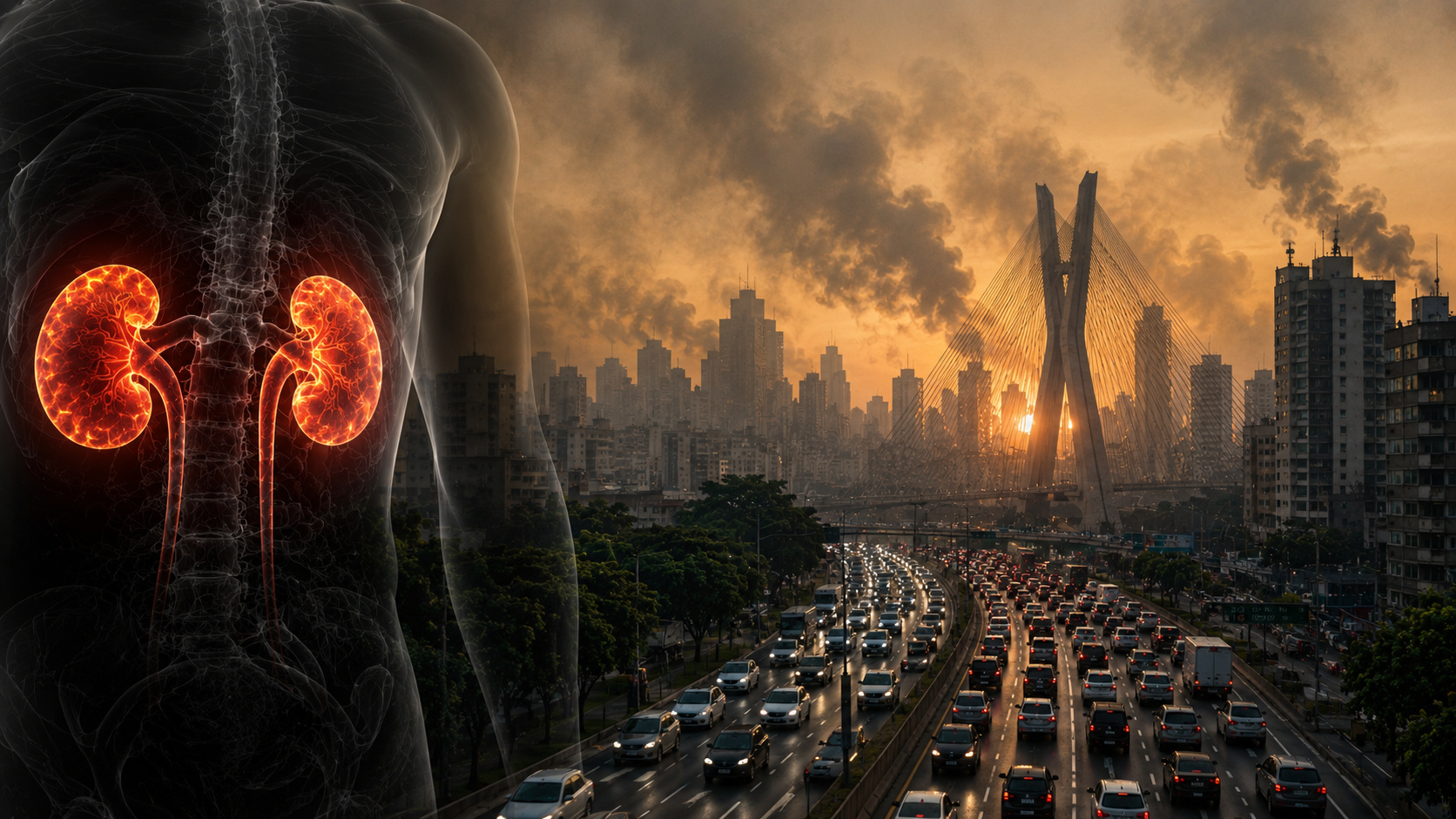

Study by Brazilian scientists links urban pollution in São Paulo to the increase in kidney diseases and reinforces urgent public health alert.
A study supported by Fapesp and published in the journal Scientific Reports on February 16 revealed a strong relationship between urban pollution in São Paulo and the increased risk of hospitalizations for kidney diseases. The research analyzed data between 2011 and 2021 and identified that the concentration of fine particulate matter reached 65 μg/m³, a value more than four times above the daily limit recommended by the World Health Organization (WHO), set at 15 μg/m³.
The Brazilian scientists involved in the work observed that even levels considered acceptable by the WHO have already shown an association with kidney problems. The study broadens the alert about the invisible effects of air pollution on public health, especially in large urban centers.
The research was conducted by specialists linked to the Institute of Astronomy, Geophysics, and Atmospheric Sciences at USP (IAG-USP), with the participation of researcher Iara da Silva and coordination by Professor Lucia Andrade, from the USP School of Medicine.
-
16-Year-Old from Brazil’s Sertão Wins Young Scientist Award for AI Predicting Rainfall with 94.5% Accuracy to Aid Farmers

-
Netherlands Reports First Child Euthanasia Case Since Rule Expansion for Minors

-
Brazilian Innovator Survives Homemade Submarine Dive in Paraty Despite Hatch Leak and False Oxygen Alarm
-
China Develops Custom 140-Ton Electric Mining Truck with 770 kWh Swappable Battery, Deploys 290 Units in Xinjiang’s Largest Zinc Mine



How microscopic particles of urban pollution can reach the kidneys
Fine particulate matter, known as PM2.5, is made up of extremely small particles released mainly by the burning of fossil fuels in vehicles. These particles are less than 2.5 micrometers in diameter, small enough to penetrate deeply into the body.
According to the Brazilian scientists, after being inhaled, these particles can reach the bloodstream and affect kidney tissues. The body reacts by trying to combat this foreign material, triggering silent inflammatory processes.
Over time, this condition can accelerate:
- Persistent kidney inflammations
- Kidney fibrosis
- Premature aging of cells
- Reduction in blood filtration capacity
The researchers believe that this continuous exposure helps explain the gradual increase in kidney diseases in highly polluted urban areas.


Brazilian scientists identify up to 4 times increase in risk of hospitalization
The results drew attention due to the intensity of the observed effects. According to the study, prolonged exposure to the highest levels of urban pollution significantly increased the risk of hospitalizations for kidney diseases.
Among the main data found are:
- Up to 4 times higher risk of hospitalization for chronic kidney disease
- Increase of up to 2.5 times in hospitalizations among men aged 51 to 75
- Greater male vulnerability in different age groups
- Increased risk of acute kidney injury in men aged 19 to 50
Brazilian scientists also identified a relationship between pollution and glomerulopathies, diseases that affect the structures responsible for filtering blood in the kidneys.
Another concerning point was the fact that the effects appeared even at concentrations close to the limit established by the WHO.
Silent kidney diseases can progress without apparent symptoms
Kidney diseases usually progress slowly and often do not show clear signs in the early stages. This causes thousands of people to live with progressive damage without realizing it.
According to researchers, urban pollution can act as a silent aggravating factor. In the long term, the damage caused by particulate matter can favor the development of chronic kidney failure.
In the most severe cases, patients may need:
- Continuous hemodialysis
- Frequent hospitalizations
- Kidney transplant
- High-cost treatments
The study warns that the progression of these diseases has a direct impact on both quality of life and public health costs.
Previous experiments reinforced the effects of urban pollution on kidneys
Before the analysis involving hospital data, Brazilian scientists had already conducted experimental tests with animals exposed to the air of São Paulo.
The researchers compared two groups of mice: one breathed the polluted air of the São Paulo capital and the other received the same air after complete filtration.
The results showed that animals exposed to particulate matter developed more severe kidney conditions, with increased inflammation, cell death, and loss of kidney filtering function.
According to the group coordinated by Lucia Andrade, biological markers also indicated greater fibrosis and signs of premature aging of kidney tissues.
These findings have strengthened the hypothesis that urban pollution can accelerate systemic damage in the human body.
Public health faces increasing pressure with the rise of kidney diseases
The impacts of pollution are not limited to individual health. The growth of kidney diseases represents a significant challenge for Brazilian public health.
Kidney treatments usually require continuous monitoring, the use of expensive medications, and complex procedures. In many cases, patients need to remain on dialysis for years while waiting for a transplant.
Brazilian scientists highlight that the increase in urban pollution may further increase this pressure on hospitals and healthcare systems.
Furthermore, experts point out that the costs related to kidney diseases may progressively grow in the coming decades if pollutant emission levels remain high.
USP and Fapesp research advocate changes in the urban model
The researchers involved in the study advocate for stricter policies to control atmospheric pollution. Among the measures considered important are reducing dependence on fossil fuels and encouraging sustainable transportation.
The work is also part of the project “Air pollution is the engine of premature renal aging,” funded by Fapesp and the Netherlands Organization for Scientific Research (NWO).
Another related project, called Metroclima Masp, coordinated by Maria de Fátima Andrade at IAG-USP, investigates the impacts of climate change and air quality in the Metropolitan Region of São Paulo.
Brazilian scientists state that combating urban pollution is not just an environmental issue but also an essential public health prevention strategy.
The invisible alert that can change debates about air quality
The findings made in São Paulo reinforce that the impacts of atmospheric pollution go far beyond the already known respiratory problems. The study shows that microscopic particles present in the air can directly affect the kidneys and accelerate silent diseases that compromise thousands of people.
By identifying levels of up to 65 μg/m³ of particulate matter and associating them with increased hospitalizations, Brazilian scientists expand the debate on urban mobility, fossil fuels, and air quality in large cities.
The results also reinforce the need for new environmental policies and investments capable of reducing risks for the population and alleviating future impacts on Brazilian public health.
With information from Scientific Reports