






 Portuguese
  Spanish


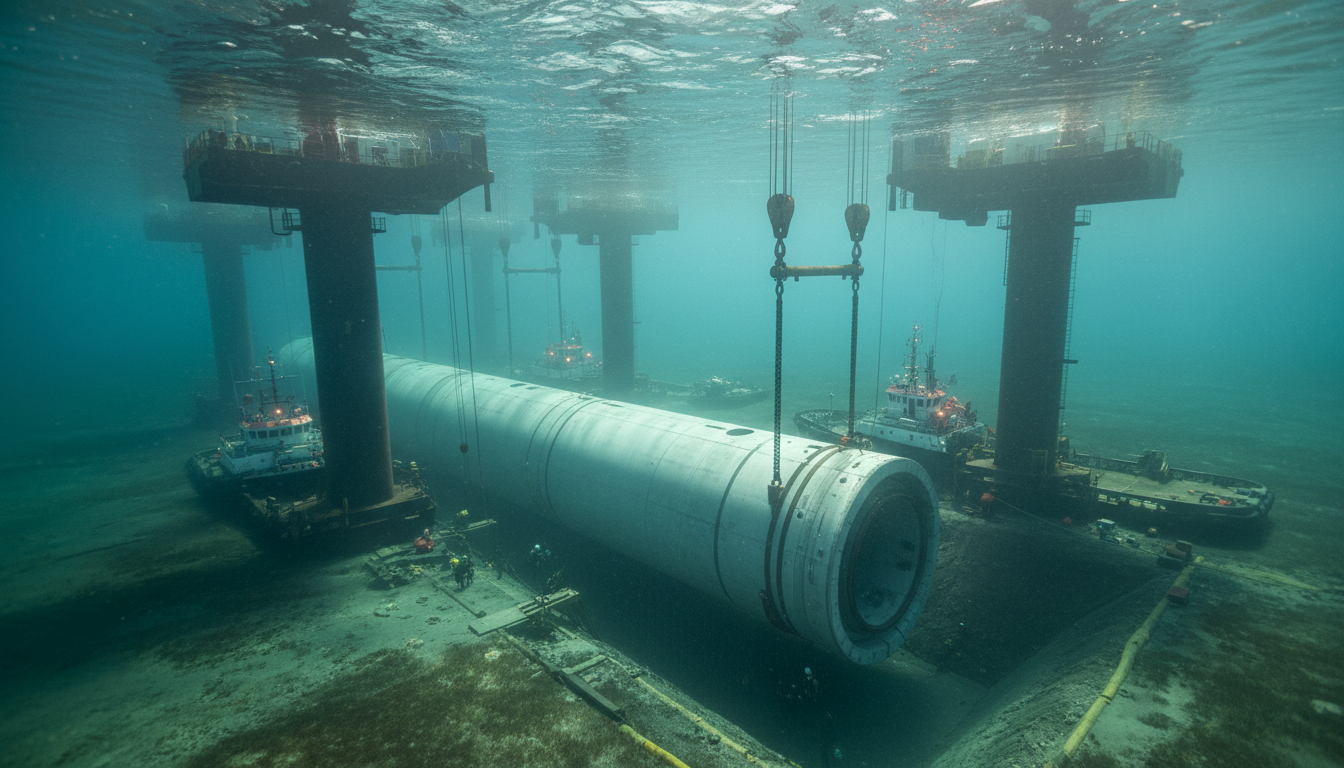

Each prefabricated concrete segment weighs 73 thousand tons and measures 217 meters in length
The world’s largest immersed tunnel is being sunk between Germany and Denmark. The Fehmarn Belt will be 18 km long, formed by 79 prefabricated concrete segments weighing 73 thousand tons each.
The construction is expected to be completed in 2029. It will shorten the journey between Hamburg and Copenhagen by up to 4 hours.
According to the Danish company Femern A/S, the first segment was sunk to the bottom of the Baltic Sea in June 2025.
-
Brazilian Fishing Couple Spends 4 Years Building Solar-Powered Floating Home on the Paraguay River, Now a Navy-Approved Vessel with Leisure Area and Tour Demand

-
While the World Opens New Airports and High-Speed Trains, Brazil Rushes to Complete Projects Stalled for 40 Years
-
Brazil Invests in Massive Waterway to Transport Soybeans by Barge, Reducing Costly Truck Reliance
-
Bridge Rebuilt in Just One Year Reconnects Two Brazilian States


The process will be repeated 78 more times. Each operation takes between 2 and 4 days to position the segment.
As reported by the World Construction Network, the project costs approximately 7 billion euros. It is financed by Denmark, with returns via tolls over 50 years.
Therefore, the Fehmarn Belt becomes the largest immersed tunnel ever built in the world. It surpasses the current record holder, the Marmaray under the Bosphorus Strait in Turkey.

How the Fehmarn Belt works and why it is different
The Fehmarn Belt is an immersed tunnel. Unlike conventional tunnels drilled in rock, the prefabricated segments are sunk on the seabed.
According to the technical record of the project, each element is 217 meters long. The width is 42 meters and the height is 9 meters.
Therefore, it is equivalent to a 3-story building lying down. Each segment has 9 vertical floors to accommodate highway and railway.
In parallel, the method has critical advantages. According to an analysis by Tunnel Magazine, the maximum depth is only 40 meters.
Thus, it is faster than drilling rock underneath. It is also cheaper and safer.
In fact, the original location planned for a bridge. But the extreme wind of the Baltic made the bridge unfeasible.

Where the Fehmarn Belt is located and the logistics of the site
The Fehmarn Belt connects Rødby, in the south of the Danish island of Lolland, to Puttgarden, in the north of the German island of Fehmarn. The current crossing takes 45 minutes by ferry.
According to Femern A/S, the 79 segments are manufactured in a dedicated plant in Rødby. The industrial complex is 1.5 km long.
Therefore, the logistics are massive. Each finished element is pulled into the sea and towed to the immersion site.
In parallel, the Femern Link Contractors consortium leads the construction. It brings together Danish, Dutch, Belgian, and German companies.
In fact, it is the largest individual infrastructure project in Europe. According to the German Federal Ministry of Transport, part of the funding comes from European funds.
- Tunnel length: 18 km (world’s largest immersed tunnel)
- Prefabricated segments: 79
- Length of each segment: 217 meters
- Weight of each segment: 73,000 tons
- Total investment: ~ 7 billion euros
- Connection: Rødby (Denmark) ↔ Puttgarden (Germany)
- Completion: 2029
- Time saving: 4 hours Hamburg-Copenhagen
Economic impact of the Fehmarn Belt in Europe
The Fehmarn Belt will transform the logistics of northern Europe. According to STRING Megaregion, the expected economic impact is billions in trade.
Therefore, Hamburg and Copenhagen will operate as neighboring cities. The real distance drops from 1,000 km by road to 18 km via tunnel.
In parallel, goods from Sweden, Finland, and Baltic countries will reach Germany in half the time.
According to an analysis by Greater Copenhagen, the metropolitan area gains 8 million residents within a “1-hour radius”.
In fact, the Fehmarn Belt redraws the economic map of northern Europe. It creates the Hamburg-Malmö-Copenhagen Megaregion with 19 million inhabitants in a single economic area.

Technical challenges and project delays
The Fehmarn Belt faced significant delays. According to the Copenhagen Post, the specialized immersion vessel took time to receive approval.
Therefore, the original schedule for 2029 became tight. There is a risk of delay to 2030 or 2031.
In parallel, engineering had to face strong currents in the Baltic Sea. As reported by the Construction Briefing, two contracts were canceled in 2025 due to delays.
Thus, Femern A/S had to reorganize the supply chain. New contracts were signed under more flexible conditions.
According to PERI International, the formworks supplier, the project requires structural tolerances of less than 5 cm over 217 meters.
According to Practical Engineering, the Fehmarn Belt is “the most implausible tunneling method ever attempted on an industrial scale”.

What the Fehmarn Belt teaches Brazil
The case of the Fehmarn Belt offers a reference for projects like the Salvador-Itaparica bridge. The 12.4 km Bahia crossing costs R$ 10 billion.
Therefore, immersed tunnel methods could be studied as an alternative. They allow for shallower depths and predictable costs per segment.
In parallel, Brazil needs companies specialized in heavy maritime construction. Femern Link Contractors is a global reference in the sector.
In fact, the Italian Webuild already operates in Brazil. Other companies in the Fehmarn consortium could also participate in future bids.
For more on current European mega-projects, it is worth reading the coverage by Click Petróleo e Gás on strategic Russian infrastructure.
For a comparison with similar Chinese projects, check the coverage by Click Petróleo e Gás on global maritime routes.
It is worth noting that the environmental impact of the Fehmarn Belt still generates discussion. German ecological organizations question the impact on the Baltic seabed.
Despite this, the schedule remains firm. In 2029, Denmark and Germany will be connected by the largest immersed tunnel in history in just 7 minutes of travel.


