Portuguese
  Spanish


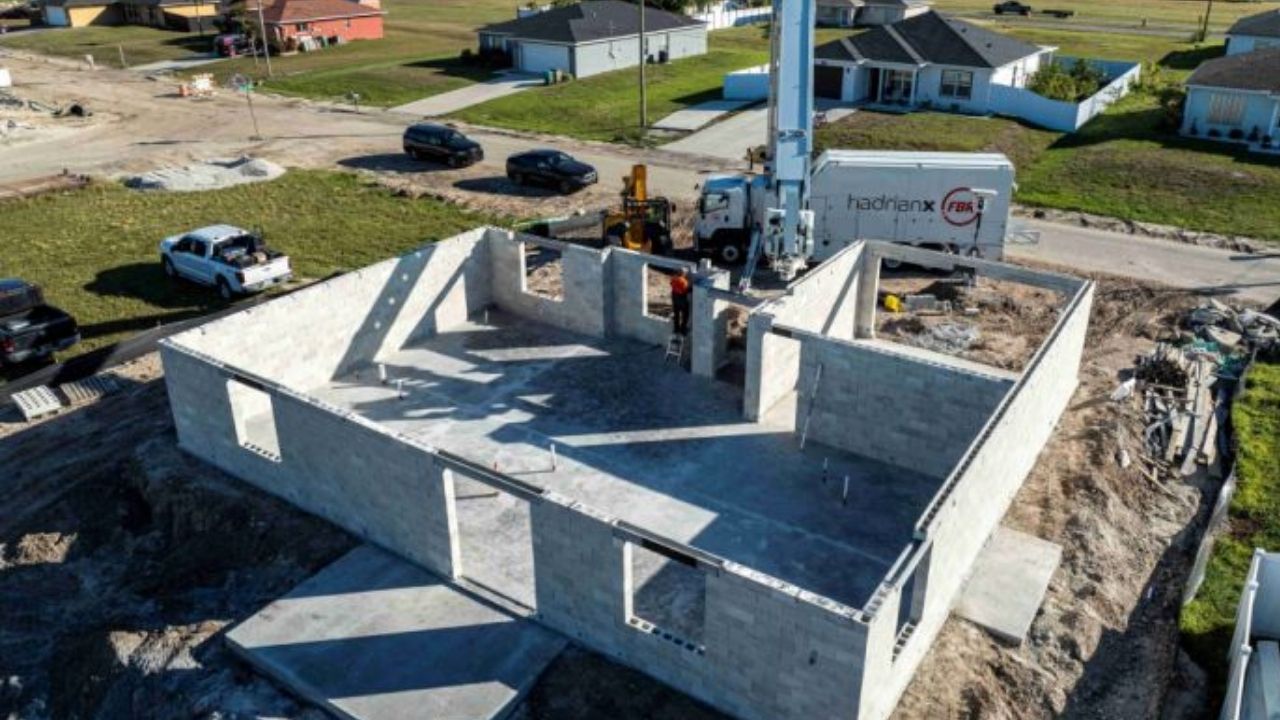


Bricklaying robot Hadrian X, created by FBR in Perth and developed for over a decade, arrives in the construction industry as a bet against the housing crisis and lack of skilled labor in Australia, with 360 blocks per hour, cost of US$ 7.8 million, and commercial scale being tested now.
The bricklaying robot Hadrian X, created by the Australian company FBR in Perth and in development for over a decade, entered a new phase after factory acceptance tests conducted at the end of last year. The machine can lay up to 360 blocks per hour and build the walls of a house in a single day.
The technology is now approaching commercial scale in Australia, with agreements signed with construction companies in Darwin and Port Macquarie, in addition to deployment planned in Perth in the coming months. The advancement comes amid the housing crisis and the lack of skilled labor in the Australian construction industry.
Bricklaying robot was created to accelerate block laying
The Hadrian X is a robotic block-laying system mounted on a truck. This structure allows the equipment to be taken directly to the construction site and installed in a few hours, without relying on a fixed factory to execute the construction.
-
Facing high rent, couple transforms parents’ garage into a fully functional apartment, creating a complete home at a fraction of the market cost.

-
MIT Scientists Develop Method to Transform CO₂ into a Construction Ally, Boosting Cement Strength by 13% in 24 Hours for More Sustainable Infrastructure

-
Canadian City Builds 8 Tiny Homes in 72 Hours for Homeless Youth, Plans 40 Affordable Houses for Female-Led Families Amid Housing Crisis

-
45-year-old Brazilian mother of 9 and grandmother of 12 receives 27 m² house made from recycled plastic, built in 15 hours with interlocking blocks and a recycled roof.


The bricklaying robot uses a 32-meter telescopic arm, capable of reaching walls up to three stories high from the roadside. With this reach, the machine can work on both internal and external walls of a standard double-brick house.
According to the source, the equipment can also lay blocks just 50 millimeters from existing structures, which broadens its application in projects where precision is needed. This combination of reach, speed, and millimetric control is what sets the Hadrian X apart from a common construction support equipment.
FBR reports that the robot can lay up to 360 blocks per hour and, under operating conditions, reach 200 or 300 houses per year. This number explains why the technology has started to be noticed in a country under pressure from housing demand.
Hadrian X enters commercial phase after years of development
The Hadrian X has been in development for over a decade. The technology has already been used to build a few houses in Perth, Australia, and also in Florida, United States, before advancing to a larger commercial scale.
After factory acceptance tests conducted at the end of last year, the bricklaying robot began to be prepared for a new stage. FBR signed memorandums of understanding with construction companies like Habitat NT, in Darwin, and Fraser Line, in Port Macquarie.
The company also plans to deploy the equipment in Perth in the coming months. This move indicates that the technology has left the isolated demonstration phase and started to seek space within real construction flows.
The commercial shift is important because a machine of this size only proves its value when it enters the rhythm of real construction projects. It’s not enough to lay blocks quickly; it needs to integrate with schedules, teams, standards, and methods already used by construction companies.
Machine costs US$ 7.8 million and is not a cheap solution
Despite the announced productivity, the Hadrian X is far from being a simple or cheap alternative. Each unit costs US$ 7.8 million, a price that limits access to the equipment and requires a large volume of use to justify the investment.
FBR’s CEO, Mark Pivac, states that the biggest barrier has been precisely the capital cost. The technology changes the logic of masonry, shifting part of the labor cost to the equipment cost.
This point helps explain why experts avoid treating the bricklaying robot as a miraculous solution. It can increase productive capacity, but still depends on planning, trained operators, compatibility with projects, and integration into the construction site.
In practice, the numbers only add up if the machine is used on a sufficient scale. For small projects or companies without constant volume, the investment may be difficult to absorb.
Housing crisis pressures Australian construction industry
The advancement of Hadrian X occurs in a context of pressure in the Australian housing sector. The construction industry faces warnings about housing shortages and a lack of qualified professionals, two bottlenecks that hinder increasing the supply of homes.
Brad Armitage, director of the Housing Industry Association NSW, states that New South Wales alone faces a skilled labor shortage of 20,000 workers. According to him, the state already builds about 30,000 fewer houses than needed.
In the Australian construction industry, the housing crisis does not depend solely on speed on the construction site, but also on the availability of skilled labor, planning, and the ability to execute projects on a scale. Therefore, Hadrian X appears as technological support, not as a sole solution to the housing crisis.
In this scenario, technologies like the bricklaying robot enter the debate because they can increase productivity in specific stages of construction. But Armitage emphasizes that robotics alone does not solve the magnitude of the problem.
The lack of housing does not only depend on the speed of laying blocks. It involves urban planning, approvals, financing, land, infrastructure, workers, and the capacity of construction companies to execute projects on a large scale.
Experts advocate robotics, but with realistic expectations

Christopher Pettit, director of the City Futures Research Center at UNSW, assesses that robotics will play an important role but warns that expectations need to be realistic. He believes it is unlikely to imagine that systems like Hadrian X or other robots will deliver 1.2 million houses alone by 2029.
Pettit sees faster advances in the short term in manufacturing plants, where automation can be more controlled. Robotics directly on-site, as in the case of Hadrian X, tends to depend on more complex change management.
The researcher points out challenges such as logistics, digital modeling, safety regulation, and workforce integration. He also highlights the need for quality digital twins, artificial intelligence support, and detailed 3D models.
In other words, the bricklaying robot does not work in isolation. To function well, it needs data, digital design, operators, planning, and acceptance within a chain that is still very dependent on traditional processes.
Operation requires three people and uses adhesive instead of mortar
According to Mark Pivac, each robot can build between 200 and 300 houses per year with only three trained operators on site. The machine is mobile, self-sufficient, and can be set up in one or two hours.
The process described by FBR involves aligning the structure to the slab, executing the design in the CAD system, loading the blocks in packages with a telescopic forklift, and starting the operation via the operators’ commands.
The Hadrian X uses standard bricks and blocks, including large and insulated formats. Instead of traditional mortar, the system uses adhesive, a method already approved by Australian construction regulations and more widespread in Europe.
This choice helps explain the speed of the process. By automating the laying and using a method compatible with robotic operation, the machine reduces manual steps and maintains precision during wall assembly.
Automation can change jobs, but still depends on people


One of the most common fears when a bricklaying robot emerges is the replacement of workers. FBR, however, states that the technology was designed to increase productivity, not to eliminate jobs.
Pivac argues that automated industries can employ more people by expanding production, citing sectors such as automotive, agriculture, and construction. Nevertheless, automation changes the type of work required.
Instead of just performing repetitive manual tasks, construction now demands operators, technicians, modeling professionals, planning, maintenance, and digital integration. This reinforces the need for updated professional training.
Armitage also advocates for changes in Australia’s vocational learning system, including more flexible pathways and shorter qualifications. Technology can speed up construction, but training people remains a central part of the solution.
Bricklaying robot shows the way, but does not replace housing policy
The Hadrian X impresses because it transforms one of the most traditional stages of construction into an automated, fast, and precise operation. Laying 360 blocks per hour and erecting walls in a day are strong numbers for any country under housing pressure.
But the debate in Australia itself shows that the bricklaying robot is just one piece of the problem. The housing crisis will not be solved with machines alone, just as the lack of labor will not disappear without training, planning, and investment.
The big change lies in the possibility of combining technology with construction at scale. If well integrated, the Hadrian X can reduce time, waste, and specific bottlenecks within the site.
In the end, the Hadrian X bricklaying robot shows that the construction industry may be entering a new phase, but it will still depend on people, regulations, and planning to deliver housing in real volume.
Do you think robots like this can speed up house construction, or does the solution still mainly rely on labor and public policies? Share your opinion.