






 Portuguese
  Spanish
  5 min of reading
  0 comments


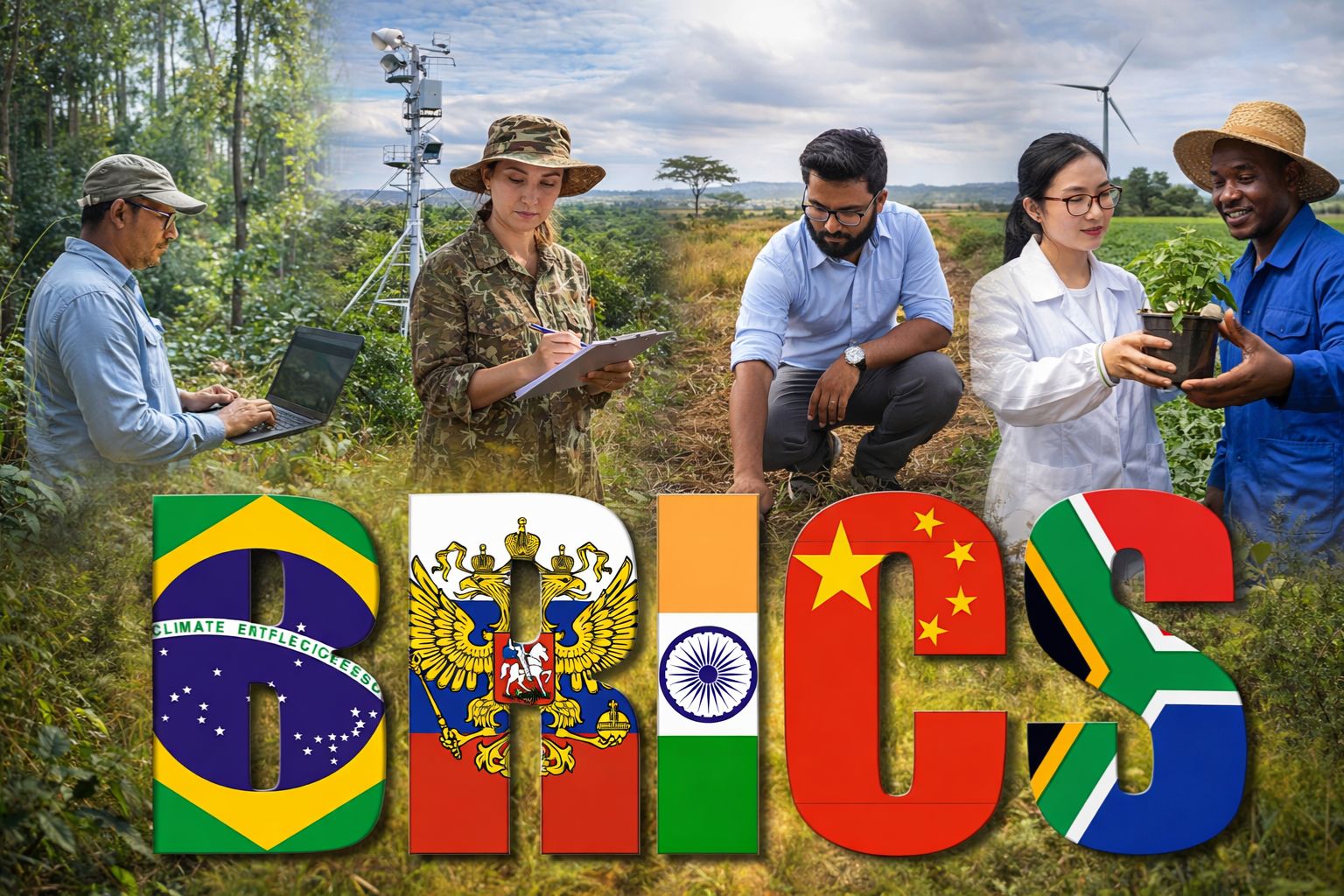
BRICS countries account for 54.5% of all global scientific production on climate intelligence, with 17,460 published articles from 2022 to 2025 in a global total of 32,040. The annual volume more than doubled during this period. Brazil stands out with research on the Amazon, Cerrado, bioenergy, and resilient agriculture that guide public policies.
The BRICS countries have just consolidated a position that few imagined possible a decade ago: the bloc now produces more than half of all global research on climate intelligence. From 2022 to 2025, 32,040 articles on the subject were published worldwide, and 17,460 of them involve researchers from BRICS countries, equivalent to 54.5% of global production. The annual volume of publications more than doubled during this period, driven by the integration of climate science, artificial intelligence, and energy technologies. Brazil has a significant presence in this set with studies on biomes such as the Amazon and Cerrado, bioenergy, and resilient agriculture, topics that connect Brazilian scientific production to the practical demands of public policies.
The data was presented during the OCTI Seminar, promoted by the Center for Management and Strategic Studies (CGEE), linked to the Ministry of Science, Technology, and Innovation, on Thursday (16). The event brought together experts to discuss trends, capacities, and opportunities for Brazil’s action in the global climate intelligence scenario, and included the launch of the eighth edition of the OCTI Report, which deepens the analyses on the subject. The president of CGEE, Anderson Gomes, acknowledged that the challenge goes beyond producing research: “We have the capacity to generate good studies, but we still face difficulties in ensuring that this knowledge actually reaches those who need to use it in decision-making.”
What the numbers reveal about BRICS climate research
According to information from the Gov.br portal, the scale of BRICS scientific production in climate intelligence is impressive when compared to the rest of the world. With 54.5% of all articles published on the subject between 2022 and 2025, the bloc surpasses the combined total of all production from the United States, Europe, and Japan in this specific field. The growth has been accelerated: the annual volume more than doubled in three years, reflecting increasing investments in climate-related research from China, India, Brazil, Russia, and the other BRICS members.
-
Helicopter Drops 180 Tons of Sand and Gravel on Swedish River to Revive Ecosystem Damaged by Decades of Exploitation

-
Brazilian Company Launches Retro Smartphone with 48 MP Camera, T9 Keyboard, and Privacy Features for Social Media-Free Use

-
Self-Taught Chinese Farmer Builds 5-Ton Submarine from Scrap, Launches It in Anhui River
-
Invisible Induction Technology Enables Wireless Power for Blenders, Coffee Makers, and Air Fryers, Reducing Countertop Cables





The concentration of production, however, is not uniform. China leads with the largest share of published articles, followed by India, while Brazil and Russia contribute smaller volumes but in strategic areas. The CGEE survey also highlights a contradiction: despite BRICS dominating global scientific production on climate, cooperation among the bloc’s members is low. Researchers from one country publish articles without partners from other group members, signaling that there is significant room to expand partnerships and develop joint solutions.
How Brazil Stands Out in Climate Research within BRICS

Brazil’s contribution to BRICS climate intelligence has its own identity. Brazil stands out in topics such as bioenergy, resilient agriculture, and studies on biomes like the Amazon and the Cerrado, areas where the country has a comparative advantage as both a natural laboratory and a global-scale agricultural producer. Brazilian researchers publish work that connects climate modeling to practical applications, such as crop forecasting, water resource management, and deforestation monitoring.
This scientific production from BRICS directly feeds into the formulation of public policies. Studies on agricultural resilience help the government define adaptation strategies for rural producers facing more frequent droughts and extreme weather events, while research on the Amazon supports policies to combat deforestation and preservation that have a global impact on emission reduction targets. The challenge, as recognized by the president of CGEE, is to ensure that these studies move from scientific journals to the decision-making tables of ministries.
The Role of Artificial Intelligence in BRICS Climate Research
Climate intelligence is not just climate science. The field integrates climate science, artificial intelligence, and energy technologies in an interdisciplinary approach that allows for predictive analyses, scenario modeling, and optimization of responses to events such as droughts, floods, heatwaves, and severe storms. The rapid expansion of BRICS publications reflects precisely this convergence between disciplines that previously operated separately.
Artificial intelligence, in particular, is transforming researchers’ ability to process massive volumes of climate data. Machine learning models trained with data from satellites, weather stations, and ocean sensors allow for more accurate and timely predictions than traditional methods, benefiting everyone from farmers who need to decide when to plant to governments that need to prepare evacuation plans for extreme events. For BRICS, mastering this technology is a matter of sovereignty: those who process their own climate data do not depend on analyses produced by other countries.
Why cooperation within BRICS is still low despite the numbers
The CGEE survey identified a paradox: despite BRICS countries producing 54.5% of global research on climate intelligence, cooperation among the bloc’s members is surprisingly low. Chinese researchers publish with Chinese researchers, Brazilians with Brazilians, and collaboration among group members is the exception, not the rule. This isolation reduces the potential impact that joint research could have on the climate policies of the bloc as a whole.
The reasons for low cooperation within BRICS include language barriers, differences in research funding systems, and a lack of institutional mechanisms that encourage joint publications. The OCTI Seminar and initiatives like the OCTI Report are attempts to reverse this trend, creating spaces for dialogue and identifying opportunities that could lead to shared research projects. If BRICS can transform the isolated scientific production of each country into an integrated network of climate intelligence, the impact on public policies and on the Global South’s capacity to respond to climate change would be multiplied.
What BRICS’ dominance in climate research means for the world
When more than half of the world’s research on a strategic topic is produced by a bloc of emerging economies, the balance of academic and political power shifts. BRICS’ dominance in climate intelligence means that solutions to climate change are increasingly being conceived from the perspective of developing countries, which face the most severe effects of global warming but until recently had little voice in shaping research agendas.
For Brazil, with its research on the Amazon, Cerrado, and resilient agriculture, its position within BRICS offers a platform to influence global climate policies based on evidence produced on national territory. The bloc represents over 40% of the world’s population and 41% of global GDP in purchasing power parity, and strengthening scientific cooperation among its members is a key piece for the Global South to have a real capacity to respond to climate change without relying solely on solutions developed in the North.
BRICS countries already produce more than half of the world’s research on climate intelligence. Did you know that Brazil stands out in studies on the Amazon and resilient agriculture? Does this scientific leadership translate into practical actions? Share your opinion in the comments.





Be the first to react!