






 Portuguese
  Spanish
  6 min of reading
  0 comments


Stad Ship Tunnel Project promises to create an unprecedented maritime route inside the rock, avoiding storms, dangerous waves, and historical delays on the Norwegian west coast
Norway has once again placed at the center of international debate a work that seems straight out of a science fiction movie but was born from a real navigation problem. The country wants to open a passage inside the Stadlandet Peninsula so that vessels can cross a mountain from within, without directly facing one of the most dangerous maritime stretches of the European coast.
The project is known as the Stad Ship Tunnel and is presented as the world’s first full-scale tunnel designed for ships. The structure is expected to connect the region between Moldefjorden and Kjødepollen, on the west coast of Norway, creating an alternative to the Stadhavet Sea, famous for storms, strong winds, and unpredictable waves.
The project gained new momentum in June 2026, after being targeted for suspension due to budget increases. With a structure planned to accommodate vessels from the Norwegian coastal route, the tunnel has become a symbol of a larger dispute between maritime safety, extreme engineering, and billion-dollar public spending.
-
INSS issues alert to retirees: decisive deadline ends this week and millions of beneficiaries may lose access to amounts that already total R$ 3.2 billion; measure involves deductions made between 2020 and 2025

-
Forget the dollar: Brazil, China, Russia, and India accelerate testing of the BRICS system to challenge SWIFT, reduce US influence, and expand transactions in national currencies, which already account for 67% of the bloc’s trade.
-
Brazil conducts the largest cleanup in history and removes over 800 tons of electronic waste; the initiative mobilizes 300 volunteers, has already collected 47 tons in 2025, and prevents thousands of devices from contaminating soil and water.
-
How recycled plastic houses are changing the housing landscape in Brazil


In practice, the proposal is simple to understand but difficult to execute. Instead of forcing ships to bypass an open sea region known for cancellations and risks, Norway intends to create a kind of “underground maritime corridor,” carved into the rock and filled by the sea itself.
Norwegian maritime tunnel will have cathedral-like dimensions carved into the rock
According to the Norwegian Coastal Administration, the Stad Ship Tunnel was designed with about 1.7 kilometers of length in the excavated section, reaching approximately 2.2 kilometers when considering the entrance areas. The passage will have 50 meters of height from the base to the ceiling, 36 meters of width between the walls, and 33 meters of free span above the water surface.
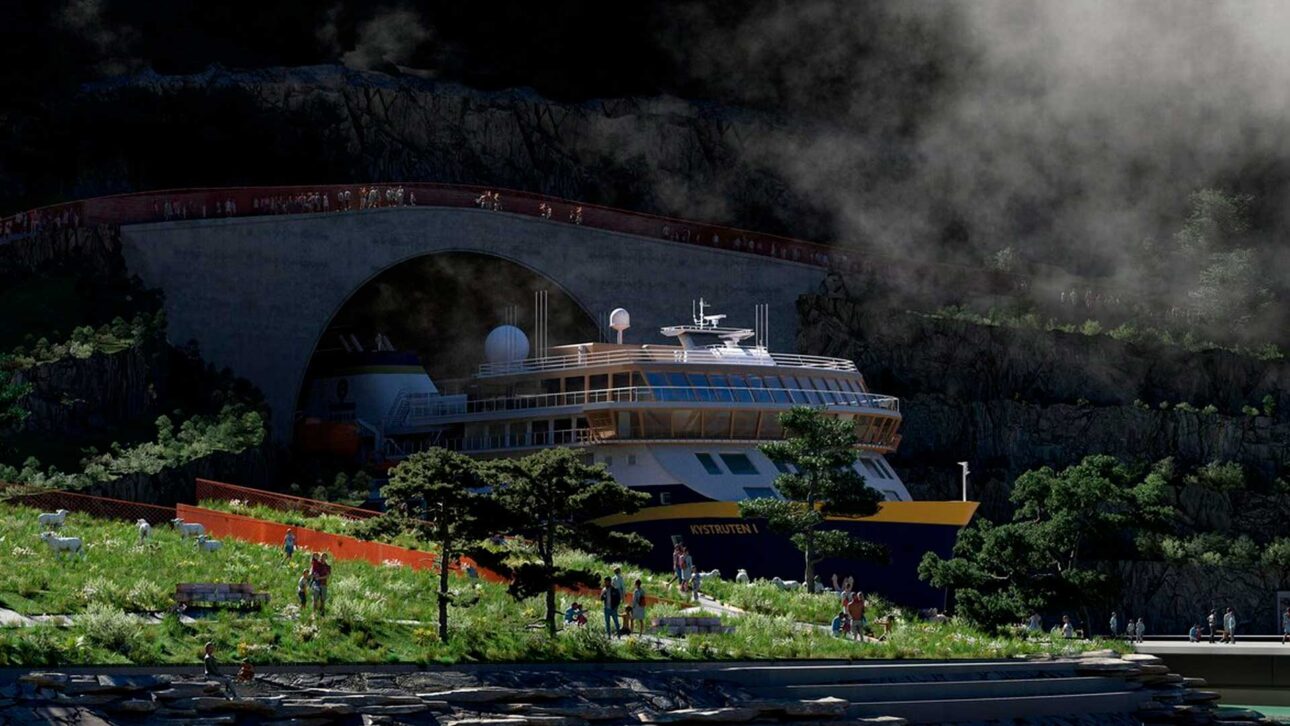
These measures explain why the project attracts so much attention. It is not a tunnel for cars, trains, or pedestrians, but a structure large enough to allow the navigation of coastal ships, passenger vessels, service boats, part of the tourist fleet, and ships linked to regional logistics.
The closest image is that of a large gallery inside the mountain, open from one side to the other, with the sea entering underneath and the rock forming the sides and the ceiling. Therefore, engineers tend to treat the work less as a conventional tunnel and more as a huge controlled artificial cave.
The sea of Stad has frightened navigators for generations and explains the rush for a new route
The reason for the work lies in geography. The Stadlandet Peninsula is in an extremely exposed region of the west coast of Norway, where winds, ocean currents, and underwater terrain create unstable conditions even when the weather seems to improve.
The sea of Stadhavet is known for forming waves coming from different directions, which makes navigation more difficult and reduces predictability for crews. This type of scenario especially affects vessels that need to maintain regular schedules, such as coastal transport ships, fishing, tourism, and logistics of sensitive products.
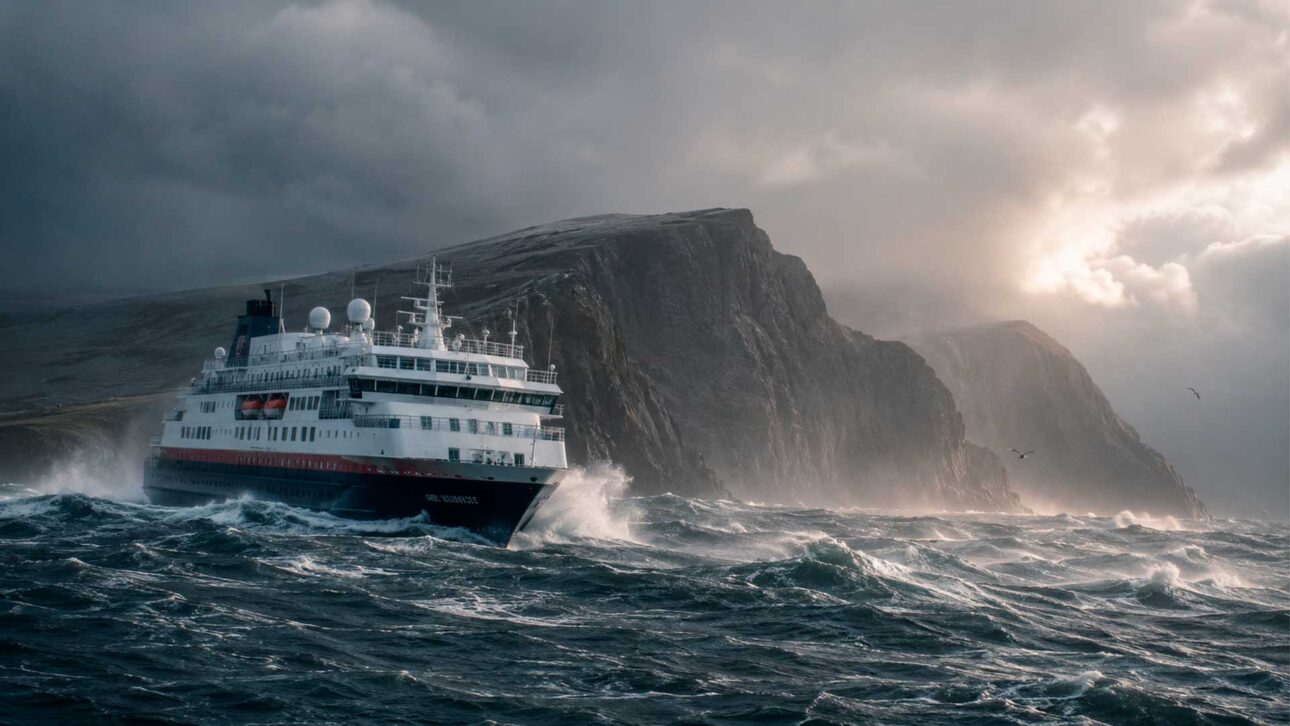
The region is also associated with long waiting periods. On bad weather days, vessels may be stopped waiting for a safe window to cross the stretch, which generates delay, additional cost, and loss of efficiency for companies that depend on the maritime route.
The promise of the tunnel is to reduce this bottleneck. With a protected passage inside the mountain, ships could avoid the most exposed part of the crossing, making navigation more regular and reducing the risk of serious accidents.
Billion-dollar project resumed after political dispute over cost and benefit
According to the Ministry of Trade, Industry and Fisheries of Norway, the updated recommended cost for the project reached 8.6 billion Norwegian kroner in March 2026. The amount was below previous estimates, but still far above the cost framework previously approved by the Norwegian Parliament.
This point turned the tunnel into a target of controversy. In May 2026, the Norwegian government even advocated for the suspension of the project, claiming that the work would not fit within the approved limit and that the calculated benefits would not justify the investment. Among the opposing arguments was the idea that resources could be directed towards maintenance and improvements of existing infrastructures.
The turnaround came with the negotiations of the revised 2026 budget. Reports from the Norwegian press indicated that parties involved in the agreement put the Stad Ship Tunnel back on the agenda, with an initial budget forecast of 150 million kroner to continue the process and a new cost structure around 8.6 billion kroner.
Even so, it is important to separate political progress from a completed work. The project gained momentum and may move towards contract signing, but the physical construction depends on formal stages, contracting, site mobilization, and maintaining financing over the coming years.
Excavation should not use tunnel boring machines and will depend on controlled detonation
One of the most curious aspects of the Stad Ship Tunnel is the construction method. Since the internal span is too large for common tunnel boring machines, popularly known as “moles,” the work should resort to traditional drilling and controlled detonation techniques.
In practice, specialized teams drill the rock, install explosive charges at planned points, and remove the fragmented material in stages. This process requires constant monitoring, progressive structural reinforcement, and rigorous control to avoid instability in the gallery.
The technical expectation is to remove about 3 million cubic meters of solid rock. After detonation, this volume expands and can reach approximately 5.4 million cubic meters of fragmented material, equivalent to hundreds of thousands of truckloads.
Besides opening the main span, engineers will need to prepare maritime entrances, approach areas, traffic control systems, and protective structures to reduce wave impacts and ensure safety in the entry and exit of vessels.
Project may change logistics, tourism, and maritime transport on the west coast
The defense of the tunnel is not limited to the safety factor. The passage is also presented as a way to strengthen the regional economy, provide predictability to coastal transport, and encourage the shift of cargo from road to maritime transport.
For sectors such as fishing, aquaculture, and tourism, the regularity of the route can have significant weight. Perishable products, like fish and seafood, depend on stable deadlines to maintain quality, while cruises and coastal lines need operational safety to meet itineraries.
The tunnel also has tourist potential. The idea of crossing a mountain aboard a ship is unusual enough to become an attraction in itself, especially in a region already marked by fjords, cliffs, lighthouses, and coastal landscapes.
Even so, the economic gain does not end the discussion. Critics point out that such an expensive project needs to demonstrate clear and measurable benefits, while supporters argue that maritime safety and logistical predictability cannot be evaluated solely by short-term spreadsheets.
Idea was born in the 19th century and crossed generations before coming off the drawing board
The proposal to create a passage in Stad is not new. The idea has been circulating since the 19th century and is often mentioned as a project debated for more than 150 years, always encountering obstacles in cost, technology, political priority, and economic viability.
For a long time, opening a passage of this size seemed more like a regional desire than a concrete plan. The advancement of technical studies, pressure from maritime sectors, and the modern ability to excavate large volumes of rock gradually changed this scenario.
Even so, history shows that the Stad Ship Tunnel was never a simple project to approve. It went through revisions, calculations, negotiations, and cost-cutting attempts before returning to the center of the Norwegian budget.
If the most optimistic schedule progresses, fieldwork could begin around the end of 2026 or the beginning of 2027, with an estimated construction period of about five years. This would place the opening of the passage only in the next decade, provided there are no further delays.





Be the first to react!