






 Portuguese
  Spanish
  6 min of reading
  0 comments


Ferdinand Cheval collected stones for decades after work, built an improbable creation in his backyard, and today is remembered as a symbol of self-taught art
A stumble during a mail delivery changed the life of Ferdinand Cheval, a rural postman from Hauterives, in southeastern France. In April 1879, at the age of 43, he found an unusually shaped stone on his work route and decided to take it home.
That seemingly simple decision gave rise to one of the most curious constructions in Europe. Without any architectural training, construction team, or official commission, Cheval spent 33 years collecting stones and assembling them, one by one, into what he would call the Palais Idéal, or Ideal Palace.
The work was completed in 1912 and became a French historical monument in 1969. What seemed like a solitary obsession of an ordinary worker ended up being recognized as a rare example of naïve art, self-taught architecture, and extreme perseverance.
-
Roman villa full of luxurious details discovered on the outskirts of Rome reignites mystery about Hadrian, Antoninus Pius, and Marcus Aurelius.

-
4-year-old child who reads like a third-grade student, counts in five languages, and scored 156 out of 160 on an IQ test joins Mensa in the United States.

-
Child who said their first word at 7 months and was counting in 5 languages by age 2 is among the top 2% most intelligent and becomes the youngest male member of the world’s largest high IQ organization.
-
A man went to the supermarket in China with the salary of a single day’s work, and what he put in the cart will make any Brazilian question why they pay so much to eat so little.





Today, the palace remains open to visitors in Hauterives and attracts thousands of people interested in the question that has spanned more than a century: how did a postman, alone, manage to transform stones found on the road into a monument preserved by the French State?
The stumble that became the starting point for a stone palace
The story begins during a work round. Cheval walked long distances on foot to deliver mail in rural areas, in a routine marked by solitude, dirt roads, and daily repetition.
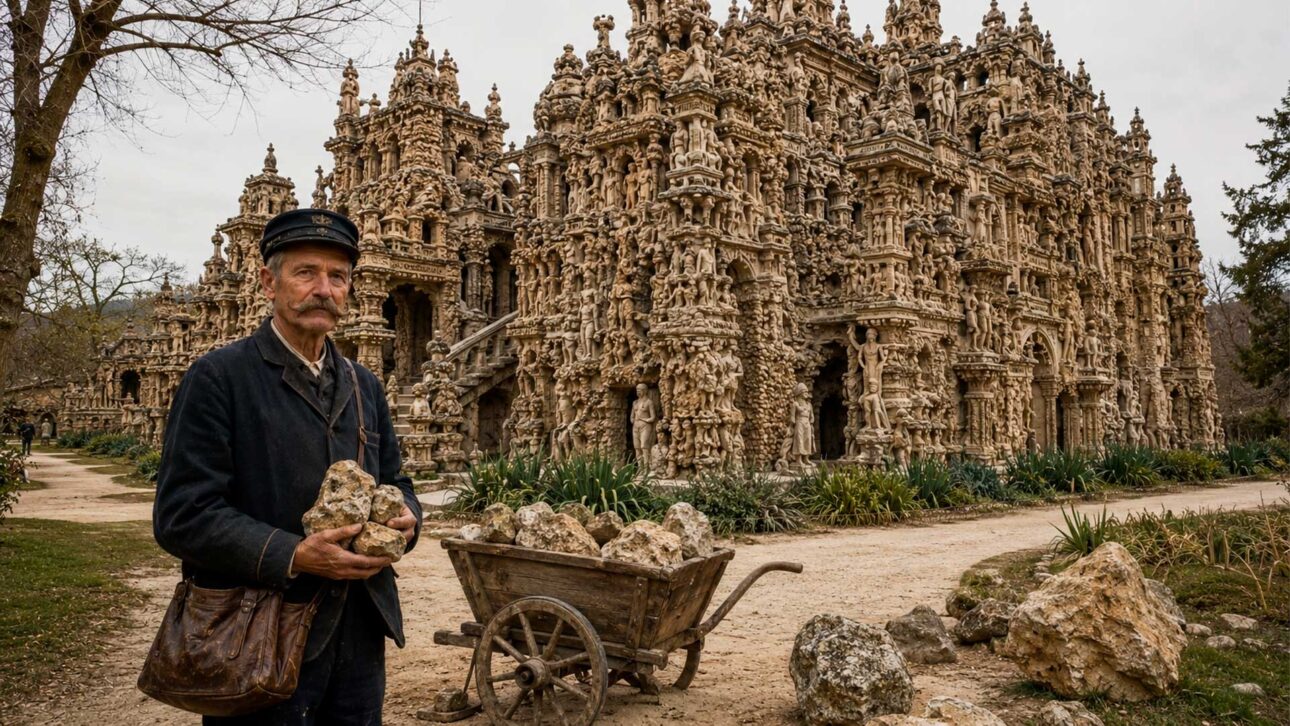
According to the official site of the Palais Idéal, the postman traveled routes of more than 30 kilometers and, on that April day in 1879, stumbled upon a stone that nearly knocked him down. Instead of ignoring the obstacle, he stopped, observed the strange shape, and kept the rock.
The next day, he returned to the same spot and found other stones that also caught his attention. From there, the idea was born that would occupy almost his entire adult life: if nature made sculptures, he would try to do the masonry and architecture.
The stone, in this case, was not just raw material. It served as a trigger for an old dream, fueled by images of distant places that reached Cheval’s hands through letters, postcards, and illustrated magazines.
How a Postman Without Training Built a 33-Year Work
Ferdinand Cheval was not an engineer, architect, or trained artist. He learned by doing, testing materials, and finding practical solutions to join stones, shells, fossils, and natural fragments.
At first, he carried the stones in his pockets. Then, he started using a basket and, as the volume increased, he adopted a wheelbarrow to transport the material found along the way.
The construction took place outside working hours. After delivering letters, Cheval returned to his backyard and worked at night, often with poor lighting, in a routine that required physical endurance and unusual discipline.
The work progressed slowly, without industrial haste and without an academic project. Each facade, column, sculpture, and ornamental detail was born from a combination of improvisation, visual memory, and persistence.
The final result was an uninhabitable palace, closer to a monumental sculpture than a common residence. On the walls, Cheval recorded the extent of his own effort: 10,000 days, 93,000 hours, and 33 years of work.
Postcards, Magazines, and Nature Fueled the Postman’s Imagination
The Palais Idéal does not imitate a single architectural style. It mixes references from temples, castles, animals, religious figures, mythology, and landscapes that Cheval probably knew more from images than from travels.
According to information from the historical site itself, postcards and the first illustrated magazines played an important role in shaping the postman’s imagination. As a postal worker, he saw images of countries and monuments circulate that he would hardly know personally.
This geographical limitation turned into creative strength. Without commitment to formal rules, Cheval created a free architecture, made of fragments, dreams, and his own interpretations of the world.
On the facades of the palace appear animals, giants, fairies, biblical figures, and shapes reminiscent of constructions from various cultures. There are elephants, birds, bears, octopuses, and elements that seem to come out of fantastic tales.
For this reason, the work is often associated with naïve art and the so-called art brut or outsider art, terms used for productions made outside traditional academic circuits. The fascination lies precisely in this freedom: the palace does not seem to follow a school, but the intimate logic of the one who built it.
From Object of Strangeness to Monument Protected by the French Government
During the construction, Cheval was not immediately seen as a genius or artist. For many residents of the region, the postman was just an eccentric man who collected stones after work and spent the nights on a project with no practical function.
This judgment changed over time. The construction began to attract curious people, artists, and intellectuals interested in a work that did not fit the traditional standards of architecture.
Official recognition came decades after its completion. According to the Ministry of Culture of France, the Palais Idéal was classified as a historical monument in September 1969, by decision linked to the then minister André Malraux.
The decision was important because it placed the work under heritage protection. What could previously be seen as an individual whim became part of the French cultural heritage, with recognized artistic and historical value.
The case draws attention because it reverses the common logic of great monuments. It was not born from a king, church, government, or company. It was born from a rural postal worker who used his free time, physical effort, and imagination to build a work that spanned generations.
The palace did not end Ferdinand Cheval’s mission
When he finished the Palais Idéal, Cheval was already elderly. Even so, his relationship with stone and construction did not end there.
He wished to be buried inside his own palace, but French legislation did not allow this type of burial outside the cemetery. Faced with the refusal, he made a new extreme decision: to build his own tomb in the cemetery of Hauterives.
This second work took another eight years and was named the Tomb of Silence and Endless Rest. Like the palace, the tomb was made with strong symbolic meaning and meticulous details.
Ferdinand Cheval died in 1924, at the age of 88, and was buried in the mausoleum he built himself. The trajectory reinforces the impression that his work was not a passing pastime, but a life project.
By adding the palace and the tomb, Cheval dedicated more than four decades to a personal creation, made without the promise of immediate fame. This persistence helps explain why his story continues to arouse curiosity.
A work admired, but also surrounded by debate
The story of Ferdinand Cheval is often told as an example of overcoming, but it also opens space for debate. After all, what separates an incomprehensible obsession from a genius work recognized over time?
For years, the postman was treated as eccentric. Decades later, artists and authorities began to see value in what many had despised. This change shows how cultural recognition does not always happen at the moment the work is born.
The case also reveals the strength of self-taught individuals in the history of art. People without formal diplomas, without sponsorship, and without access to major cultural centers can produce creations capable of challenging experts.
In the end, Cheval’s palace impresses not only for its size or details. It draws attention because it was built against the logic of the probable, by a man who transformed repetition, fatigue, and solitude into one of the most improbable constructions in France.








Be the first to react!