Portuguese
  Spanish


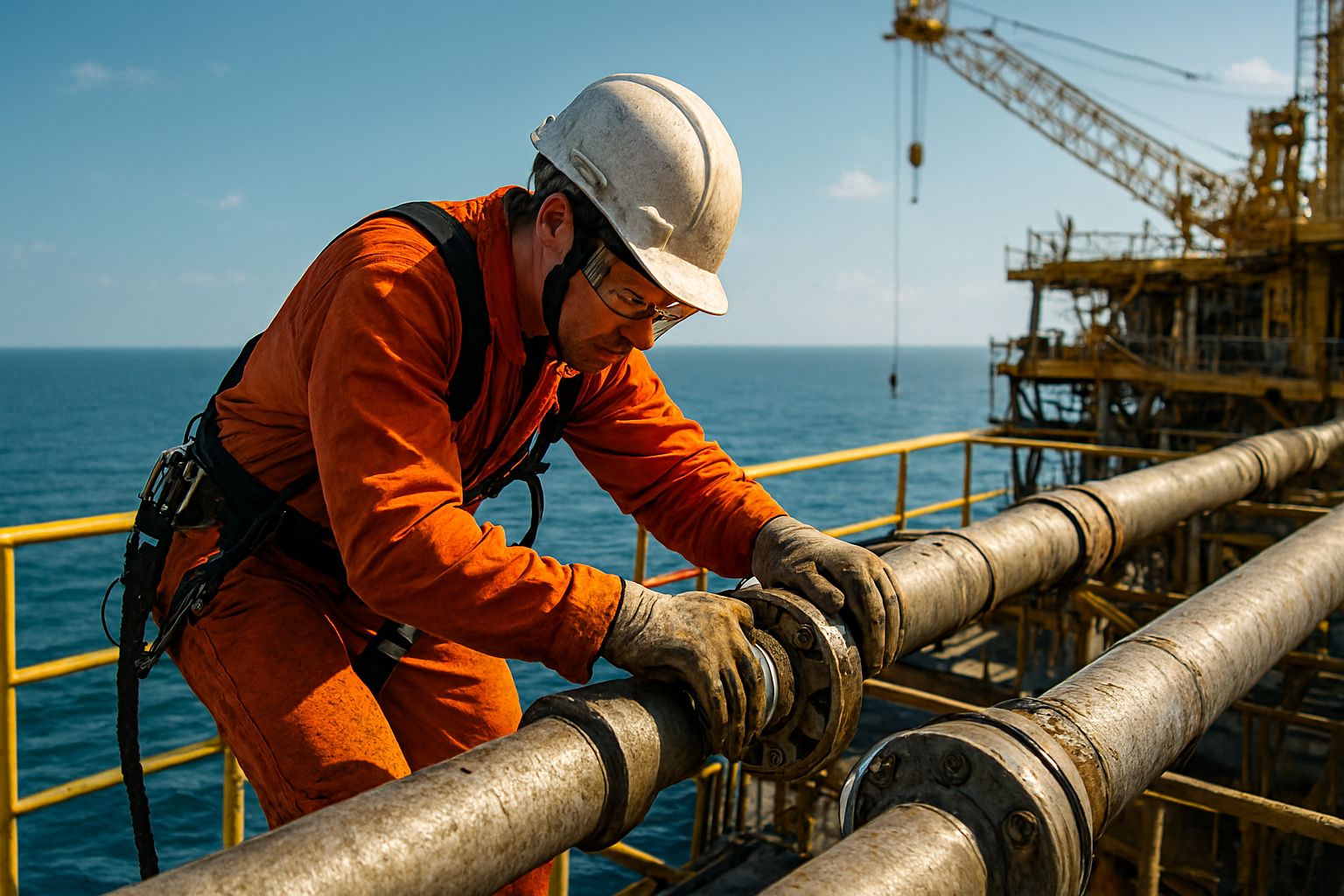


Derrickman Climbs 40 Meters Offshore to Install Heavy Pipes on Oil Platforms. Critical Role in Pre-Salt Pays Up to R$ 18,000 Per Month.
The offshore routine is filled with roles that combine technical knowledge, physical effort, and a resilience that few can develop. Among them, one stands out due to the complexity and inherent risk of the work environment: the profession of derrickman, known internationally as derrickman. In Brazil, this professional mainly works on pre-salt drilling platforms, climbing structures up to 40 meters high to manipulate heavy pipes while the vessel moves with the natural sway of the sea. In 2025, the role remains one of the most in-demand and valued in the oil industry, with salaries reaching R$ 18,000 per month, according to unions and companies in the sector.
The derrickman is a fundamental part of the offshore drilling chain. His primary role is to work at the top of the tower — the derrick — where the supports that organize, connect, and stabilize the drilling pipes are located, which can reach 7 kilometers deep. It is there, at the highest point of the platform, that he helps assemble, align, and guide thousands of kilos of pipe, always coordinated with the driller, the rotary table operator, and the entire drilling team.
Working at 40 Meters High, in 30 Knot Winds and Constant Swell
The derrick of a platform or drillship is a metal structure whose height ranges from 35 to 45 meters — equivalent to a 12 to 15-story building. Up there, the derrickman works secured by harnesses and safety equipment that are checked daily. However, even with strict protocols, the environment is highly challenging.
-
A 24,200-ton oil platform is removed from the North Sea in just 10 seconds and taken to be scrapped on land, in an operation where more than 97% of the Brent Delta structure was reused or recycled.

-
Ocyan takes AI and data to the FPSO Brazil Congress 2026 to showcase how digital technologies can enhance safety, integrity, and performance in next-generation FPSOs.

-
Sodexo debuts unique maritime hospitality on Seagems ship to transform the well-being, food, and comfort of offshore professionals.

-
European ship will transport captured CO₂ to be stored under the North Sea as the Greensand project prepares the first industrial offshore storage in the European Union to operate in 2026 with an initial target of 400,000 tons per year in Denmark.





The height exposes the professional directly to winds that can exceed 30 knots (about 55 km/h) in regions like the Fluminense pre-salt. Furthermore, when the work is carried out on drillships — which do not anchor but maintain position with dynamic positioning systems (DP) — the movement of the sea creates oscillations that reach 2 or 3 degrees of tilt, enough to alter the operator’s balance at the top of the tower.
Another critical factor is the weight of the piping. A single 9-meter drilling pipe can exceed 400 kg, depending on the grade of steel. The derrickman handles blocks of dozens of pipes, aligning structures that weigh tons. Even the drilling fluid, pumped at high pressures, can splash and create slippery conditions, requiring extra attention.
This is a scenario where there is no room for mistakes. On modern platforms, the derrick also houses equipment that operates under high loads, such as top drives, pulleys, and hooks capable of lifting over 500 tons. The derrickman moves between these elements, adjusting cables, guides, and heavy metal structures while the operation progresses at a continuous pace.
Why the Derrickman Is Essential in Pre-Salt Drilling
The offshore drilling chain involves hundreds of steps, but few depend as much on physical precision as the alignment of the drilling column. The derrickman:
- organizes and stacks drilling pipes on the fingerboard;
- aligns the piping with the top drive;
- assists in inserting and removing pipes within the well;
- controls the mud room in some rigs;
- ensures that the tower is always clean and operational;
- guides the team on the synchronization of the column during connections and disconnections.
In the pre-salt, complexity increases due to the depth. Typical drilling crosses:
- 2,000 to 3,000 meters of water,
- 2,000 meters of sediments,
- and dense layers of rock and salt, which require frequent pipe changes.
Each change involves repositioning enormous pipes, and the derrickman ensures that everything happens with perfect alignment — an essential condition to keep the well stable, avoid losses in circulation, and respect the pressure parameters, which can exceed 10,000 psi in deep zones.

Salaries, Qualifications, and Paths in the Offshore Career
The role of derrickman requires technical qualifications, prior experience in the industry, and specific certifications. Among them:
- CBSP (Basic Platform Safety Course)
- HUET (Helicopter Underwater Escape Training)
- NR-35 (Work at Height)
- NR-33 (Confined Spaces)
- International drilling certifications (IADC / IWCF)
The salary, according to Sindipetro and companies like Valaris, Seadrill, and Ocyan, varies between:
- R$ 12,000 (beginner level in smaller rigs)
- R$ 18,000 (experienced derrickmen on 6th and 7th generation drillships)
In addition, many derrickmen move up to positions of greater responsibility, such as:
- driller (driller)
- toolpusher (toolpusher)
- drilling supervisor
Positions that can exceed R$ 40,000 per month.
A Job That Combines Strength, Technical Skill, and Courage
The derrickman is, without exaggeration, one of the most challenging professions in the offshore sector. Working suspended dozens of meters high, manipulating heavy structures, and dealing with the constant sway of the sea, requires a rare type of professional: focused, physically, technically, and mentally prepared.
The pre-salt depends on this set of skills. Without the derrickman, drilling simply does not advance — and no barrel would reach the surface.