Portuguese
  Spanish


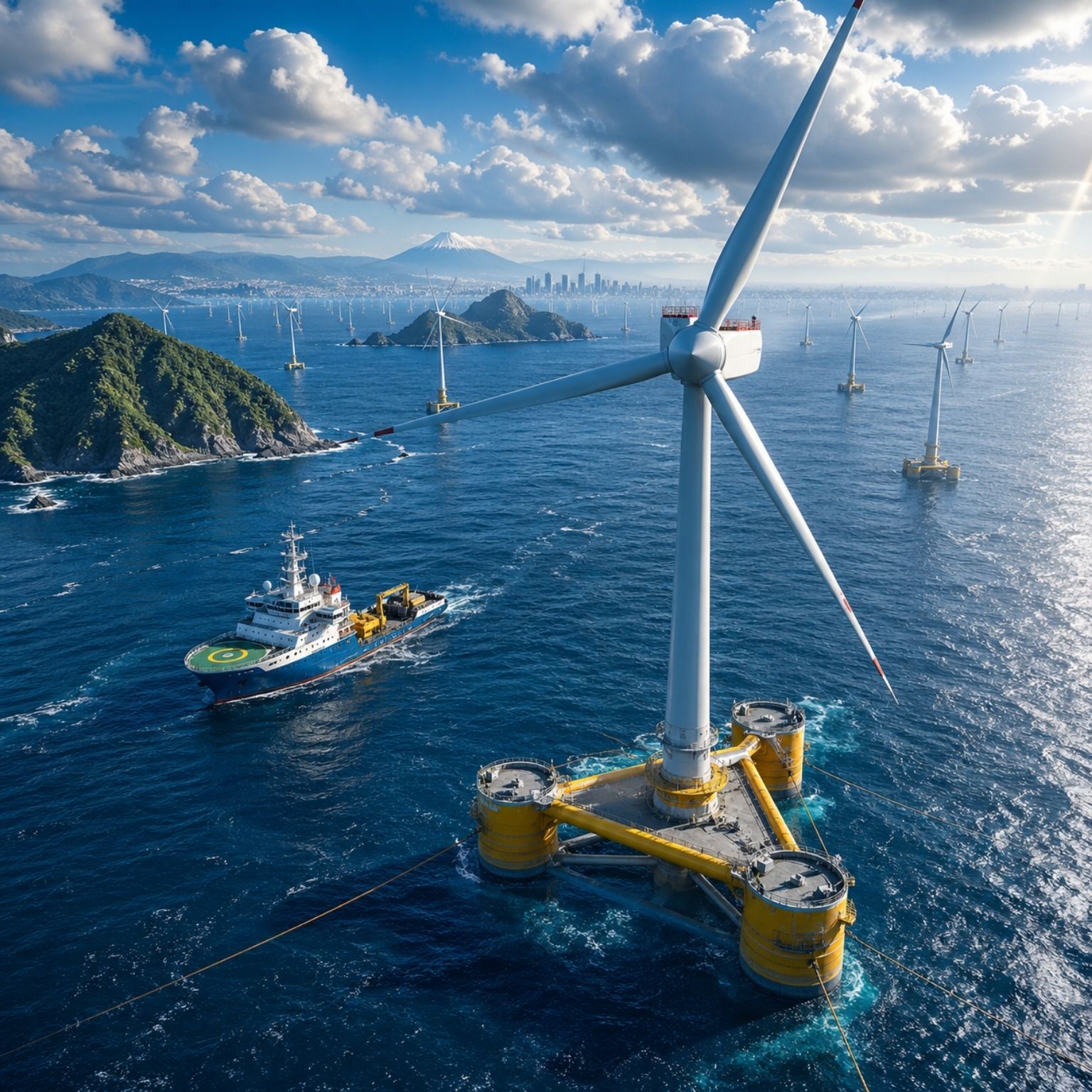

The floating wind farm planned by the Metropolitan Government of Tokyo aims to transform the coast of the Izu Islands into a new energy frontier in Japan, with a goal of delivering at least 1 GW by 2035, connecting islands and capital with submarine cables and placing in the ocean a structure almost ten times larger than the largest floating farm in operation today
The floating wind farm announced by Tokyo places Japan at the center of a global competition for scale and technology in offshore energy. The plan envisions installing, off the Izu archipelago, a structure with at least 1 gigawatt of capacity to supply both the island communities and the Japanese capital. If realized on schedule, the project will become the largest of its kind in the world.
The proposal draws attention for its size and the contrast with the current scenario of the sector. Today, the largest floating operation in operation is in Norway and produces less than 100 megawatts. Tokyo’s goal is almost ten times larger. In practice, this means attempting to place in the sea a power plant comparable in size to a nuclear reactor, but based on floating turbines anchored in the ocean.
Floating wind farm becomes central bet to bring energy from the Izu Islands to Tokyo
The project was launched by the Metropolitan Government of Tokyo as a strategic initiative to expand offshore energy generation and strengthen Japan’s energy transition. The structure will be installed near the Izu archipelago, focusing on supplying five island communities and also the city of Tokyo.
-
Brazil to Hold First Auction for Batteries to Store Solar and Wind Energy from the Northeast

-
Brazilian scientists are simultaneously advancing two research projects on clean hydrogen and driving solutions that could transform the energy matrix, enhance industrial competitiveness, and accelerate large-scale emission reduction targets.

-
Advancement in renewable energy: A R$ 150 million project launched by Petrobras and Finep aims to create state-of-the-art electrolyzers for green hydrogen, strengthening national research and preparing Brazil to compete in a billion-dollar energy market.
-
Illiterate or semi-literate grandmothers were trained to repair solar systems, open rural workshops, and light up homes that still depended on kerosene.



The idea did not emerge recently. Governor Yuriko Koike presented this vision for the first time at COP29 in 2024. Since the fiscal year 2025, the government has been consulting local residents and the fishing and maritime transport sectors to address the social and logistical impacts of the proposal.
What makes this project almost ten times larger than the largest current operation
The difference in scale is the first factor that places the Japanese plan on another level. The future plant is designed to produce at least 1 GW. Meanwhile, the largest floating farm in operation today, located in Norway, generates less than 100 megawatts.
This comparison helps to measure the size of the ambition. Japan is not just trying to enter the sector with a new project. It is attempting to jump straight to global leadership in a segment that still represents only a small fraction of global wind installations.
The numbers that explain the size of the Japanese bet
The central goal of the project is to achieve at least 1 gigawatt of capacity by 2035. This production was designed to meet both the islands in the region and the Japanese capital. The budget for the fiscal year 2026 has been tripled and raised to 2.7 billion yen, about $17 million, focusing on studies about wind strength and seabed.
The plan also connects to Japan’s broader strategy for offshore energy. The national government is working with the goal of achieving 45 gigawatts of offshore wind capacity by 2040. In this context, the park in the Izu Islands is treated as a strategic piece of a larger transition.
How a floating wind farm works at sea


Unlike fixed offshore wind farms anchored to the seabed, the floating wind farm uses platforms that remain on the water’s surface. These structures are held in place by a system of mooring cables and anchors.
This model is considered less aggressive to the marine environment during installation because it avoids heavy excavation on the ocean floor and dispenses with the driving of piles used in fixed projects. After generation, the energy is converted into electricity and sent via high-voltage submarine cables to the islands and the mainland grid.
What the government has already started to do to take the plan off paper
To keep the schedule moving, the Tokyo government has started field research to analyze the topography of the seabed and the climate patterns of the region. These studies are essential to define the layout of the cables and assess the technical feasibility of the project.
At the same time, the project is still in initial stage. The Izu region is classified only as a preparation zone, indicating that the plan has not yet entered the full implementation phase. This makes the current studies decisive for the future of the proposal.
The five island communities that are at the center of the project
The plan focuses on five island communities in the Izu archipelago: Oshima, Niijima, Kozushima, Miyake, and Hachijo. These areas are at the heart of the energy and logistics strategy designed by the metropolitan government.
This choice shows that the project was designed not only to supply Tokyo but also to connect remote island areas to a new energy route. Thus, the floating wind farm presents itself as a work of generation and territorial integration at the same time.
Why the path to 2035 is considered difficult
Despite the ambition, the schedule faces doubts. Authorities and analysts warn that the commercialization of the project is still challenging and that the private sector shows growing skepticism regarding long-term profitability and the risks of operating offshore.
Critics also point out that the 2035 target may be unrealistic. Offshore projects often take more than a decade to complete, and the Izu Islands project is still in the initial phase. This puts pressure on deadlines, costs, and execution capacity.
What weighs against the confidence of the private market
The caution of the private sector did not arise from nowhere. In 2025, Mitsubishi Corp. abandoned large wind projects in northern Japan. According to the reported basis, the central factors were the increase in material costs and the devaluation of the yen.
This episode raises doubts about the ability of large offshore projects to advance quickly in the country. Even with public support, investors and contractors continue to look carefully at the profitability risk and the real cost of operating in open water.
1 GW capacity does not mean continuous production at the same level
The project has a comparable scale to that of a nuclear reactor in installed capacity, but the actual production will not be equivalent all the time. Analysts cited in the basis note that wind energy tends to operate with actual production close to 40% of capacity, while a nuclear reactor usually operates between 80% and 90%.
This point is important because it helps to separate installed power from effective delivery. The number 1 GW is huge and helps to size the project, but the concrete generation will depend on the wind regime and operational conditions over time.
Why the Izu Islands were chosen for this floating wind farm
The Izu region has natural wind speeds that reinforce the Japanese government’s interest in the location. This factor provides a technical basis for the proposal and helps explain why the area was placed at the center of the metropolitan plan.
Additionally, the distance between the islands and the consumer centers makes the use of submarine cables a strategic solution. The floating wind farm was designed precisely to reduce the distance between the ocean and the consumer, creating a direct energy link between a remote area and the urban and electrical grid of Tokyo.
What this project represents for Japan’s energy transition
The Izu Islands plan goes beyond an isolated project. It serves as a scale test for a country that wants to increase the share of offshore wind energy in its matrix and advance towards the goal of net zero emissions by 2050.
If successful, the venture could transform Japan into a reference in an area where the country currently lags behind European technological leadership. At the same time, if it delays or loses momentum, the project could reinforce the perception that ambitious offshore goals are hindered by cost, risk, and execution time.
The next steps before Japan attempts to lead the sector
The next moves involve deepening studies on wind and seabed, advancing local consultations and preparing the future tender for construction and operation. This will be the moment when the proposal begins to move from strategic discourse into the realm of practical decisions.
Until then, the floating wind farm of the Izu Islands remains a powerful and large-scale vision, but still surrounded by uncertainties. Japan has put a project on the map capable of changing the sector. Now, it needs to prove that it can turn ambition into delivery.
In your view, will Japan really be able to bring this giant floating wind farm to fruition by 2035, or will costs, risks, and the slow pace of offshore projects continue to weigh more?