






 Portuguese
  Spanish
  4 min of reading
  0 comments


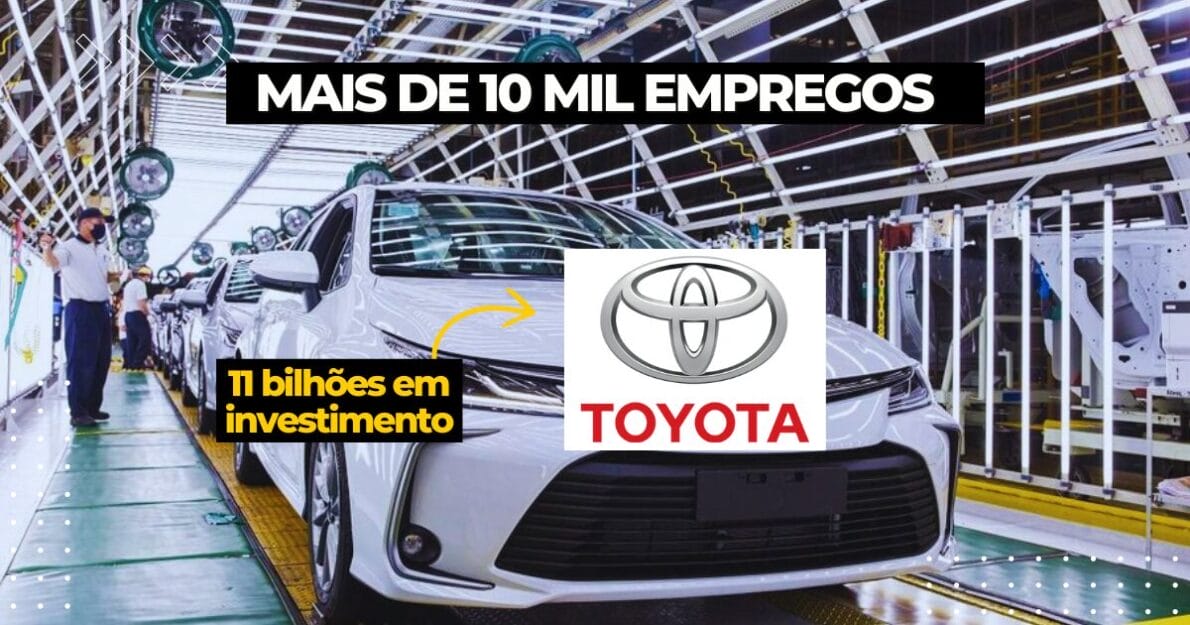
With Billion Dollar Investment, Toyota Starts a New Era in Brazil: 10,000 Jobs, Eco-Efficient Factory, and Flex Hybrid Models.
Brazil is about to experience a turning point in the automotive sector.
With a billion dollar investment, one of the largest automakers in the world is planting roots even deeper in national soil, promising an impact that goes beyond new production lines.
This new venture brings not only innovation and sustainability but also the promise of thousands of job opportunities and the potential transformation of the regional economy.
-
Chinese Giant Uses Metal Structures and Cranes to Deliver Over 700 Electric Cars to Brazil

-
Uber Faces Shareholder Scrutiny as Board Accused of Ignoring Safety, Compliance, and Harassment Warnings Amid Over 3,500 U.S. Lawsuits

-
Ferrari’s First Electric Car Divides Fans, Priced at $630,000, Amid Concerns Over Limited Editions; Brand Clarifies It’s Not Just for Future Perks
-
BYD Dolphin Mini: The Electric Car That Defies Depreciation, Losing Only 3.58% in a Year and Becoming the Best-Selling Retail Model Under $22,000


According to Toyota, the new plant in Sorocaba (SP) is expected to begin operations in 2026.
This expansion accompanies the ambitious plan of R$ 11 billion by 2030, reflecting a modernization and expansion strategy aimed at meeting the growing demand for sustainable vehicles.
In the coming years, the complex, which focuses on eco-efficient production and high technology, promises to heat the market with new flex hybrid models and generate a positive impact for the Brazilian economy.
Sustainability as the Foundation of the New Project
Toyota, always at the forefront of innovation, brings a bold proposal: the new factory will follow the Ecofactory concept, a model that seeks to minimize environmental impacts at every stage of the production process.
According to the automaker, eco-efficient practices include the use of renewable energy and the reduction of CO2 emissions, a differentiator that aligns Brazil with the United Nations’ Sustainable Development Goals (SDGs).
The facility will also use water-based paint, which, according to Toyota, reduces pollutant emissions by 20%, and logistical systems designed to optimize transportation.
Additionally, the location of the main suppliers just one kilometer from the factory will reduce fuel consumption, minimizing truck circulation and strengthening regional partnerships.
For Toyota, this type of integration not only brings more efficiency but also drives the economic and social development of Sorocaba and nearby cities.
Job Creation and Economic Development
By 2030, the expectation is that 10,000 indirect and 2,000 direct jobs will be created.
Thus, the factory presents itself as an important hub for employment and economic development for the Sorocaba region.
This number represents a new era of local prosperity, with a strong impact on the labor market and workforce qualification.
According to Toyota, the proximity to suppliers and the strategic location aim to optimize processes and open doors for new business opportunities and technological innovation.
The strengthening of the national production chain, with more parts and components being manufactured locally, promises to boost the country’s automotive industry, increasing attractiveness for investments and companies interested in partnerships.
Democratization of Sustainable Mobility
Toyota reaffirms its commitment to the environment by planning the production of new flex hybrid models at the new facility.
According to the automaker, this technology combines electrification with biofuels, merging energy efficiency with a lower environmental impact.
With a launch scheduled for 2025, the first flex hybrid model will mark a milestone in the democratization of sustainable mobility, offering a more accessible alternative to Brazilian consumers.
The company states that, in addition to sustainability, the eco-efficient factory aims to make production more competitive, aligned with global expectations for conscious consumption.
This investment in vehicles that combine electricity and biofuel fits into Toyota’s global strategy to promote greener mobility, providing an economically viable option with a lower environmental impact.
Toyota: Local Partnerships and Social Impact
With an investment of this magnitude, Toyota plans not only to expand its production but also to strengthen ties with Brazilian society.
According to the automaker, the new plant will directly collaborate with the sustainable development of the region and will bring tangible economic and social benefits, reinforcing the company’s confidence in the Brazilian economy.
Through local partnerships, the automaker also seeks to stimulate the training of qualified professionals, with an emphasis on the technology and sustainability sectors, reflecting the need for a workforce adapted to the new market demands.
For many industry analysts, this is a strategic move that places Brazil in a prominent position, attracting even more investors and paving the way for other companies to follow Toyota’s example, boosting the automotive market and the economy as a whole.
Will Toyota open doors to a new era of jobs and sustainable development in Brazil?


Be the first to react!