Portuguese
  Spanish


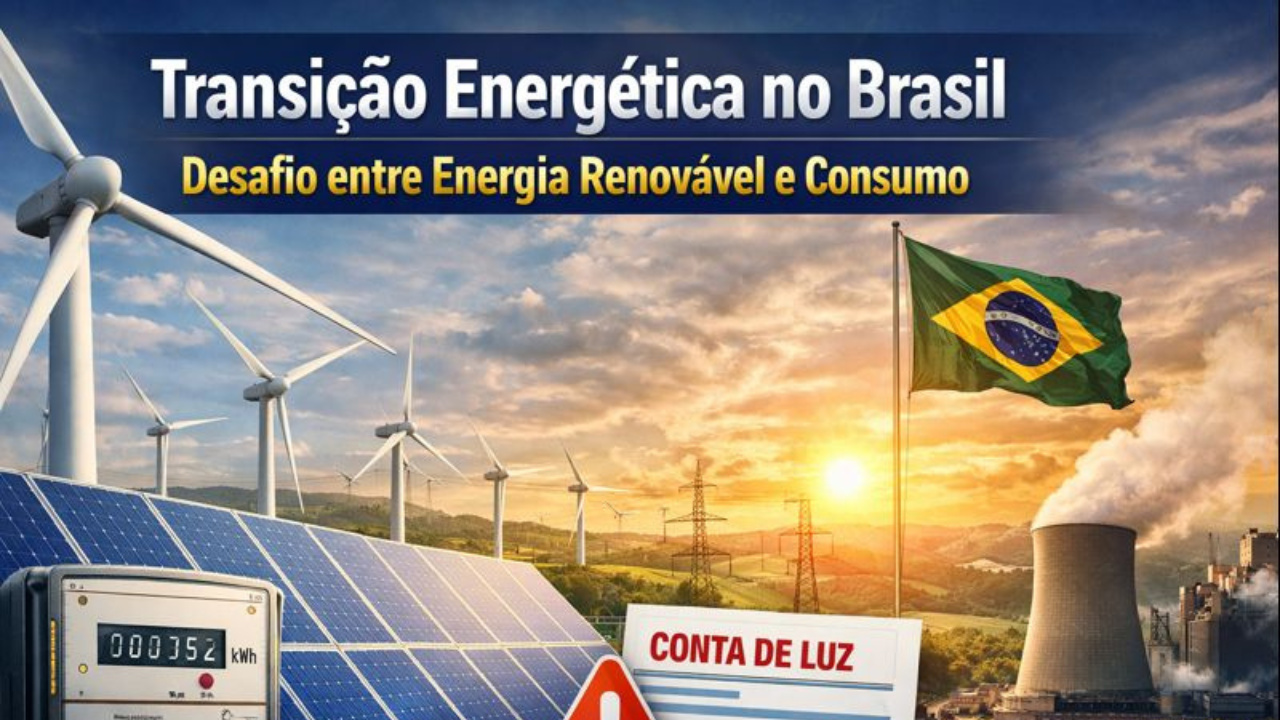


Energy Transition Advances, but There Is a Lack of Balance Between Generation and Consumption of Renewable Energy, Pressuring Tariffs and Demanding Planning.
What Is at Stake, Who Debates, When and Where: the energy transition in Brazil became the focus of national debate this Tuesday (27/1), during the O TEMPO Seminars – Energy Transition, held in Belo Horizonte, bringing together regulators, distributors, and industry representatives.
How to advance in renewable energy without distortions in the electric system and why the country faces generation cuts even with a Brazilian energy matrix that is mostly clean were the key points.
Thus, the answer lies in energy planning and in the balance between generation and consumption, an essential condition to ensure safety, fair prices, and sustainability.
-
Over 60 Tractors Take to the Streets in Lopera as Solar Parks Compete with Olive Groves, Affecting 13,000 to 100,000 Trees According to Conflicting Reports

-
Green Hydrogen Projects in Northeastern Brazil Stalled for 18 Months Awaiting Government Decree, Delaying Billions in Investments
-
Brazil Concludes Largest Energy Auction in History, Secures 18.97 GW and Mobilizes $12.8 Billion to Ensure Supply Until 2031
-
How Norway Produces More Energy Than It Consumes with Nearly 1,800 Hydropower Plants and Over 1,100 Reservoirs


Energy Transition Requires Coordination Between Data, Agents, and Society
Although Brazil is a global reference in clean sources, the accelerated expansion of renewable generation does not always find equivalent demand.
According to Ivo Sechi Nazareno, Secretary of Auctions at the National Electric Energy Agency (ANEEL), the transition is only consolidated when there is harmony between sustainability, energy security, and affordable tariffs.
“For the energy transition to develop, balance between agents, data, and society is necessary,” said the secretary.
So this tripod, according to him, supports a reliable and financially healthy electric system.
Renewable Energy Grows, but Generation Cuts Expose Bottleneck
The Brazilian paradox appears in the so-called curtailments, technical generation cuts.
Unlike other countries, where the problem arises from a lack of grids, in Brazil the main reason is the absence of consumption at the moment energy is produced.
“There is no instantaneous balance between the generation being carried out by all sources and the consumption at that very moment,” Nazareno explained.
Thus, part of the renewable electricity is not used, affecting the system’s efficiency and final costs.
Brazilian Clean Energy Matrix Pressures Tariffs
The excess supply has a direct impact on the electricity bill.
For Marcus Madureira, president of the Brazilian Association of Electric Energy Distributors (Abradee), the current model carries a high volume of subsidies.
“I am completely against any subsidy.
Thus, the bill is very high. Per year, consumers paid around R$ 54 billion,” he pointed out.
According to him, the advancement of renewables requires a review of incentives to avoid tariff distortions.
Energy Planning and the Role of Biomass
The criticism of incentives concentrated on solar and wind also came from the bioenergy sector.
Mário Campos, president of the Bioenergy and Sugar Industry Association of Minas Gerais (Siamig), highlighted the potential of biogas produced from sugarcane as an alternative to diesel.
“Today, honestly, biomass is totally disincentivized.
We are not seeing the real cost of each source,” he stated.
For him, broader energy planning is essential to value complementary sources and reduce imbalances.
Balance Between Generation and Consumption Passes Through Thermoelectric Plants
Despite the prominence of renewables, experts argue that thermoelectric plants remain key components for system stability.
Madureira reminds us that solar and wind depend on specific weather conditions.
“Who ensures energy 24 hours a day, 365 days a year?” he questioned.
According to him, hydropower plants help, but suffer during dry periods.
In this scenario, thermoelectric plants — including those powered by natural gas — ensure supply when other sources fail.
Energy Transition: Concept and Brazilian Context
The energy transition goes beyond the exchange of fossil fuels for clean sources. It involves rethinking generation, distribution, and consumption, incorporating efficiency, digitalization, and decentralization.
In Brazil, this process occurs from an already renewable base, which differentiates the country on the global stage.
Data from the Energy Research Company (EPE) indicate that, in 2023, 89% of the Brazilian energy matrix was composed of renewable sources, leading among G20 countries.
Renewable Energy and Diversification of the Matrix
The growth of wind and solar has been changing the historical composition based on hydropower plants.
Projections from the National Electric System Operator (ONS) indicate that, by 2028, these sources are expected to account for 51% of installed capacity.
This diversification reduces water dependency and broadens decentralized generation.
Furthermore, Brazil’s climatic potential favors expansion without putting sensitive areas under pressure.
Structural Challenges and Demand Expansion
Despite the advances, the reliance on thermoelectric plants persists in critical moments, increasing costs and emissions.
The Decennial Energy Expansion Plan 2034 projects an annual consumption growth of 2.1%, requiring investments in transmission, storage, and efficiency.
Without these measures, the advancement of renewable energy may hit technical limits, widening the imbalance between generation and consumption.
Paths to Strengthen the Energy Transition
To consolidate a more resilient system, experts advocate for integrated public policies, development of national productive chains, and professional training.
Thus, the expansion of transmission infrastructure and electric mobility is also decisive.
In this context, Brazil has the conditions to assume a strategic role in the global energy transformation.
With a Brazilian energy matrix that is clean and diversified, the country can attract investments, lead low-carbon solutions, and transform the energy transition into a vector of sustainable development.
See more at: Energy Transition Seeks Balance Between Generation and Consumption and Energy Transition: Challenges and Opportunities in Brazil