Portuguese
  Spanish


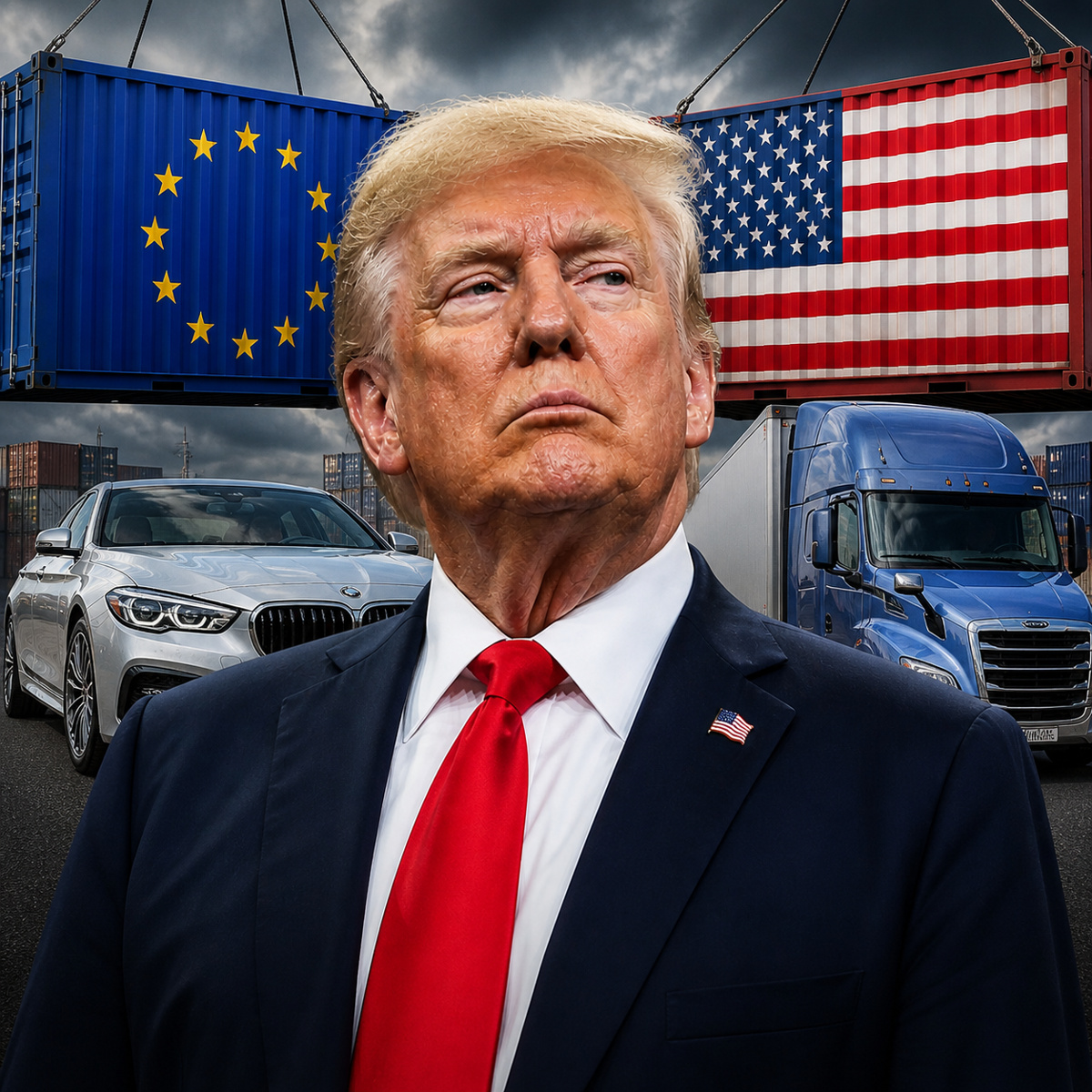

Trump proposes 25% tariff on European Union cars and trucks, raising alarm over higher prices, export decline, and global trade tensions
Donald Trump’s decision to raise the tariff to 25% on cars and trucks imported from the European Union marks a new moment of tension in international trade. The announcement was made this Friday (1st) with implementation expected as early as next week, increasing urgency and concern among governments, businesses, and investors.
Trump justified the measure by claiming that the European Union was not fully complying with the terms of a trade agreement previously signed with the United States. At the same time, he signaled that European companies producing vehicles within American territory would not be affected by the new tariff policy, which reinforces the strategy of stimulating domestic investment.
This move rekindles fears of a new trade dispute between major economies, with the potential to impact prices, production chains, and the global flow of exports.
-
As Brazil Expands Social Welfare, Survey Reveals 40% Blame Poverty on Laziness, While 58% Cite Lack of Opportunities

-
China Tightens Control on Antimony, Driving Prices from $22,000 to Nearly $40,000 per Ton as U.S. Rushes to Bolster Strategic Reserves

-
BlackRock Freezes $1 Billion in Brazilian Renewable Energy, Impacting 1.5 GW of Planned Projects and Highlighting Investor Concerns Over Infrastructure Bottlenecks Cutting Up to 25% of Solar and Wind Generation
-
Labor Shortage: Despite Record Average Salary, 90% of Brazilian Bar and Restaurant Owners Struggle to Hire Key Roles Like Sushi Chefs and Head Cooks


Trump raises tariff on European Union cars and trucks, rekindling trade tension
Trump’s announcement of the new 25% tariff on cars and trucks from the European Union does not happen in a vacuum. It is part of a recent history of trade disputes that have already affected strategic sectors of the global economy.
The automotive industry is one of the most sensitive to this type of measure. This is because it involves complex production chains, with parts and components crossing different countries before the final product reaches the consumer.
According to the World Trade Organization, higher tariffs tend to reduce international trade and create market distortions. In the specific case of the automotive sector, the impact can be even more intense due to the global integration of the industry.
Trump also highlighted that the decision is directly related to encouraging domestic production. He mentioned that there are over 100 billion dollars in ongoing investments in the construction of car and truck factories in the United States, classifying this volume as a historic record.


Direct impact on vehicle prices and consumer pockets
One of the most immediate consequences of the new tariff is price increases. When import taxes rise, the additional cost is usually passed on to the final consumer.
In the case of cars and trucks from the European Union, experts point to some probable effects:
- More expensive European vehicles in the American market;
- Reduced competitiveness of foreign brands;
- Possible decrease in the variety of available models;
- Adjustments in automakers’ pricing strategies.
Studies by the Peterson Institute for International Economics indicate that industrial tariffs tend to generate domestic price increases, in addition to reducing access to imported products.
This scenario can directly impact consumers looking for vehicles from European brands, especially in premium segments, where the European Union’s presence is stronger.

European exports under pressure with new 25% tariff
The tariff increase proposed by Trump represents a significant challenge for European Union exports. The United States is one of the main markets for European vehicles, which makes any trade barrier particularly relevant.
Data from the European Automobile Manufacturers’ Association shows that millions of units of cars and trucks are exported annually to the American market. With the new tariff, these products could quickly lose competitiveness.
Among the possible impacts are:
- Reduction in export volume;
- Drop in revenue for European automakers;
- Reevaluation of market strategies;
- Pressure for factory installations in the US.
The trend, in this scenario, is for companies to seek alternatives to maintain a presence in the American market, including expanding local production, which could significantly alter the global automotive industry map.
Trump, tariffs, cars and trucks, and the European Union at the center of a possible global escalation
Trump’s decision does not only affect the automotive sector. It could trigger a chain reaction in international trade. The European Union has a history of responding to measures considered protectionist, which increases the risk of retaliation.
The European Commission may evaluate countermeasures, including tariffs on American products. In previous disputes, sectors such as agriculture, beverages, and technology were directly impacted.
The risks of an escalation include:
- Increase in tariffs across different sectors;
- Reduction of trade between major economies;
- Instability in financial markets;
- Decrease in investor confidence.
This type of scenario has already been observed in past trade conflicts, where initial measures eventually led to cycles of retaliation that affected global economic growth.
Trump’s strategy prioritizes domestic production and billion-dollar investments
By emphasizing that companies producing cars and trucks within the United States will not be affected, Trump makes clear the central objective of the measure: to strengthen national industry.
The figure of 100 billion dollars in investments he cited reinforces this strategy. According to the president, this volume represents a record in the history of automotive manufacturing in the country.
In practice, this could encourage:
- Transfer of production to American territory;
- Creation of local jobs;
- Reduction of import dependence;
- Reorganization of global production chains.
However, experts warn that this type of policy can also generate side effects, such as increased costs and loss of efficiency, especially in highly globalized sectors.
Decision follows trade gesture involving the United Kingdom
The announcement of the new tariff comes shortly after a different decision in the commercial sphere. Trump had signaled the withdrawal of restrictions involving the trade of whiskey between Scotland and the American state of Kentucky.
This measure was announced after diplomatic meetings with King Charles III and Queen Camilla, who were on an official visit to the United States. During the agenda, the monarch even addressed Congress, reinforcing the importance of relations between the countries.
Trump indicated that the easing of whiskey tariffs also had a symbolic character, related to the visit of the British royal family. This contrast shows how trade decisions can vary according to strategic and political interests.
What could change in global trade in the coming months
The implementation of the new tariff may still open space for negotiations between the United States and the European Union. In many cases, such measures are used as a tool for pressure to renegotiate agreements.
Among the scenarios most discussed by analysts are:
- Negotiations to avoid the full application of the tariff;
- European retaliation with equivalent measures;
- Adjustments in global production chains;
- Redirection of exports to other markets.
The automotive industry, in particular, should closely follow developments, as any change in trade rules can impact investment and production decisions in the short term.
A move that could redefine trade relations between the US and Europe
Trump’s decision to raise the tariff to 25% on cars and trucks from the European Union goes beyond a simple economic measure. It signals a shift in how the United States conducts its trade relations with historical partners.
The impacts could be broad and long-lasting. Consumers may feel it in their pockets, companies may review strategies, and governments may be led to adopt new policies to protect their economies.
In an increasingly interconnected global scenario, decisions like this have effects that transcend borders. What begins as a tariff measure can quickly transform into a determining factor for international economic balance.
With information from G1.