Portuguese
  Spanish


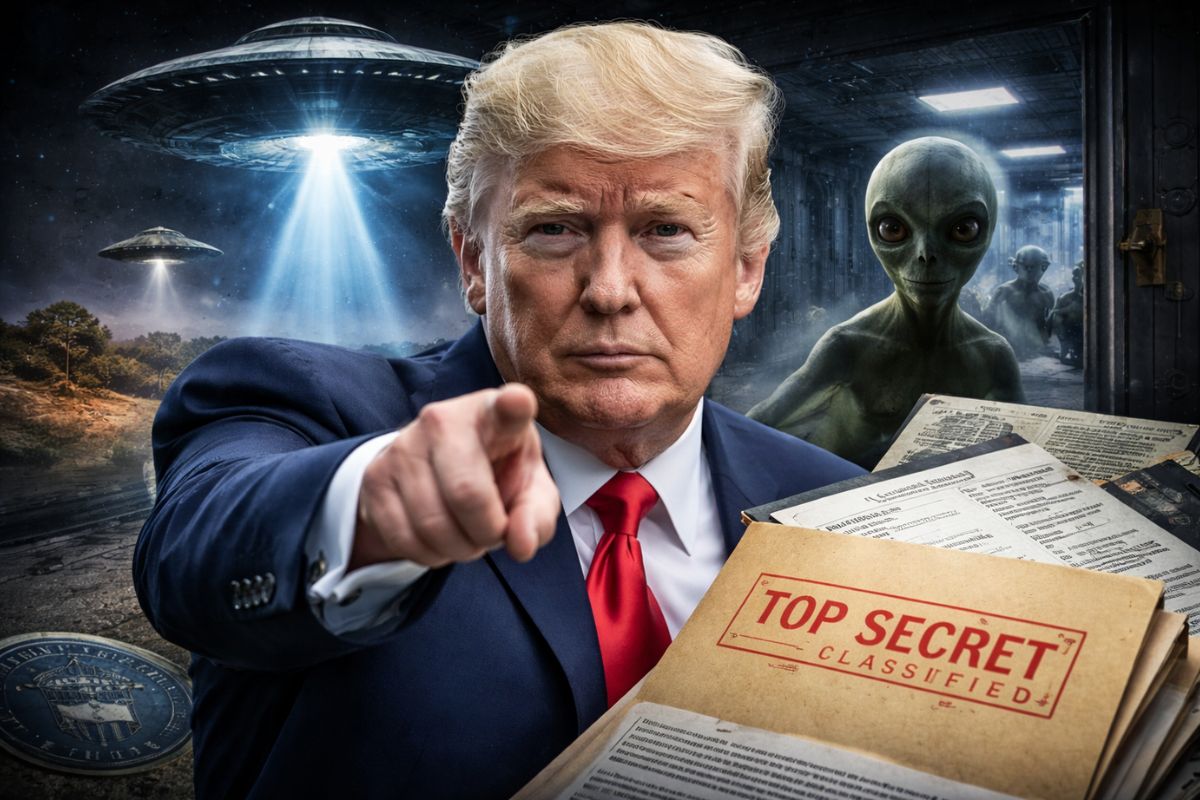


On Thursday, 19, Trump said on Truth Social that he would order the identification and disclosure of files on extraterrestrial life, UAPs, UFOs, and aliens, citing public interest and Pentagon investigations. The decision came after an interview with Obama, who said, “they are real,” and then relativized by saying that he didn’t see evidence.
UFOs and aliens have become a government topic in the words of Donald Trump, who announced that he would order the release of official files and, at the same time, attacked Barack Obama for allegedly touching on classified information. The immediate effect is political: public curiosity has become an argument and ammunition.
The announcement comes in the wake of Obama’s statements about life beyond Earth, first with a phrase that ignited the imagination and then with a more rational brake based on probability and distance between solar systems. Between fascination and skepticism, the debate has shifted to the realm of secrecy and what the State can prove.
What Trump Promised And Why It Matters Now
On Thursday, 19, Trump wrote on Truth Social that he would instruct the Secretary of War and other departments and agencies to initiate a process of identifying and disclosing files related to alien and extraterrestrial life, as well as unidentified aerial phenomena, the UAPs, and unidentified flying objects.
-
AI Data Centers Now Feature Built-In Nuclear Power Plants and Have Ordered Non-Existent Reactors

-
In India, thousands earn about $2.50 an hour cooking and cleaning with a phone strapped to their heads, as every move is recorded to train humanoid robots for jobs they might one day replace.

-
Nuclear Fusion Study Proposes Transforming Mercury into Gold Using Tokamak Neutrons, but Real-World Application Remains Uncertain
-
Brazilian Researchers Develop Floor Tiles That Convert Student Footsteps into Electricity to Reduce University Energy Costs





The choice of tone is calculated: he calls the subject complex, interesting, and important.
The central point, however, is not just the content of the documents. It is the message that UFOs and aliens deserve institutional treatment, with government language, not just folklore.
When the announcement comes out as an “order” and “process,” the discussion stops being just belief and becomes a demand for evidence.
What Type Of File Is Targeted And Where The Pentagon Appears
Trump ties the announcement to the “enormous interest” of the public and cites Pentagon investigations into reports of alleged alien visits to Earth.
This detail is crucial because it takes the subject out of the realm of rumor and places it on the radar of the Department of Defense, although the existence of an investigation, in itself, is not proof of visitation. Investigating does not mean confirming, but it also does not mean ignoring.
In practice, the announcement suggests two simultaneous fronts: documents about UFOs and aliens as a phenomenon and documents about how the government has handled the subject, including with secrecy, reports, and classifications.
If what comes to light is more bureaucracy than revelation, the reaction will depend on how much the government can explain without turning into rhetorical smoke.
Obama, The Phrase That Exploded And The Retreat That Tried To Close The Door
The direct trigger for the announcement was the repercussion of an interview with Obama on Saturday, 14, in which he said, “They are real, but I haven’t seen them,” adding that they would not be kept at Area 51 and denying the existence of an underground facility unless there was a huge conspiracy hiding it from the president himself.
The phrase works like a match: it ignites curiosity and opens space for opposing interpretations.
Afterward, Obama published a clarification, stating that he did not reveal classified information and that he only made a supposition based on the probability of the existence of extraterrestrial life, given the size of the universe.
He also stated that the distances between solar systems make the chances of visitation low and said that he did not see evidence, during his presidency, of contact with extraterrestrials.
The retreat does not erase the initial phrase, but it shifts the focus: from certainty about visitation to the probability of life somewhere.
Trump’s Accusation Of Secrecy And The Collateral Effect Of The Dispute
Trump went beyond the announcement of disclosure and accused Obama of breaking the secrecy, saying that he had removed the declaration from confidential information and that “he shouldn’t do that.”
At the same time, when asked if he believes in aliens, Trump replied, “Well, I don’t know if they’re real or not.” This contradiction is a political fact: it demands transparency but preserves room for retreat.
In this scenario, UFOs and aliens cease to be just a topic of scientific or cultural curiosity and become a tool for public dispute over credibility.
If on one side there is the promise to open files, on the other there is an accusation of leaking and a response that mixes certainty, doubt, and narrative. The risk is that the subject turns into a test of support, not of evidence.
Area 51, Theories And What The Disclosure May Really Change
Area 51 appears as a symbol because conspiracy theories often point to the site as a repository for extraterrestrial bodies and crashed spacecraft, while the purpose of the facility is kept under secrecy.
It’s a type of scenario where any silence is interpreted as confirmation and any incomplete document becomes fuel for new hypotheses. The information vacuum is always filled with imagination.
Therefore, any eventual disclosure could have two opposite effects. If it brings verifiable material, it could reduce speculation and elevate the debate.
If it comes fragmented, with hidden excerpts or vague language, it could increase distrust, because the question shifts from “Is there something?” to “What was hidden?”. Partial transparency, on this subject, is often read as provocation.
What The Public Should Demand Beyond The Spectacle
If the promise to disclose files is carried out, public interest is not resolved with headlines but with criteria: what will be declassified, who audits, what the temporal cut is, and how the government separates accounts, hypotheses, and evidence.
UFOs and aliens only leave the realm of myth when there is method, traceability, and context.
It is also worth observing the difference between “life beyond Earth” and “visits to Earth.” Obama placed these two ideas in distinct keys: probability of life somewhere in the universe, and low chance of visitation due to distances.
Mixing the two is the most common shortcut to confuse the debate.
The promise from Trump to open government files on UFOs and aliens emerges at a point where the subject was already heated, with Obama’s comments reverberating and the mention of Pentagon investigations giving institutional gloss.
Now, the conversation shifts from “do you believe?” to “what will be shown, and with what standard?”.
If you had access to these documents, what would you consider sufficient proof to take UFOs and aliens seriously: official reports, images, sworn testimonies, or something that could be checked externally from the government? And where do you think the debate is most lost today: in the lack of data, the excess of theories, or the political use of the subject?