Portuguese
  Spanish


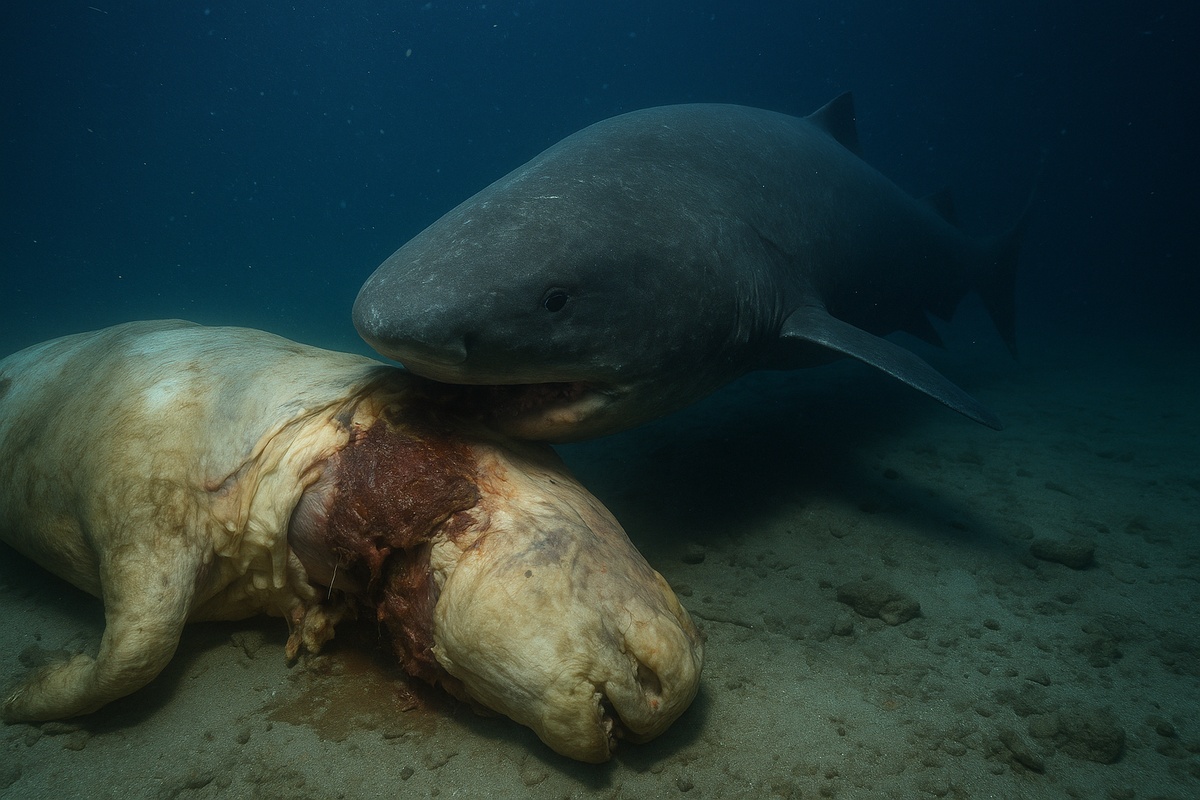


Chinese Researchers Launch Dead Cow More Than 1,600 Meters Deep and Identify Rare Sharks Feeding in Disciplined Relay.
In October 2023, a team from Ocean-Land-Atmosphere Research conducted an unusual experiment in the depths of the South China Sea.
The scientists launched the carcass of a dead cow at a depth of 1,629 meters, near the coast of Hainan Island, with the aim of simulating the sinking of a whale.
The proposal, therefore, aimed to observe how scavenger species would react to the presence of organic matter on the ocean floor, an area still little explored by science.
However, what happened next surprised even the most experienced researchers on the mission.
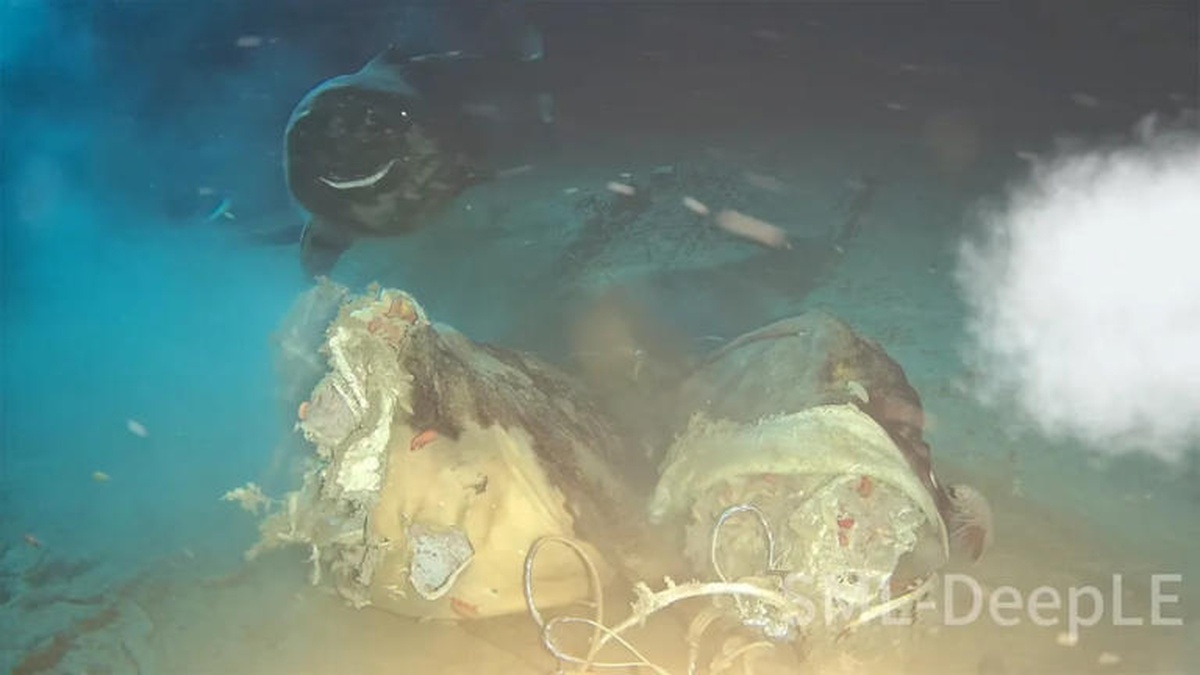
“Hey, buddy!” (Image: Han Tian, Ocean-Land-Atmosphere Research)
Eight Pacific Sleeper Sharks Appear for the First Time in the Region
Shortly after the carcass sank, the site was invaded by eight Pacific sleeper sharks (Somniosus pacificus), which astonished the team.
This was the first time the species was recorded in southern China, an area where they had never been observed before.
-
Furong: The 2,000-Year-Old Chinese City Built on a 60-Meter Waterfall Becomes a Global Tourist Phenomenon

-
YouTube Inventor Dubbed “Real-Life Tony Stark” Builds Robotic Legs for Father’s Day, Creating a Wheelchair That Conquers Stairs and Rough Terrain

-
Brazilian Scrap Dealer Processes 3,000 Tons of Ferrous Scrap Monthly, Paying $0.09 to $0.70 per Pound, Reveals Why a Hidden Cylinder Costs 1,500 kg Discount

-
Alabama Family Converts Giant Grain Silos into a 1,750 sq ft Rustic Home, Spending $100,000 to Prove the Impossible





Until then, these animals were considered exclusive to the northern Pacific, where they appear between Japan, Alaska, and Baja California.
Therefore, the unprecedented appearance raises questions about the true distribution of the species, in addition to reinforcing hypotheses about movements caused by climate change.
Underwater Recording Shows Rare Feeding Behavior in Predators
Besides the unexpected presence, the behavior of the sharks surprised the team even more.
Submersible cameras, in turn, captured the animals taking turns peacefully to feed on the carcass, without disputes or attacks.
This type of feeding rotation is rarely seen among large predators, suggesting a level of social organization previously unknown for this species.
In this way, researcher Han Tian, who is responsible for the project, claims that competitive intensity may replace brute strength in defining the food order.


Body Size Defines Aggressiveness and Strategy
The images also revealed distinct behavioral patterns, especially related to the size of the individuals.
Sharks larger than 2.7 meters approached in a direct and dominant manner, while the smaller ones circled the carcass cautiously before attacking.
This shows that, even in environments with food scarcity, behavioral hierarchy prevents unnecessary conflicts among the animals.
Additionally, the researchers noted a curious behavior: retinal retraction during bites, likely to protect the eyes during attacks.
This adaptation, therefore, could compensate for the absence of the nictitating membrane, present in great white sharks, felines, and reptiles like lizards.
Eye Parasites Reinforce Connection with Arctic Species
Another relevant detail captured by the cameras was the presence of parasitic copepods in the eyes of the sharks, which caught the team’s attention.
These parasites are, in fact, common in Greenland sharks (Somniosus microcephalus), reinforcing an evolutionary link with species from cold and deep waters.
According to Han Tian, however, the team has yet to accurately identify the copepod species, although the behavior is consistent with records in the Arctic.
Banquet Attracts Forgotten Biodiversity from Tropical Depths
In addition to the sharks, the carcass attracted dozens of amphipods and snailfish, which surprised researchers due to the observed diversity.
This demonstrated that the bottom of the South China Sea is, in fact, more productive than previously thought.
For a long time, it was believed that tropical depths harbored less life than polar regions.
However, the experience showed the opposite: there is abundant life even in areas considered biologically poor.
Lack of Data or Effect of Climate Change?
The big question, in this context, is: Did sleeper sharks always live there and were never observed, or did they arrive recently due to global warming?
According to Han Tian, there are sporadic records of the species in Palau and the Solomon Islands, which suggest undocumented populations in tropical areas.
The low frequency of scientific studies in the region, therefore, may have kept these populations invisible for decades, without any official record.
Scientific Simplicity with Major Results
The experiment showed that simple methods, such as using a cow instead of a whale, can reveal high-impact ecological discoveries.
The strategy even allowed the observation of behaviors, social interactions, and physiological adaptations that were previously unknown for the species.
Moreover, Han Tian’s team’s idea shows that it doesn’t take a million-dollar budget to conduct relevant and revealing science in the depths of the ocean.
Challenges and Perspectives for Marine Biology
For many specialists, this discovery reinforces the importance of continuous investments in oceanographic research and deep biology.
Despite recent advances, much of the ocean remains unexplored, which limits the understanding of marine biodiversity.
This type of study, therefore, provides valuable data on threatened species, in addition to helping understand the impacts of climate change in extreme environments.
What Does the Future Hold for Ocean Research?
Behaviors such as the feeding rotation and the retinal retraction of the sleeper sharks indicate that life in the depths is more complex than previously imagined.
Therefore, the current challenge is to expand scientific missions, strengthen data collection, and disseminate results with clarity and accessibility.
Meanwhile, one question remains: how many other species are hiding in the shadows of the seabed, just waiting to be discovered?