






 Portuguese
  Spanish
 3 min of reading
  0 comments


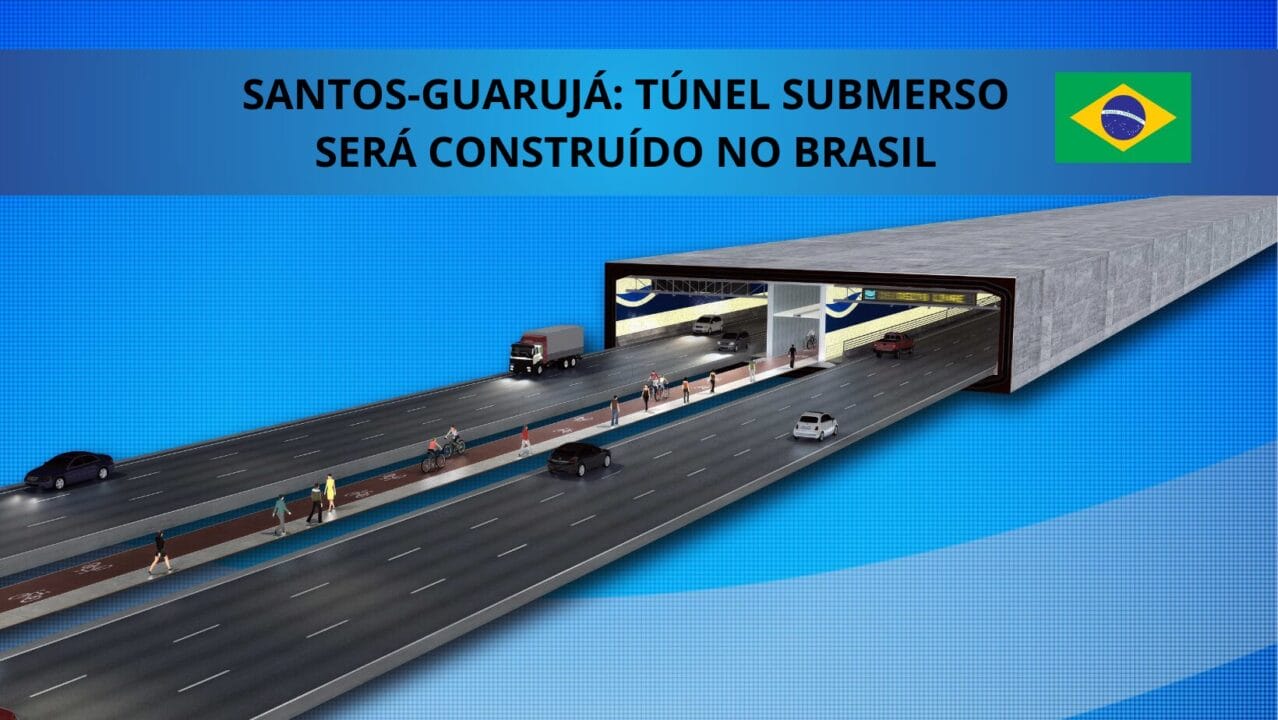
The Government Announced the Construction of an Underwater Tunnel Between Santos and Guarujá, the First in Latin America. The Work Will Improve Mobility, the Environment and the Economy in the Region.
An ancient dream of more than 100 years is about to become reality: the land connection between the cities of Santos and Guarujá, on the São Paulo coast, through an underwater tunnel that will pass under the Santos port channel, the largest in Latin America. The project, which is a partnership between the federal and state governments, was announced last Friday, (02/02), and promises to revolutionize urban mobility in the region.
Characteristics of the Underwater Tunnel: Length, Lanes, Bike Path and Sidewalk
The underwater tunnel will be 1.5 km long, with 870 meters under the channel, and will have three traffic lanes in each direction, one of which will be reserved for Light Rail Vehicle (VLT).
Additionally, the tunnel will have a bike path and a sidewalk for pedestrians, ensuring accessibility and sustainability of the project.
-
Bolivian Female Construction Workers Form Association to Combat Discrimination and 38% Pay Gap in the Industry

-
Near Amsterdam, residents buy land and discover they must also build streets, manage drainage, handle waste, and grow food on half their plot.
-
Brazil’s WEG to Open New Factory in China by 2027, Expanding Production of Large Rotating Electric Machines and Low to Medium Voltage Motors in Rugao

-
Chinese Shipyard Secures $1 Billion in Orders for Low-Carbon Container Ships Amid Global Fleet Renewal Efforts


The estimated crossing time by car will be only a minute and a half, reducing the travel time between the two cities by about 50 minutes.


Stages of the Construction of the 1st Underwater Tunnel that Will Connect Santos to Guarujá
The work will be a milestone in civil engineering, as it will be the first underwater tunnel in Latin America and one of the few in the world.
The tunnel will be formed by six prefabricated reinforced concrete modules, which will be submerged to a minimum depth of 21 meters in the channel bed.
The modules will be produced in a dry dock and transported by flotation to the construction site, where they will be fitted and fixed, without interfering with ship traffic in the channel.
The construction process of the underwater tunnel involves several complex stages, which require detailed and rigorous planning.
First, an executive project is made, which takes into account the geology, the environment, structural sizing, and the logistics of the work.
Next, the modules are manufactured in a dry dock, with specific dimensions and characteristics to adapt to the tunnel.
Then, the modules are transported by flotation to the construction site, avoiding the use of land routes.
Before the installation of the modules, the channel bed is prepared to receive the structures, with excavations, leveling, and other necessary interventions.
The modules are then gradually submerged in the channel bed, fitted and securely fixed to form the tunnel.
This process is delicate and must be done precisely to ensure structural integrity.
Finally, final safety and quality checks are carried out, and necessary adjustments are made to ensure the stability and efficiency of the tunnel.
Benefits of the Project for Residents, the Environment, and the Economy
The underwater tunnel will bring several benefits to the region, such as improved vehicle flow, reduced demand for the Ponta da Praia ferry, and decreased carbon dioxide emissions.
In addition to prioritizing the port channel for the transport of cargo and passengers, and the economic and social development of the two cities.
The estimated cost of the work is about R$ 5.8 billion, which will be divided between the Union and the state of São Paulo, each with 50% of the value.
The project is part of the Growth Acceleration Program (PAC) and plans to charge a toll on the tunnel, equivalent to the ferry rate, which is R$ 12.30 for passenger vehicles on weekdays.
However, there will be no toll charge for pedestrians.
The underwater tunnel between Santos and Guarujá is an innovative project, which will put Brazil in the spotlight of civil engineering in Latin America.
The work is eagerly awaited by residents and visitors of the two cities, who will be able to enjoy a new, faster, safer, and more sustainable way of connection.
The start of the works is scheduled for the second half of 2024, with completion expected by the end of 2027.
Source: Engenharia É





Be the first to react!