Portuguese
  Spanish


Two Brazilian students from Faetec, in Niterói, created a hospital stretcher that adjusts only by voice, without cranks or screens. The voice control project, designed to give autonomy to the elderly and quadriplegics, won the award for best international project at a science fair in Portugal.
Two Brazilian students transformed the experience of caring for a sick grandmother into an award-winning project abroad. João Marcelo and Cauã Da Cal, from the Electronics course at Faetec, in Niterói (RJ), created a hospital stretcher that adjusts only by the patient’s voice and won, at the end of May, the award for best international project at a science fair in Portugal.
The stretcher uses voice control technology so that the patient themselves can adjust the inclination and height of the bed, without cranks or touch screens. The proposal is to give more autonomy to the elderly, people with reduced mobility, and even quadriplegics, reducing dependence on others even in hospitals with many beds.
How the voice-controlled hospital stretcher works
The great idea lies in its simplicity of use. The hospital stretcher, nicknamed stretcher 3.0, was assembled with the Arduino platform and voice recognition modules, similar to those of assistants like Alexa.
-
Scientists Find Regular Activity Can Mitigate Alzheimer’s Impact, Even in Genetically High-Risk Individuals, Offering Strong Evidence for Cognitive Protection and Healthy Aging

-
Exploring Nazareth: Uncovering the Historical Setting of the Annunciation, Not Proving a Biblical Miracle

-
Former Student Returns to Teach Over 100 Children in São Paulo How PET Bottles Can Help Protect the Oceans
-
Man Buys Metal Detector for Recovery Walks, Discovers 27.2 kg Gold Nugget in Brazil


With this, the patient can raise, lower, or tilt the bed just by speaking, without relying on the cranks or touch screens of commercial stretchers.
This voice control feature changes the routine of those who have movement difficulties. According to Faetec, the application of this technology in a hospital stretcher in this way did not exist yet, and the differential is precisely to return autonomy to the patient.
Instead of calling a caregiver or nurse for every small adjustment, the person commands their own bed, which makes a difference especially for the elderly, bedridden, and quadriplegics.
The inspiration: João Marcelo’s grandmother
Behind the technology, there is a story of affection. The idea was born from the experience of João Marcelo, 18 years old, one of the Brazilian students behind the project.
He wanted to find a way to improve the routine and quality of life for his grandmother, who is bedridden due to a heart condition and faces mobility limitations.
From the desire to help his grandmother to the award-winning prototype, the journey passed through the classroom.
Under the guidance of Professor Altair Martins, the two students dedicated about a year to research, tests, and technical visits to the Antônio Pedro University Hospital.
It was in this process that the hospital stretcher with voice control took shape and began to attract attention at science fairs.
The award in Portugal and the trajectory of achievements
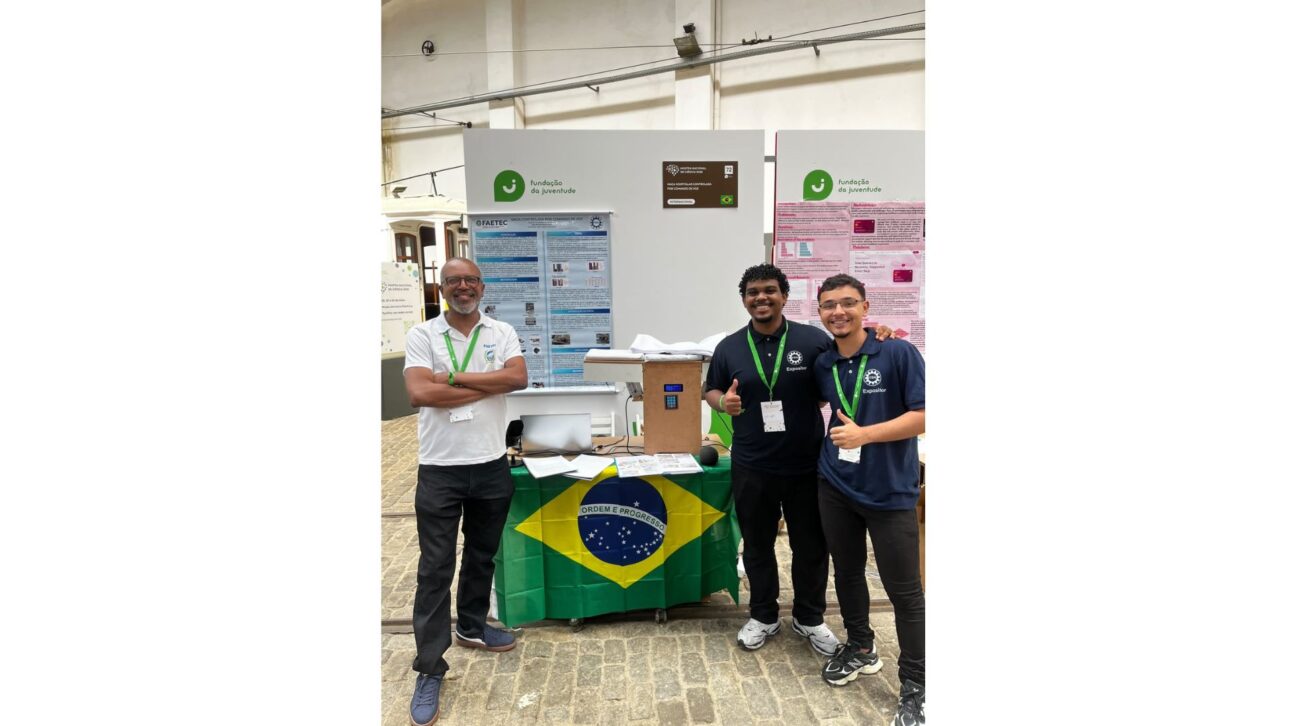
International recognition came at the end of May. The Brazilian students won the Best International Project award at the 2026 National Science Fair, held in the city of Porto, in Portugal, on Saturday (30).
João Marcelo and Cauã were the only representatives from Brazil in the competition, at an event supported by the Porto City Council and the Youth Foundation.
The victory in Portugal crowned a series of good results. Before that, the hospital stretcher with voice control had already won 1st place at the CRT-RJ fair, won Mostratec in the Electronic Engineering category, placed 2nd at FECTI, and 3rd at Febrace, one of the main student science and engineering fairs in the country.
The value of public technical education
More than a trophy, the achievement highlights the role of public technical education. The project was born within Faetec, at the Henrique Lage State Technical School, and shows how a classroom idea can achieve international relevance when it combines guidance, technical knowledge, and social sensitivity. The result also puts Niterói on the map of student innovation.
It is worth remembering that the invention is still a prototype, and the path to becoming a widely available product usually involves new tests, refinements, and validations.
Even so, the achievement of these Brazilian students already holds enormous value: it proved that impactful technology can arise from the desire to care for a loved one.
For João Marcelo and Cauã, the voice-controlled hospital stretcher started as a gesture of love and ended up winning an award in Portugal.
Seeing two young students from a public technical school create a voice-controlled stretcher and win in Portugal demonstrates the strength of Brazilian education and creativity.
Tell us in the comments what you think of these Brazilian students’ invention and where else this voice technology could help patients.