






 Portuguese
  Spanish


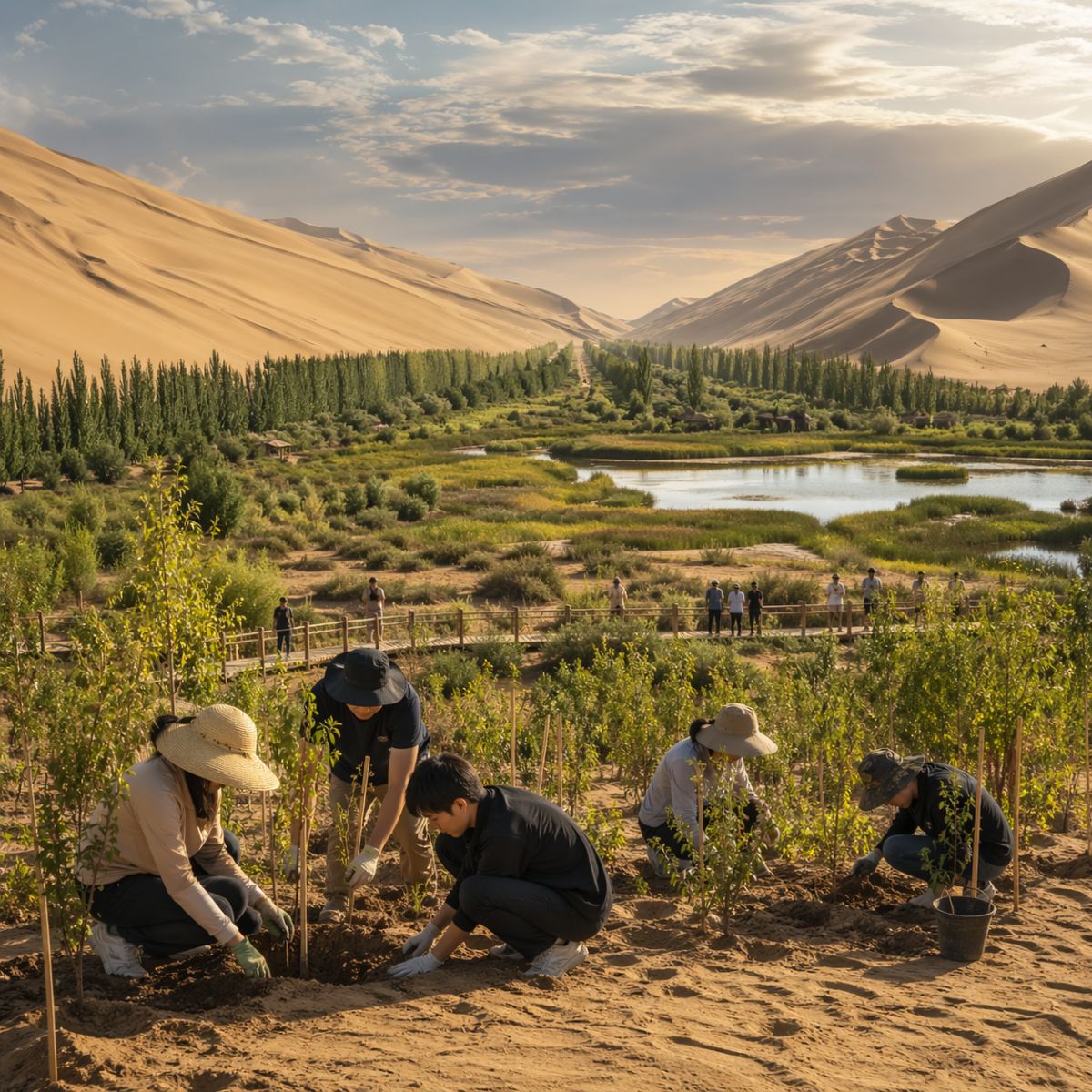


Minqin County, in Gansu Province, in northern China, was the last oasis preventing the merging of the Tengger and Badain Jaran deserts. In 2004, estimates indicated that the groundwater would dry up in 17 years, but volunteers started a tree-planting campaign that restored vegetation, boosted the economy, and transformed the region into an ecological tourism destination.
The story of how China managed to prevent two giant deserts from merging begins in Minqin, a county about 160 kilometers long nestled between the Tengger and Badain Jaran deserts in Gansu Province. The territory served as the last oasis in the region, a fertile area sustained by an aquifer that nourished local life. But the oasis was losing the battle against the advancement of the deserts: each year, the sand encroached upon farmland, dried up springs, and pushed residents out of their properties.
In 2004, the situation reached a breaking point. Studies estimated that the groundwater in Minqin would disappear in just 17 years, at which point the two deserts would merge and the oasis would cease to exist. It was in this urgent scenario that a group of volunteers decided to take action. The campaign began with the planting of drought-resistant trees, species capable of stabilizing the soil and halting the spread of sand. The goal was not only to save the oasis but to transform it into an economically viable region through fruit cultivation and tourism.
How tree planting saved the last oasis between two deserts in China

According to information released by the portal Poder360, the recovery project in Minqin was based on a simple logic: if the sand was advancing because there was no vegetation to hold it back, the solution was to create a living barrier. The volunteers planted species adapted to the arid climate in strategic bands around the oasis, forming green belts that act as shields against the wind laden with sand. Over 22 years, hundreds of people participated in the planting campaigns, many of them coming from different provinces of China.
-
Man Transforms Childhood Building in Detroit into Community Bookstore, Draws 400 to Opening

-
Two Brothers Leave City Life to Build Mud House in the Himalayas with Help from Over 100 Volunteers from 18 Countries, Including Brazil

-
At 9, Hailey Builds Mini Shelters for the Homeless Using Recycled Materials in Her Backyard
-
Seven-Year-Old Nicknamed Hulk Wins Gold in Brazilian Jiu-Jitsu After Defeating South American Competitors



The result was visible. The vegetation cover in Minqin has consistently grown, and areas that were once pure sand now support fruit plantations and other agricultural crops. The groundwater, which was heading towards depletion, stabilized as the vegetation reduced evaporation and helped retain moisture in the soil. The oasis not only survived but expanded, defying the most pessimistic forecasts from two decades ago.
The transformation of Minqin into an ecological tourism destination
What began as an environmental survival campaign has turned into a tourist attraction. Minqin has become an ecological tourism hotspot in China, where visitors can directly participate in tree planting in the desert. Platforms like Trip.com already offer specific travel guides for the activity, with information on the best times of the year to plant and directions on how to get to the county.
Planting tourism operates in an accessible way. It is possible to reserve a spot for planting trees in advance through local social assistance organizations or cultural tourism platforms. Public sites charge a fee between 50 and 100 yuan per person, equivalent to R$ 37 to R$ 74, which includes seedlings, shovels, and buckets. In addition to tourists who specifically come to plant, Minqin also attracts volunteers from all over China who engage in the cause as a way to contribute to combating desertification.
The national program of China that supports the fight against desertification
The case of Minqin is not isolated. The Chinese government supports the preservation project of the county and has maintained a national reforestation and desertification combat program for over 48 years. China is the country that has contributed the most to global reforestation in the last decade, according to a report by the Food and Agriculture Organization of the United Nations. This effort includes the so-called “Great Green Wall,” a strip of vegetation planned to contain the advance of the Gobi Desert.
The Chinese model for combating desertification combines public investment with popular mobilization. In Minqin, success came precisely from the convergence between the initiative of volunteers and the institutional support of the government, which provided resources, technical assistance, and infrastructure to enable large-scale planting. The result is that a region condemned to extinction has become an example of how collective action can reverse environmental processes that seemed irreversible.
What Minqin teaches about large-scale environmental recovery
The story of the Minqin oasis is often cited as proof that desertification is not a one-way street. 22 years ago, the prediction was that the Tengger and Badain Jaran deserts would merge and eliminate the last fertile barrier between them. Today, the scenario is different: vegetation has advanced, the local economy has diversified with fruit growing and tourism, and the county receives visitors from all over China and abroad.
The challenge, however, is not over. Climate change continues to pressure arid regions around the planet, and maintaining the green belts of Minqin requires ongoing replanting and monitoring efforts. The trees planted two decades ago need management to ensure their survival in the extreme conditions of northern China, where temperatures range from -20ºC in winter to over 40ºC in summer. What Minqin demonstrates is that environmental recovery is possible, but it requires persistence measured in decades, not in political mandates.
Do you believe that the Minqin model could be replicated in regions of Brazil facing desertification, or do local conditions make this unfeasible? Leave your opinion in the comments, we want to know if stories like this change the way you view the fight against the advance of deserts.





Yes, the Minqin model can be replicated elsewhere as long as will and diligence persist.