






 Portuguese
  Spanish


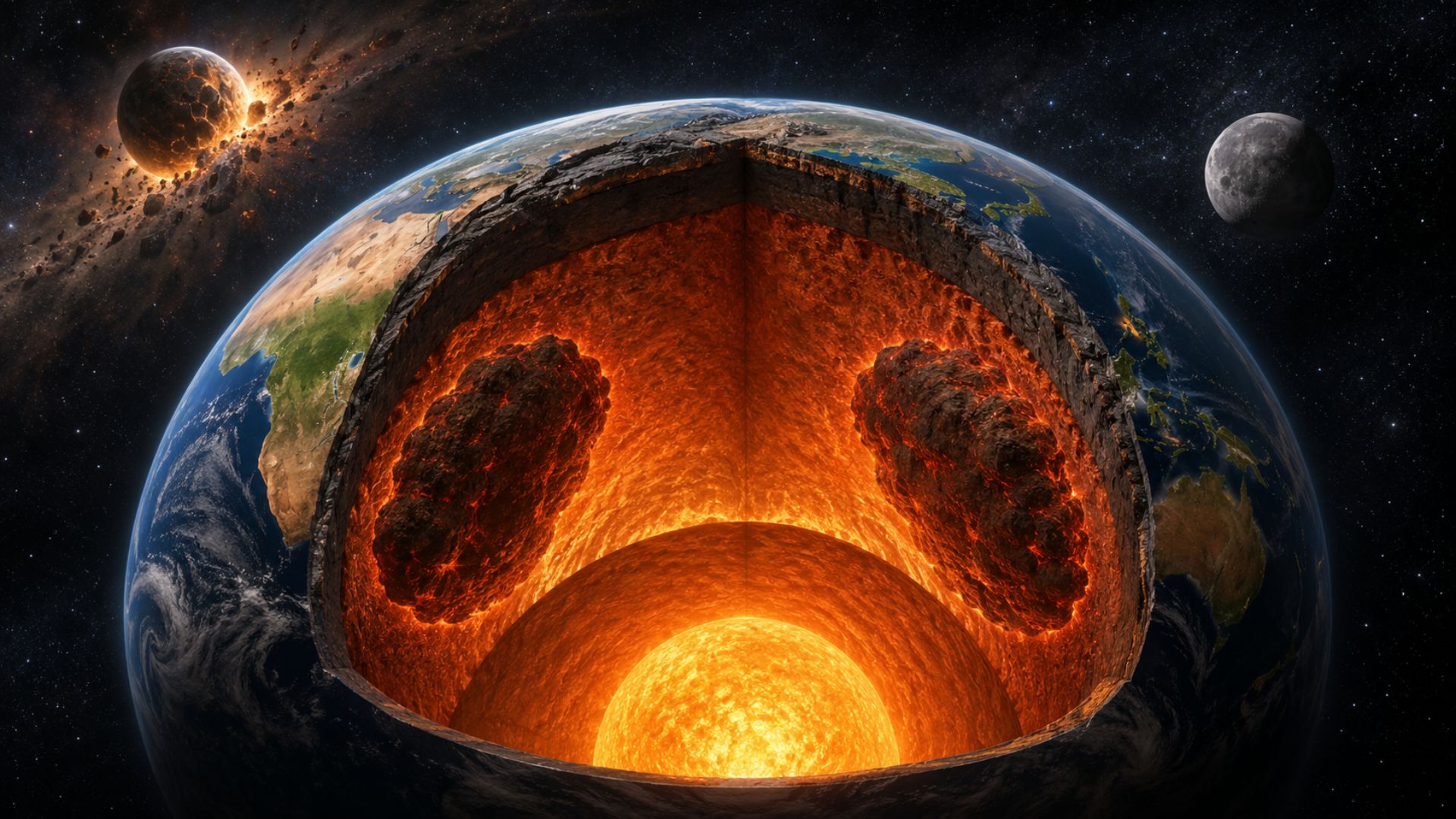

Larger than continents and taller than dozens of stacked Mount Everests, they are 2,900 kilometers deep, far from any drilling. Scientists only see them through earthquake waves. And they debate whether they are remnants of a lost planet or cemeteries of ancient plates sunk in the mantle.
At the bottom of our planet, hidden from any direct view, there are structures that defy imagination. Two gigantic and ancient masses, one under Africa and the other under the Pacific, have rested at the bottom of the Earth’s mantle for at least 500 million years, and one of the most fascinating hypotheses suggests that they are remnants of the planet that collided with Earth and formed the Moon.
Known to scientists by the acronym LLSVPs, but nicknamed blobs, these two gigantic masses are about 2,900 kilometers deep, at the boundary between the mantle and the planet’s core, each with continental proportions. A 2025 study, co-led by seismologist Arwen Deuss from Utrecht University in the Netherlands, mapped these structures in more detail and reignited the debate about their origin and age. Below, we explain what these formations are, how scientists can see them, and why they are so intriguing.
The size of the gigantic masses inside the Earth
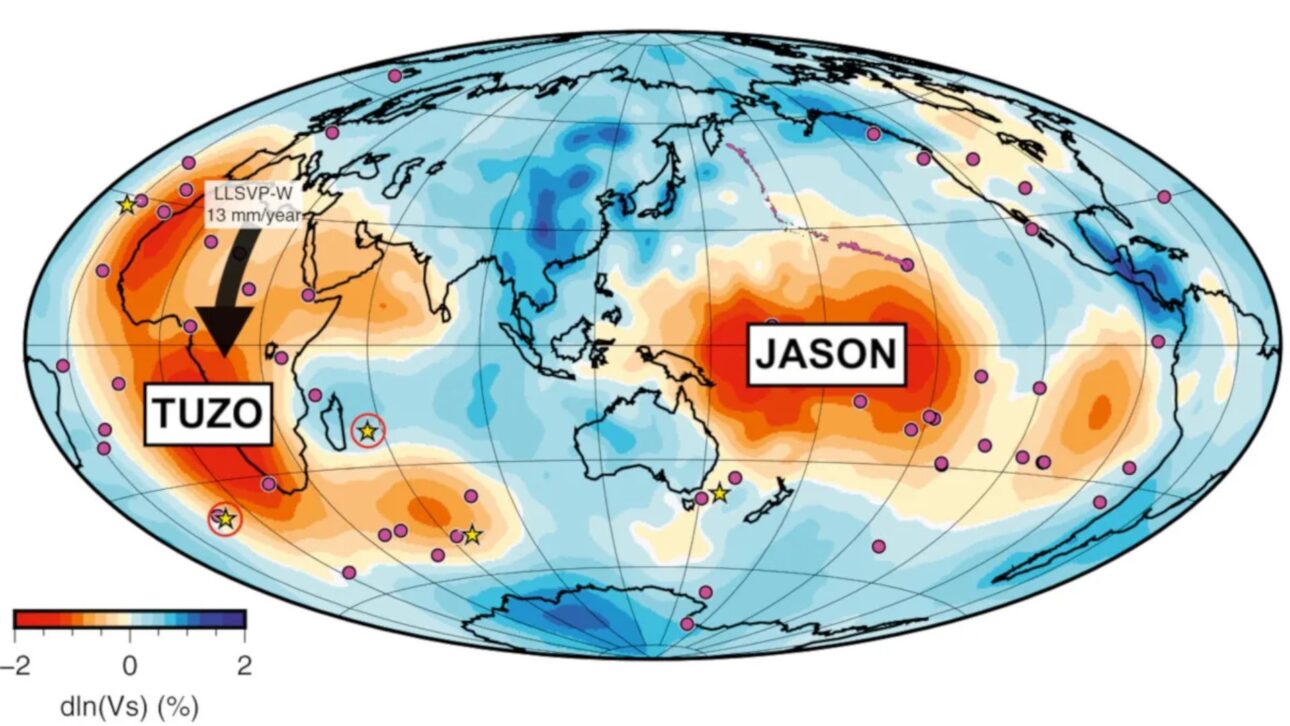
The mass located under Africa, named Tuzo, is about 800 kilometers high, which is approximately 90 times the height of Mount Everest, which is just under 9 kilometers, while the one under the Pacific, nicknamed Jason, has equally colossal dimensions.
-
Artesian Well Becomes Lifeline for Small Brazilian Farm: Drilling Reaches 60 Meters, Finds Marble, Navigates Rock Fissures, and Strikes Fresh Water

-
Street Cleaner in Brazil Finds Discarded Books That Helped His Wife Pass Civil Service Exam and Become Police Captain
-
July’s Night Sky to Feature Planetary Alignments, New Moon, Venus at Sunset, Buck Moon, and Two Meteor Showers

-
Fisherman Catches 18kg Catfish Near Brazil’s Itaipu Lake, Among Largest Recorded in Recent Years



Together, these two gigantic masses cover about a quarter of the area surrounding the Earth’s core.
It is no exaggeration to call them monstrous internal mountains: if they were on the surface, they would be impressively visible from space.
But they are buried at a depth that no human drilling has ever reached, and everything known about them has come indirectly.
Why they don’t dethrone Everest
This is a point that deserves clarification because there is a lot of confusing information circulating about it.
Even though they are gigantic, these structures do not take away Everest’s title as the highest mountain on Earth, and the reason is simple: Everest is the highest point above sea level, on the surface where we live, while the blobs are at the bottom, inside the planet, in completely different contexts.
Comparing the height of one with the other is like comparing the height of a building with the depth of a well; they are measurements of distinct worlds.
One is a mountain that can, in theory, be climbed; the other is a formation buried thousands of kilometers beneath our feet.
Therefore, Everest remains secure in its position as the highest peak in the world, without any threat from these deep masses.
How it is possible to see so deep
Since no one can dig that deep, the inevitable question arises.
Since no one can excavate to that depth, scientists use an ingenious technique called seismic tomography, similar to an X-ray of the planet, which relies on waves generated by earthquakes to reveal what exists inside the Earth, without needing to drill anything.
The process works like this: when an earthquake occurs, it generates waves that travel through the planet’s interior, and sensors spread around the world record these waves.
As they pass through different regions, the waves change speed, and in the blobs, they slow down, indicating that there is something different and hotter than the surrounding material.
By cross-referencing thousands of these data points, it is possible to map what is hidden, like using an echo to discover the shape of a never-seen cave.
The mystery of billions of years
What intrigues scientists the most is not the size, but the longevity of these masses.
Estimates suggest that these structures are at least 500 million years old, possibly reaching billions, perhaps existing since the formation of the Earth, which contradicts the old idea that the planet’s mantle would be well mixed, like a constantly moving soup, without stable regions for so long.
According to the study from the University of Utrecht, the blobs show that there are parts of the mantle that have remained relatively still and intact for an immense amount of time, without dissolving in this mixture.
This reveals that the Earth’s interior is much less uniform than previously imagined, with gigantic islands of material that resist movement around them for hundreds of millions, perhaps billions of years.
The hypothesis that connects everything with the Moon
This is where the most cinematic explanation for the origin of these masses comes in.
One of the hypotheses, supported by researchers like Qian Yuan, suggests that the blobs are remnants of the mantle of a planet called Theia, which collided with Earth about 4.5 billion years ago, in the same impact that would have ejected the debris that formed the Moon, with denser pieces of Theia sinking and becoming trapped inside our planet.
It is important to clarify, however, that this is just one of the hypotheses, and there is still no scientific consensus.
Another explanation, considered quite likely by many researchers, holds that the blobs are accumulations of ancient tectonic plates, that is, oceanic crust that sank into the mantle over hundreds of millions of years, forming a kind of plate graveyard.
Both ideas remain in debate, and new studies are still seeking to decipher the true origin of these formations.
Why this matters to us
It may seem like a topic too distant, but it has concrete relevance.
These gigantic masses can influence the way heat circulates between the Earth’s core and mantle, a process linked to the magnetic field that protects the planet from radiation coming from the Sun, in addition to feeding plumes of hot material associated with major volcanic eruptions throughout geological history.
In other words, understanding these hidden giants helps to comprehend how Earth works from within and how it remains habitable.
It serves as a powerful reminder: humanity has already sent probes billions of kilometers into space, but has barely scratched the surface of what lies beneath its own feet.
Some of the greatest mysteries of science may be much closer than we imagine, at the heart of our planet.
The two gigantic masses hidden in the Earth’s mantle are among the largest and most intriguing enigmas of modern geology, combining the colossal scale of their dimensions with the mystery of their origin and their billions of years in age.
Whether they are remnants of a planet that helped form the Moon or graveyards of ancient plates, these formations show that the interior of our world is much more complex and surprising than previously imagined.
More than a curiosity, they are a window to understanding the very history and functioning of the Earth.
And you, did you ever imagine that such colossal structures were hidden at the bottom of our planet? Which hypothesis fascinates you more, the remnants of planet Theia or the ancient sunken plates? Leave your comment, share your opinion, and help spread the article to those interested in science, geology, and the mysteries of the Earth.


