






 Portuguese
  Spanish


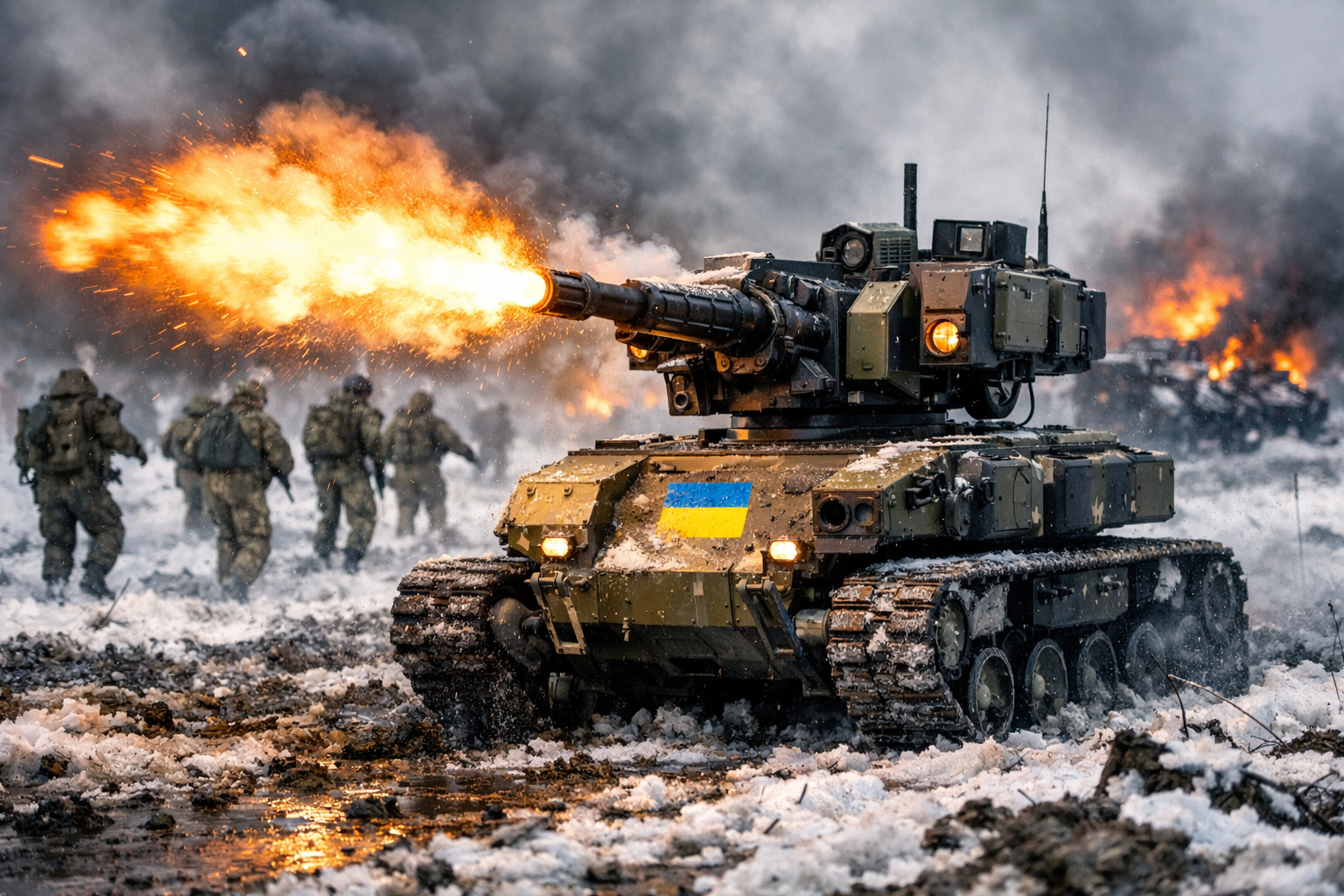


The Country Transformed Scrap, Consumer Drones, and Civilian Technology into Warfare Robotic Systems That Are Already Forcing Surrenders, Reducing Casualties to Zero, and Accelerating a Military Revolution Observed by the US, NATO, Russia, and China
Ukraine has stopped trying to compete with Russia in the traditional model of war, based on troop volume, armored vehicles, and heavy artillery. Instead, it has adopted a radical strategy: replace soldiers with machines whenever possible. The result is something that, until a few years ago, seemed like science fiction — a functional army of unmanned ground robots, already employed in real combat, with measurable results on the battlefield.
The information was disclosed by Business Insider, Current Time, Army Technology, and confirmed by direct accounts from Ukrainian commanders involved in military robotics programs, as well as combat images analyzed by independent experts. According to these sources, Ukraine’s ground robotic systems are already conducting attack, logistics, medical evacuation, mining, demining, reconnaissance, and even air defense missions, keeping human soldiers away from the so-called “death zone.”
This concept did not arise in sophisticated laboratories or billion-dollar contracts. On the contrary, it was built in garages, abandoned Soviet warehouses, and makeshift workshops, many of them located just a few kilometers from the front line.
-
NASA’s Plan to Dump ISS Debris in Ocean Sparks Environmental Concerns Among Scientists

-
14-Year-Old Invents Eco-Friendly Water Pump Using Recycled Materials to Aid Communities Without Water Access
-
Pigeons Trained to Detect Cancerous Changes in Medical Images Astonish Scientific Community

-
Plastic Waste from Beaches and Poor Communities in Kenya Transformed into School Desks, Replacing Wood in Classrooms and Turning Marine Litter into Durable Study Tables


From Total Absence of Robotics to the First 100% Automated Offensive in History

When the Russian invasion began in 2022, Ukraine practically had no capability in unmanned ground systems. Ukrainian forces had about 20 Bayraktar TB2 drones manufactured in Turkey and a few voluntary units operating adapted civilian quadcopters. Ground robots simply did not exist in the country’s military inventory.
However, as the conflict progressed, the need to innovate became existential. By mid-2022, volunteers began converting commercial DJI drones into improvised attack platforms. They were slow systems, vulnerable to Russian electronic warfare, but still capable of destroying tanks valued in the millions of dollars.
In 2023, a decisive turning point occurred: the FPV drone revolution. Ukraine produced approximately 600,000 FPV drones that year, direct descendants of racing drones, capable of flying between trees, ruins, and trenches with surgical precision. By 2024, production jumped to 15 million units. In 2025, the country is on track to produce 45 million FPV drones, equivalent to more than 12,000 per day.
While aerial drones dominated the headlines, something quieter was happening on the ground. Ukrainian brigades began experimenting with unmanned ground vehicles (UGVs) on a limited scale. Some tested wheeled platforms, while others used tracked ones. Everything was done through trial and error, directly on the battlefield.
The breaking point occurred in December 2024, when Ukrainian forces executed the first fully robotic documented attack in military history. No human soldier participated directly in the offensive. Aerial drones provided surveillance and guidance while ground robots advanced to destroy Russian positions.
In July 2025, the 3rd Assault Brigade went even further. Using only drones and ground robots, it conducted a complete operation that forced Russian troops to surrender, with zero Ukrainian casualties. For military analysts, this episode represented a concrete glimpse into the future of ground warfare.
War Workshops: Where Civilians and Soldiers Build Life-Saving Weapons

To understand how Ukraine reached this level in less than three years, it is necessary to visit places like the workshop run by Alexander, a platoon leader of the Antares Battalion, which operates from an old Soviet warehouse in the Donetsk region.
Alexander’s journey encapsulates the revolution of Ukrainian ground robots. His unit was built through personal connections, civilian fundraising, raffles, and voluntary donations. Only a small portion of the robots remains with his platoon; most are sent to brigades facing greater pressure on the front.
When manufacturers deliver new unmanned ground vehicles, they arrive with a critical problem: analog communication systems, easily neutralized by Russian interference. According to Alexander, these systems “disappear under interference like wet paper.”
Therefore, his team completely dismantles each robot. Structures are re-welded, wiring is redone, and systems are replaced with encrypted digital communications, military LTE networks, or Starlink terminals. Converting a single ground robot requires thousands of dollars, not including the cost of hardware and communication subscriptions.
Additionally, maintenance is constant. These machines suffer severe damage after practically every mission. Still, the investment pays off because each operational robot represents preserved Ukrainian lives.
The evolution of these systems occurred at an unprecedented speed. In early 2022, Ukraine’s robotic capability was practically zero. By the end of 2023, ground robots began appearing in combat images, delivering supplies or evacuating injured personnel under enemy fire. In December 2024, they became attack platforms. By 2025, they began to integrate into brigade-level operations.
The Ukrainian government itself announced plans to deploy at least 15,000 ground robots by the end of 2025, not as prototypes, but as fully operational systems.
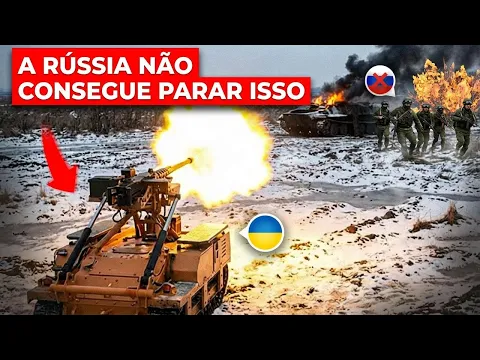

Robots That Attack, Save Lives, and Transform Logistics in the Death Zone
As Ukrainian ground robots evolved, their uses on the battlefield multiplied rapidly. According to Alexander and Iab Chanka, head of robotic systems for the 20 Wolves battalion, there are at least eight main applications for these platforms, one of which is considered the most promising: the use as mobile explosive weapons.
According to an interview with Business Insider, the logic is simple and brutally efficient. Ground robots can carry much more explosives than aerial drones. While the largest flying drones can carry about 10 kg of payload, the smaller ground robots used on the front can carry more than 22 kg, with larger models transporting even greater volumes.
Verified battlefield videos show these robots advancing directly into trenches, underground shelters, and basements before detonating. In one mission reported by Chanka, a robot carried 30 kg of explosives to a basement occupied by Russian infantry and detonated inside the structure, eliminating the position. This represents a level of precision that human soldiers cannot achieve without extreme risk and that aerial drones only attain after multiple attempts and losses.
However, kamikaze attacks represent only a fraction of the real impact of these systems. Daily logistics is where ground robots save lives the most. The so-called “death zone” in the Ukrainian conflict already extends more than 16 kilometers beyond the front line, driven by the massive proliferation of drones on both sides.
According to estimates from Army Technology, up to 80% of Russian casualties on the battlefield today are caused by drones. On the Ukrainian side, the scenario is similar: according to Colonel Constantin Humeniuk, chief surgeon of the medical forces, the most dangerous task today is not combat, but rather transporting supplies in and out of forward positions.
Ukraine has lost so many trucks on logistical missions that many units face a critical shortage of vehicles. It is at this point that ground robots have become essential. They deliver food, ammunition, and medical supplies to trenches without exposing soldiers to enemy fire. They operate primarily at night and at low speed — up to 16 km/h, considered ideal to avoid tipping over and reducing detection by Russian FPV drones.
Some robots carry communication relay masts, others modules for electronic warfare, remotely controlled towers, or even mortars for fire support. In all cases, the principle is the same: each robotic mission means one less soldier crossing the death zone.
Medical Evacuation, Mines, Reconnaissance, and Improvised Air Defense
Medical evacuation is both the most life-saving application and the most technically challenging. Robots with tracks can extract wounded soldiers from trenches without requiring the teams of up to eight soldiers normally needed for such operations.
However, the risk remains high. If the robot loses communication during the evacuation, the wounded soldier is exposed to Russian drones. Therefore, according to Chanka, this type of mission is used only as a last resort. Still, when it works, it prevents multiple additional casualties.
Additionally, ground robots have begun to be used for mine installation, an extremely dangerous task in an environment saturated with enemy drones. These machines can carry more mines than a soldier and deploy them without exposing human operators. The reverse process also occurs: robots advance ahead of troops to clear routes, absorbing blasts that would otherwise kill soldiers.
Another grim but necessary function is body collection. Rescuing the wounded or dead typically puts several soldiers at risk from the same factors that caused the initial casualty. Robots offer an imperfect but often safer alternative.
Reconnaissance completes the operational cycle. Although ground robots have limitations — simple obstacles like tall grass reduce their effectiveness —, when combined with aerial drones, they form coordinated unmanned systems, capable of operating semi-independently from human troops.
Reports from Current Time, with journalist Olexei Prodeivoda, show soldiers from the 5th Assault Brigade working in makeshift workshops near Donetsk. Using code names like Agronomist and Moped, they modify robots that move silently among the debris, firing at Russian positions without being detected from more than 30 meters away.
The improvements are continuous: new structures, repositioned cameras, thermal sensors for nighttime operations, towers for machine guns, and versions with tracks, more stable for medical evacuation. Everything is tested and reworked in real-time, just a few kilometers from combat — a direct contrast to the slow traditional military procurement process in the West.
Electronic Warfare, Technological Race, and Global Impact

Despite Ukrainian ingenuity, the challenges are growing. Russia has also entered the race. In August 2024, Russian state media showcased an armed ground robot with thermobaric launchers. Moscow arrived late, but has significant economic advantages: about 8% of Russia’s GDP is allocated to the military sector, compared to 35% of Ukrainian GDP, along with oil and gas revenues and potential technological support from China.
The biggest obstacle faced by Ukrainian robots is Russian electronic warfare, which has evolved drastically. Interference systems operate in 15-minute cycles, forcing operators to wait for windows of opportunity. To circumvent this, teams like Alexander’s replace analog systems with encrypted digital communications and Starlink terminals.
Another creative solution emerged: fiber-optic-controlled drones and robots, dragging cables up to 20 km, completely immune to electronic interference. The irony is evident — a physical solution from the 20th century to a technological problem of the 21st century. The risk, however, is the breaking or tangling of the cables, as well as curiosities like bird nests made from discarded fiber optics.
According to Chanka, losing communication turns the robot into “expensive scrap,” susceptible to capture and Russian reverse engineering. In response, there have been advances in autonomous AI, allowing robots to complete missions even after losing signal. The technology exists, but making it reliable in combat remains a challenge.
The impact of this revolution goes beyond Ukraine. In February 2024, Kyiv created the National Unmanned Systems Forces, an independent military branch. Russia did the same in December 2024. NATO established the JTEC in Poland to study Ukrainian innovations. The United States launched the Replicator initiative, with $1 billion allocated for drones, while cutting traditional programs.
American General Mark Milley estimated that, in 10 to 15 years, up to one third of the US armed forces could be composed of robotic systems. China has also reorganized its forces to incorporate integrated operations of drones and electronic warfare.
A New War Economy and Survival as the Driver of Innovation
The economic model of this revolution is disruptive. An F-35 costs around $80 million. A Patriot system costs hundreds of millions. In contrast, Ukrainian FPV drones cost between $400 and $500, capable of destroying million-dollar tanks. Ground robots cost a few thousand dollars and replace missions that would require dozens of soldiers and expensive vehicles.
When the defender needs to spend millions to neutralize attacks that cost only thousands, traditional military logic collapses. Reusable ground robots, capable of completing dozens of missions, represent a completely different value proposition.
In the end, however, this revolution is not abstract. As explained by a soldier from the 3rd Assault Brigade, identified as Kostas, the immediate goal is logistics and evacuation, followed by expansion to direct assault and fire support. “We need to reduce costs and simplify operations. This is the next frontier,” he stated.
The goal of deploying 15,000 ground robots by the end of 2025 may seem ambitious, but compared to the jump from zero to 45 million FPV drones per year in just three years, it is conservative. Everything indicates that tens of thousands of ground robots could operate on the Ukrainian front in the coming years.
Ukraine did not choose this path out of technological curiosity, but out of necessity. When survival is at stake, innovation ceases to be an option. Makeshift workshops, adapted civilian technology, and extreme creativity are changing the very nature of war — in real time — as the world watches and tries to catch up.


Enquanto isso o Brasil com esse jeito de neutralidade expôs ao mundo que somos um povo sem comando sem governo sem forças armadas e pagadores da corrupção sem fim.
“Uma guerra aumenta sempre a tecnologia mesmo sendo guerra santa, quente, morna ou fria…”
Líderes não pensam na perda humana, no caos que suas escolhas provocam…