Portuguese
  Spanish



Drones become ‘underground assembly line’ in Ukraine… for FPV drones… China’s restrictions… Pentagon’s attention.
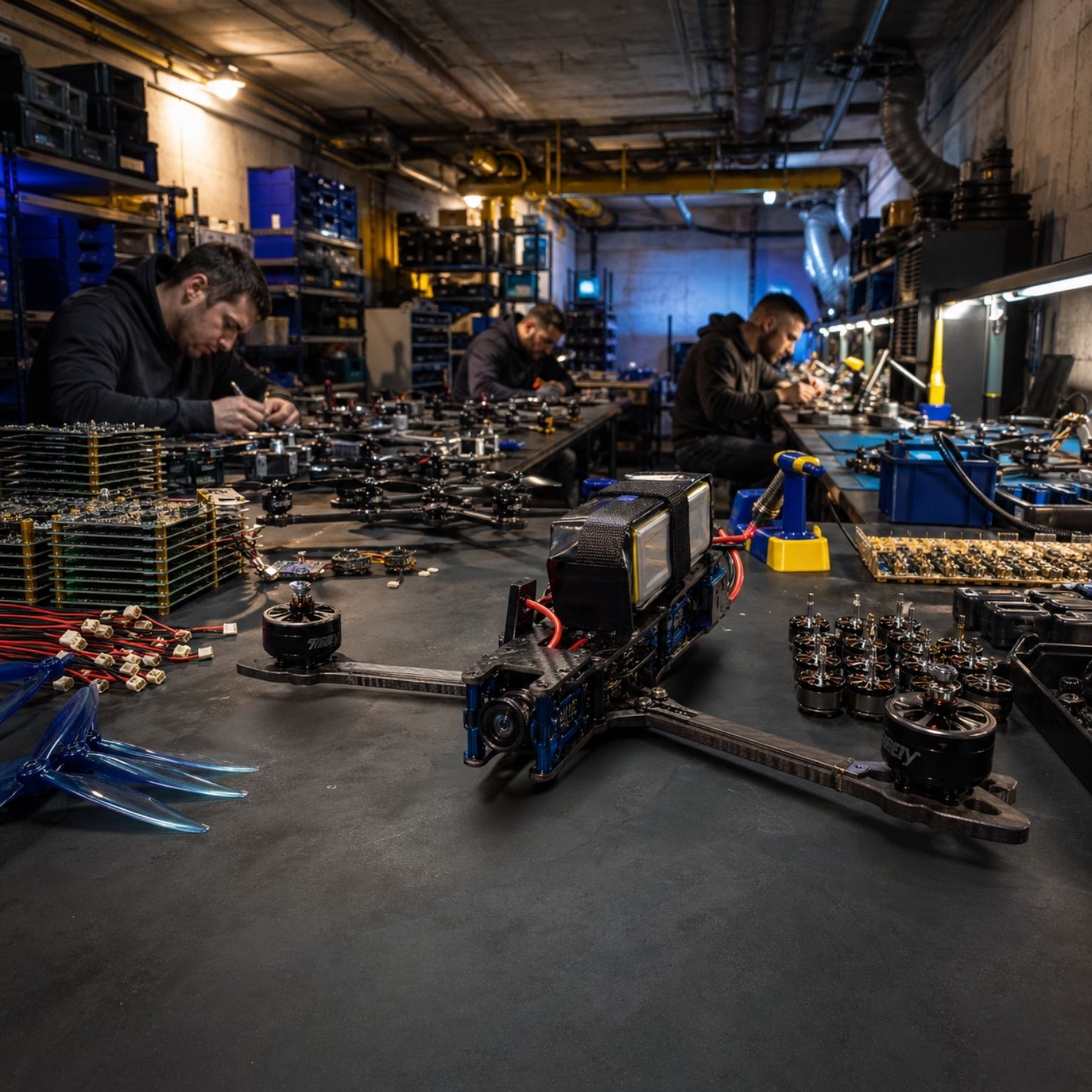
Hidden in discreet basements across Ukraine, a silent revolution is unfolding, with welding smoke, headlamps, and the local production of circuit boards that control the country’s army of FPV drones. What seems small, according to the report, has become a turning point: manufacturing critical components internally reduces a strategic vulnerability and maintains production capacity even when external supply chains falter.
The transformation also draws attention due to its pace. Ukraine reportedly produced only 3,000 to 5,000 drones in 2022, jumped to 2.2 million in 2024, and reached an estimated 4.5 million in 2025, a growth that the text describes as up to 900 times in three years. This progress, however, ran into a central risk: almost all components came from abroad, mainly from China.
What made FPV drones a game-changer in the war

The text describes a practical effect that is hard to ignore: an FPV drone costing around US$500 can destroy much more expensive equipment, such as tanks and air defense systems, changing rules of engagement and bringing lessons that armed forces worldwide cannot ignore.
-
Scientists Discover 125-Million-Year-Old “Pregnant Fossil” with Preserved Embryos and Microscopic Larvae Inside Mollusk in England

-
17-Year-Old Justin Bernstein Develops Bacteria to Produce Glass on Arctic Ice to Reflect Sunlight, Wins $50,000 U.S. Scholarship

-
The 19-Meter Rocket-Helicopter: A Private Industry Prototype That Challenged Space Race Logic

-
Brazilian Students Convert Seized Illegal TV Boxes into Linux-Powered Mini Computers for Schools and Social Projects Across São Paulo




More than the technology itself, what matters is the industrial logic. Cheap, fast, and maneuverable weapons have scaled up, and the race has become about quantity, cost, and constant replenishment. Therefore, interrupting the supply of drone components became a risk considered unacceptable.
The vulnerability that exposed China’s dependence and forced change
In the initial stages of the war, Ukrainian producers bought almost all parts used in the assembly of drones from Chinese companies. The text states that, in 2023, Kyiv bought 60% of DJI’s global production of Mavic quadcopters, citing the Mavic as an industry standard, both civil and military.
The dependence is amplified by market data mentioned in the source: the DJI drone family reportedly holds up to 90% of the commercial drone market in the United States and 80% of the global consumer drone market. Furthermore, even those attempting to manufacture drones outside of China still rely on the country for critical items, such as batteries.
The 2023 and 2024 restrictions that triggered national production
The breaking point appears in two moments. In June 2023, China began restricting the export of long-range drones weighing over 7 kg to both Ukraine and Russia, stating it wanted to prevent their use in the war. The text, however, says that the justification was not convincing, citing the continued supply to Russia of dual-use technologies, such as semiconductors and motors.
Then, on September 1, 2024, new restrictions affected China-made drones and components for both sides, including flight controllers, carbon frames, motors, radio modules, and navigation cameras. The immediate consequence was described as a major obstacle to Ukrainian production, at a time when, according to the material, there was no domestic component ecosystem.
Motor G and ASTA: how motors and parts begin to be produced “in-house”
Ukraine’s response involves local companies. The text cites the CEO of Motor G as responsible for leading the manufacturing of electric motors for drones in the country. Starting in 2023, the company took seven months to build a prototype and a year and a half to begin mass production. By the end of 2025, production was approaching 100,000 motors per month, mainly for FPV drones and slightly larger models.
Another front appears with ASTA, a manufacturer of fiber-optic cable-guided FPV drones. According to the report, it 3D prints cable spools and casings and uses adapted lathes to continuously guide the line. The founder states that Ukrainian production is advancing in thermal vision, controllers, motors, and frames, with expectations of also reaching cameras.
Circuit boards: the “brain” of drones that started being manufactured in basements
Among the most crucial components, the text highlights circuit boards, described as the central nervous system of the drone. They control flight stabilization, power distribution, and rapid data transmission, processing sensor information to adjust motors in real-time and maintain balance and responsiveness to pilot commands.
These boards used to come from China but are now produced in Ukraine, according to the material. The central idea is that mastering this type of component reduces the weakest point in the supply chain, especially when exports are restricted.
What production numbers show and why the world is watching
The industrial leap is the most impressive data point: from 3,000 to 5,000 drones in 2022 to 2.2 million in 2024 and 4.5 million in 2025. The text also mentions that, to compete, Ukraine needs to continuously replenish its fleet and that there are estimates of significant monthly losses, which reinforces why scale has become part of the survival strategy.
The material also suggests that import substitution has already occurred for several components, such as carbon structures and antennas, and that production has expanded to include flight controllers, speed regulators, radio modules, and video transmission systems, with cameras remaining the most sensitive exception.
Pentagon tests Ukrainian drones in 2026 and opens door for large orders


Local production was not limited to domestic efforts. According to the source, two Ukrainian companies were invited to a rigorous Pentagon test in February 2026, alongside 25 companies in total. After this stage, 11 finalists were selected, including one Ukrainian company, alongside manufacturers from the United States and the United Kingdom.
The text states that the Pentagon intends to award approximately US$150 million for about 30,000 unidirectional attack drones, with deliveries expected for military units in the next five months. The presented interpretation is that the selection demonstrates confidence in Ukrainian technology and reinforces the strategic importance of these systems in the international arena.
Why the dispute over drone components has become a national security issue
The material broadens the context and states that this vulnerability is not exclusive to Ukraine: almost all drone manufacturers face dependence on Chinese components. As an example, it cites that in October 2024, China halted the sale of drone batteries to Skydio, which reduced production and affected shipments to Ukraine.
The final message is that relying on a major adversary for critical components is seen as a strategic vulnerability, and the best way to mitigate risks is to nationalize as much of the supply as possible and diversify the rest, especially in a sector where scale determines the outcome.
In your view, will Ukraine be able to maintain the industrial drone race with less dependence on China, or will Chinese dominance in components still hinder this strategy in the long term?