






 Portuguese
  Spanish
  5 min of reading
  0 comments


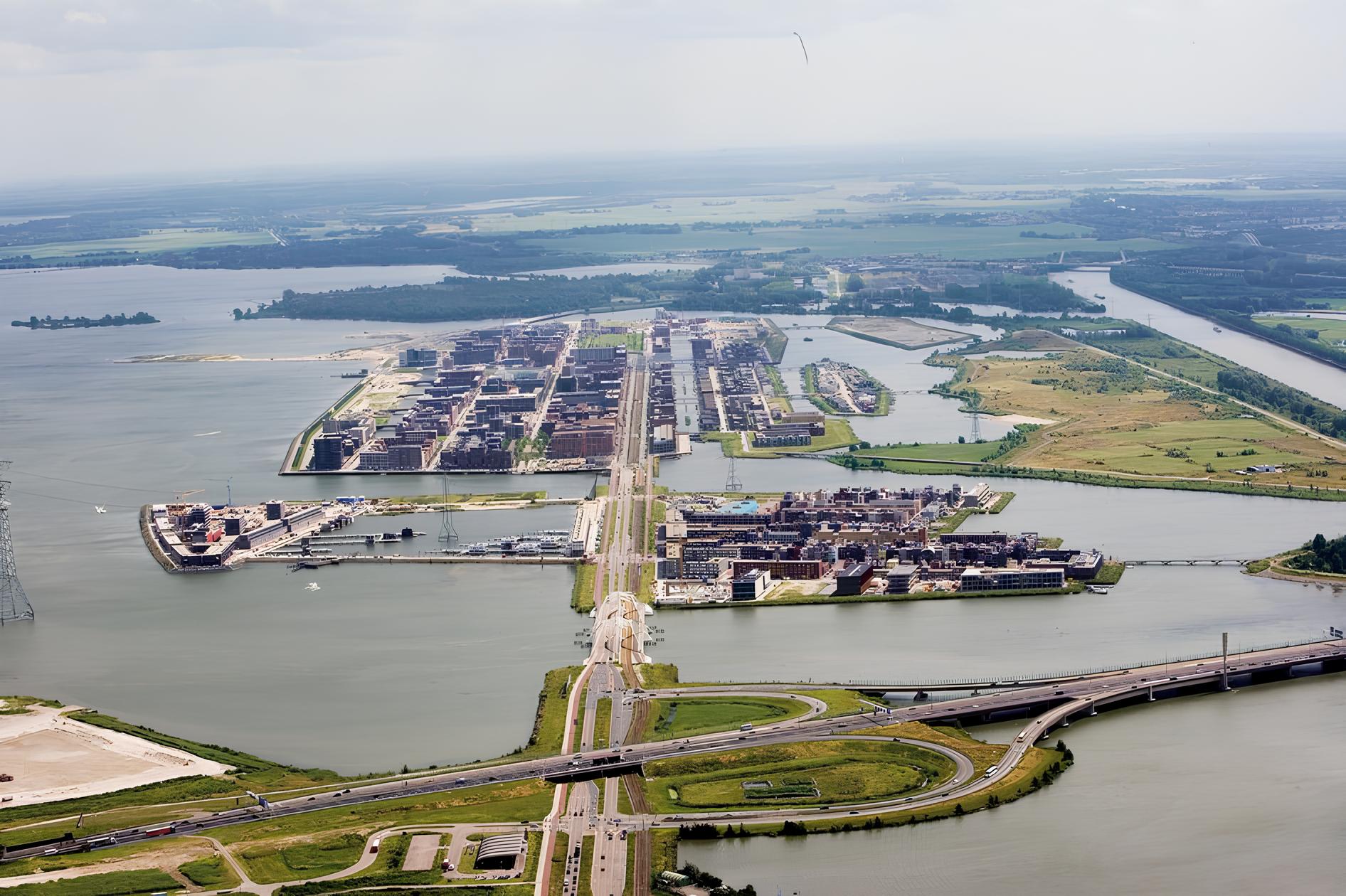
Built On Artificial Islands, Deep Piles, And Floating Platforms, The Neighborhood Of IJburg In Amsterdam Serves As A Complete City On The Water And Adapts To Extreme Tides Without Traditional Walls Or Dikes.
When talking about urban adaptation to rising waters, images of isolated floating houses, experimental projects, or ad-hoc solutions almost always arise. What is rarely mentioned is that, in Amsterdam, this logic has been applied on a real urban scale, with structural planning, deep foundations, complete infrastructure networks, and thousands of residents. The name of the project is IJburg, an entire neighborhood built on artificial islands and floating platforms, designed from the outset to coexist with extreme variations in water level.
IJburg is not a neighborhood “on the water” in the figurative sense. It was literally raised where there was once only lake, using a combination of hydraulic fill, piles driven into submerged soil, controlled floating platforms, and urban systems adapted to water instability. It is one of the most advanced applications of permanent floating urban engineering ever executed.
Where Is IJburg And Why Did It Need To Be Built On The Water
The IJburg neighborhood is located in the IJmeer Lake, east of Amsterdam’s historic center. The area is part of a complex water system, directly influenced by winds, level variations, internal tides, and artificial control by dikes and sluices.
-
Concrete reinforced with carrot and beetroot nanoplatelets defies the logic of traditional additives, outperforms graphene in initial tests, saves 40 kg of cement per cubic meter, and can build buildings and bridges stronger than current products.

-
Family builds natural pool without chlorine and without mud; the water is so crystal clear that fish and shrimp clean the bottom by themselves and guests get a free “fish manicure.”

-
Without cement, glue, or a single screw, interlocking wooden blocks promise to erect the skeleton of a house in about seven days, with one worker assembling one square meter of wall in less than a minute.
-
Suspended house made with reused containers, wood, and steel, does not have a television or Wi-Fi system and was designed to operate without air conditioning; the residence was built among trees in the interior of São Paulo and relies on natural ventilation and a green roof.




With the population growth of the Dutch capital and the severe limitation of land space, the government opted for a radical solution: creating new urban areas on the water, instead of expanding the city horizontally over unstable or protected land.
The decision was not only urbanistic but structural. The natural soil in the region is primarily composed of soft clays and lake sediments, unable to support conventional constructions without deep foundations. Instead of trying to “defeat” the soil, the IJburg project started from the premise of coexisting with it.
The Base Of The Neighborhood: Artificial Islands And Deep Piles
IJburg began to be constructed in the late 1990s, with the creation of six large artificial islands, formed by hydraulic fill. Millions of cubic meters of sand were dredged and deposited in the lake, creating initial platforms above water level.
However, these islands are not massive in the traditional sense. To ensure stability, nearly all buildings in the neighborhood are supported by deep piles, driven down to more resistant layers of the subsoil, tens of meters below the water surface.
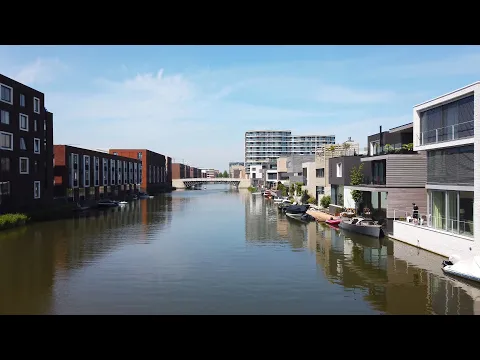
These piles serve not only a structural purpose. They also allow for differential movements of the soil, slow settlements, and load variations without compromising the buildings. In IJburg, the foundation is not an invisible detail: it is the central element of the engineering.
Floating Platforms: When The Neighborhood Rises With The Water
In addition to the fixed artificial islands, IJburg houses a significant area of floating housing and urban facilities, built on floating concrete platforms.
Unlike boats or rafts, these platforms are massive structures, with weight and volume carefully calculated to ensure stability, controlled buoyancy, and resistance to waves and winds.
These constructions are not simply loose. They are connected to the bottom of the lake by vertical guides and containment piles, which allow vertical movement but prevent lateral displacements. In practice, the buildings rise and fall with the water level, remaining aligned with access networks, walkways, and urban systems.
This system eliminates the risk of structural flooding and drastically reduces the need for walls, dikes, or constant artificial elevation of the land.
Complete Urban Infrastructure On The Water
What sets IJburg apart from experimental projects is the fact that all urban infrastructure operates normally, even in an aquatic environment. The neighborhood has:
– Potable water and sewage networks integrated with flexible systems
– Electricity and telecommunications with connections adaptable to movement
– Streets, bike paths, and public transport
– Schools, commerce, recreational areas, and public facilities
– Drainage systems designed to operate with level variation

From a construction point of view, this required specific solutions. Pipes use flexible joints. Electrical cables have calculated slack. Walkways and accesses are designed to accommodate vertical displacements without rupture.
None of this is improvised. Each element has been dimensioned for a city that is not rigidly anchored to the ground.
Why IJburg Is Considered A Model Of Future Engineering
IJburg is frequently cited in technical studies as a permanent urban laboratory for cities threatened by rising sea levels. Unlike monumental dikes or retaining walls, the neighborhood adopts an opposite philosophy: to accept water as part of the urban system.
From a construction perspective, this represents a profound shift. Instead of fighting against the physical environment with increasingly rigid structures, IJburg bets on structural flexibility, controlled buoyancy, and adaptive foundation.
This approach reduces long-term costs, minimizes emergency interventions, and increases the city’s resilience to extreme climate scenarios.
Real Scale: Not A Pilot Project, But A Functional Neighborhood
Today, IJburg houses tens of thousands of residents and continues to expand. It is not a set of conceptual houses or an academic experiment, but an integrated neighborhood within the urban fabric of Amsterdam, with real estate value and permanent occupancy.
Building on water has ceased to be an exception and has become a deliberate urban policy, backed by heavy engineering, technical standards, and decades of Dutch experience in dealing with the sea.
A Work That Redefines The Concept Of Urban Foundation
IJburg shows that foundation does not need to mean absolute rigidity. In a world where soils sink, seas rise, and extreme events become more frequent, civil construction begins to explore a new paradigm: structures that move, float, and adapt without collapsing.
The Dutch neighborhood does not draw attention for skyscrapers or record concrete volumes, but for something rarer: engineering applied on an urban scale to solve a problem that only tends to grow.
And perhaps that is exactly why IJburg is still underexplored outside technical circles — it does not seem like an exaggerated futuristic work. It simply works.





-

-

2 people reacted to this.