






 Portuguese
  Spanish
  3 min of reading
  0 comments


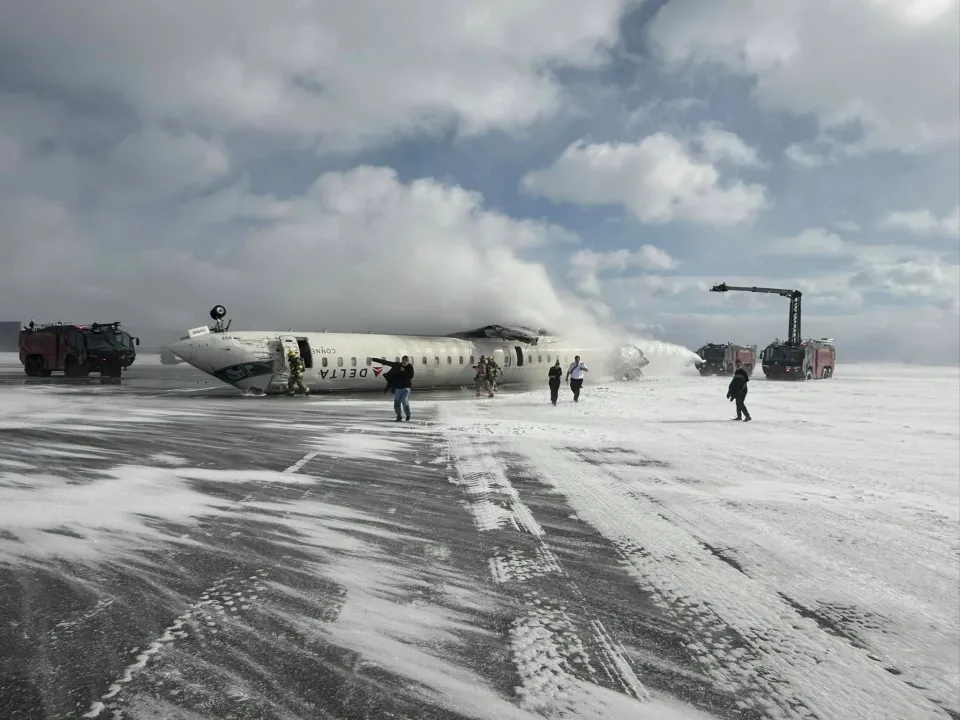
Plane Crash in Canada Revives Discussions on Aviation Safety, with Experts Explaining That the Spike in Aircraft Incidents in 2025 May Be the Result of a “Random Cluster”.
On February 17, the plane crash of Delta Air Lines in Toronto left the world in shock with the images. The aircraft, a Bombardier CRJ-900, exploded in a fireball upon landing at Pearson International Airport.
After skidding on the icy runway, the plane completely flipped over, creating an impressive scene. The incident joins a worrying sequence of air disasters in the United States, which have recently occurred in Arizona, Philadelphia, Alaska, and Washington DC.
In Brazil, according to Cenipa, 20 occurrences were recorded in just 38 days, of which five resulted in fatalities.
-
Mother acts quickly and saves 6 children from fire in studio apartment on the coast of SC before firefighters arrive

-
A 21-year-old woman was carried in the arms to the platform and launched from about 40 meters in a bungee jump in Limeira while a rope appeared coiled on the ground behind the group; witnesses were shouting something that no one around managed to stop in time.

-
Truck breaks down in the middle of the Sahara, leaving Nigerians without water on a remote route and turning the journey back home into a tragedy with nearly 50 dead

-
Unusual incident: a taxi driver stopped at a corner because of a red light and his car with CNG caught fire in Argentina




Accident in Canada
Stunning images show the plane skidding before coming to a stop. A video on social media reveals the moment rescuers evacuate passengers and crew amid the flames.
Despite the severity of the accident, all 80 occupants survived. Twenty-one people required medical attention, with two of them airlifted to trauma centers, but with no risk of death.
Cory Tkatch, from Peel Regional Paramedical Services, reported that rescuers suffered injuries such as back pain, head injuries, nausea, and vomiting caused by exposure to the aircraft fuel. Images from inside the plane show panicked passengers trying to escape.
John Nelson, one of the passengers, shared a video on Facebook shortly after the emergency landing. He reported that the plane had just landed and was upside down, with the fire department present at the scene.
According to him, most people seemed to be fine, everyone was leaving the aircraft, and there was a bit of smoke coming out.
Despite the scare, Deborah Flint, CEO and President of Pearson International Airport, assured travelers that the airport is safe. She explained that the location was operating with delays due to severe winter weather conditions.
In the days leading up to the accident, two snowstorms had accumulated over 50 centimeters in the area. Flint described the survival of everyone on board as “truly amazing” and emphasized that “air travel continues to be the safest mode of transport”.
Expert Discussed Aircraft Accidents in the USA and Canada
In an interview with The US Sun, Jason Matzus, an attorney and aviation expert, commented on the recent string of air accidents.
For him, it is a “random cluster”, a phenomenon that occurs when multiple accidents happen in a short period of time, creating the false perception of an increase in the frequency of these events.
Matzus highlighted that “air travel is statistically the safest way to travel” and that the recent wave of accidents does not indicate a systemic safety problem.
As passengers and authorities continue to process what occurred, the incident in Toronto will be remembered for the stunning scene of the overturned and burning plane, but, above all, for the remarkable fact that everyone on board survived.
With information from the-sun.





Be the first to react!