Portuguese
  Spanish


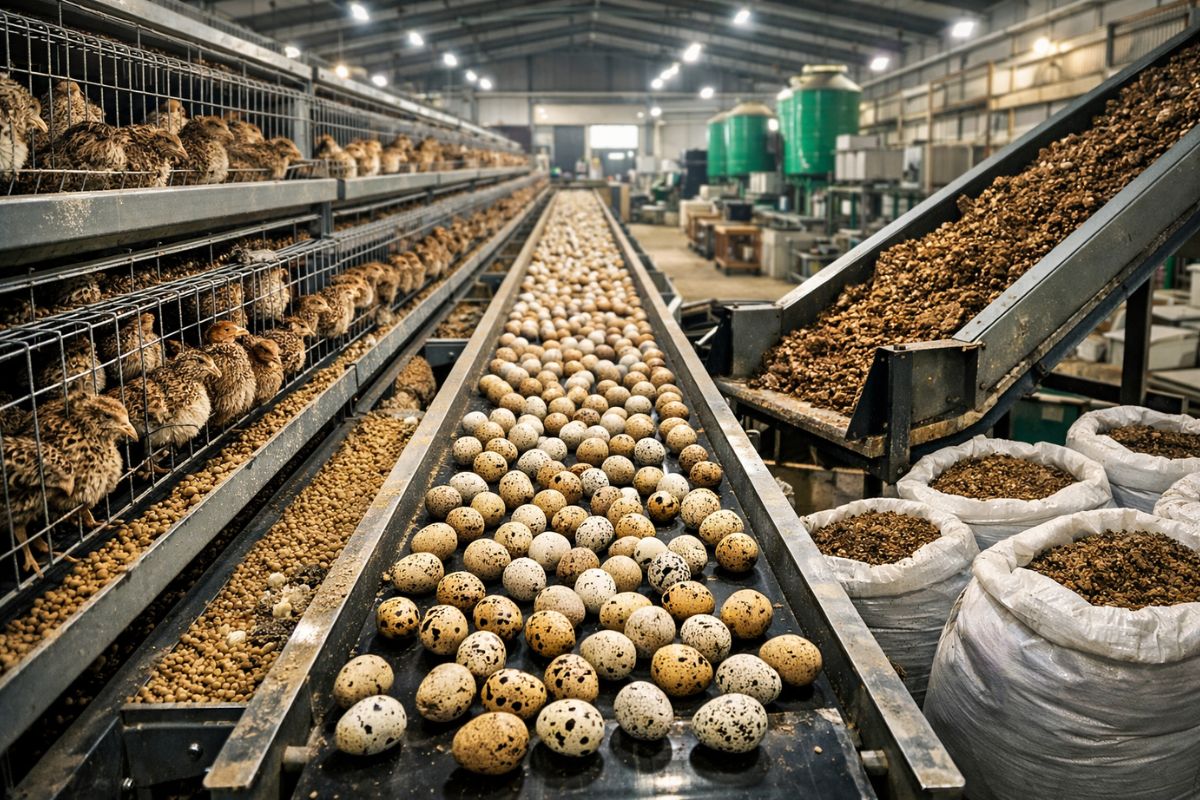


At Hamanako Farm, located in Kosai, Japan, one of the three producers of quail eggs in the province, quails live in an intensive system with fermented feed, automated collection, and total waste reuse. The result is a closed cycle: eggs move along the conveyor, manure becomes stable fertilizer, and the garden returns food to the process itself.
Quails rarely appear at the center of large discussions about food production, but the routine described at Hamanako Farm shows why this small animal can sustain a large operation. With 90 thousand quails and 70 thousand eggs per day, what seems simple turns into a chain of steps that must function without interruptions.
In practice, what stands out is not just the quantity, but the logic: food comes in, eggs go out, waste does not become the “end of the line.” Even the manure becomes an input, and the resulting fertilizer returns to the soil to produce fruits and vegetables, maintaining a cycle where animal production and plant cultivation connect in the same space.
When 90 Thousand Quails Become a System: Flow, Rhythm, and Control

In a farm of this size, quails cannot rely on improvisation. The scale imposes a standardized routine: feed distribution, monitoring of the flock, continuous collection, and separation of what goes for consumption from what needs treatment.
-
Cashew Becomes Billion-Dollar ‘Superfood’ in Ivory Coast: 1.6 Million Hectares of Monoculture Encroach on Forests as Families Trade Food for Nuts

-
In Rural Brazil, José Sirval Operates a Water-Powered Mill Grinding 125 Kilograms of Corn Daily Using His Great-Grandfather’s Century-Old Monjolo
-
From Market Stall to Agribusiness: Patagonian Fruit Grower Owns 550 Hectares and Processes 18 Million Kilos of Pears and Apples Annually, Exporting Directly to Brazil
-
At 93, Brazilian Farmer Restores 56 Hectares of Forest and Revives Spring in the Amazon, Installs First Climate Tower in the Region


The secret here is the flow, because any small bottleneck, repeated thousands of times, quickly becomes a big problem.
There is also a silent yet decisive component: biological predictability. Quails lay eggs frequently, and this requires that collection and handling be synchronized with the flock’s rhythm.
The conveyor, in this context, is not a detail of “comfort,” but an operational response to prevent accumulation, reduce direct handling, and maintain a clear path between laying, collection, and packaging.
From Egg to Adult: Hatching in 17 Days and Laying Around Six Weeks

The timeline of the flock begins before the daily production appears on the conveyor. Quail eggs take, on average, 17 days to hatch, with a reported variation between 16 and 19 days, depending on the environment. This variation seems small, but in continuous production it matters because it defines handling windows, batches, and the cadence of replenishment.

After hatching, growth to adulthood takes about 1 to 2 months, and females start laying eggs around six weeks.
In other words, it is a relatively quick cycle, which facilitates planning and rejuvenation of the flock, but it also demands consistency in the environment and management so that the transition between phases does not disorganize the operation.
The longevity appears as an interesting contrast: the average life span is 7 to 8 years, with cases of over 10 years, depending on the environment and the animal’s constitution. In the production routine, this helps to understand why welfare and environmental stability are not just abstract topics: they directly influence the regularity of the batch and the predictability of the system.
Feed Inspired by Japanese Cuisine and Fermentation: Why Include Lactic Acid Bacteria

Nutrition is treated as a central step, not merely as “energy replacement.” The feed at Hamanako Farm is described as inspired by Japanese cuisine and includes lactic acid bacteria to prevent diseases.
In practical terms, this points to a management strategy where the microbiota plays a protective role, helping to create an environment less favorable to the advance of unwanted microorganisms.
Fermentation, in this scenario, does not mean just “making the feed different.” It can alter the smell, stability, and microbial dynamics of the food, with an indirect impact on the birds’ digestive tract.
The care here is technical: when feeding becomes a process, it is not enough to produce feed; it is necessary to maintain standards, adequate storage, and controlled distribution so that the sanitary proposal makes sense over time.
And distribution also fits into the industrial logic: the produced feed is transported via pipelines and delivered to the quails continuously.
This reduces delivery variations and diminishes dependence on manual transport, which, in intensive systems, is often a sensitive point to maintain routine, reduce repetitive human errors, and preserve the consistency of the batch.
Conveyors, Collection, and Packaging: The Path of the Egg Without Losing Regularity

When the quails lay eggs, the eggs proceed to a conveyor belt that performs the collection. The main change here is transforming a dispersed event (multiple birds laying in different spots) into a single, organized flow.
The egg stops “staying” at the laying location and begins to circulate, which facilitates sorting, separating, and forwarding.

This type of collection also helps reduce unnecessary contact and shortens the time between laying and packaging.
On a large scale, this interval is essential for practical reasons: less time exposed to dust, less risk of minor breakage from repeated handling, and a more standardized routine for those who package and organize daily production.

The packaging stage, in itself, is the moment when the system shows its final objective: to transform biological production into a consistent product.
This is not about “beautifying” the egg, but about classifying, conditioning, and ensuring that what came from the conveyor reaches the consumer in an appropriate state. This is where efficiency and care meet, because haste without method leads to waste, and method without flow stalls the system.
Manure as Raw Material: Organic Fertilizer with Microorganisms to Prevent Decomposition

The same logic of utilization appears in the waste. The farm collects the manure from quails that ate fermented feed to produce fertilizer.
The description highlights a known issue with organic fertilizers: depending on the time and conditions, they can rot and harm the soil. The chosen response was to use the “power of microorganisms,” including lactic acid bacteria, to prevent decomposition.
This suggests a stabilization goal: instead of letting the material go through an uncontrolled rotting process, the farm seeks to direct microbial activity toward a more predictable outcome.
The central point is not to “disappear” the manure, but to transform it into something the soil can receive without negative effects associated with deterioration under inadequate conditions.
In practice, this type of strategy creates an important link: animal health and soil health become interconnected in the same circuit. If the fertilizer is stable, cultivation tends to have a more consistent basis for development. If cultivation works, the closed cycle becomes more viable as routine, not as an exception.
Fruits and Vegetables in the Same Cycle: Efficiency, Limits, and Why This Stands Out
The use of fertilizer to grow vegetables and fruits completes the proposed circle: animal production generates waste, waste becomes fertilizer, fertilizer nourishes cultivation. What would be “leftovers” becomes a bridge between the farm and the garden, and this integration helps to reduce reliance on disposal and create value from what would normally be a logistical problem.
At the same time, it is a model that demands continuous care. Closed cycles work when each step is stable: feed, flock health, collection, manure treatment, soil management. If one link fails, the impact spreads.
That is why the detail of lactic acid bacteria and decomposition prevention stands out as a key piece: the system does not depend only on “environmental goodwill,” but on microbiological control and disciplined routine.
In the end, the farm approaches a simple yet demanding idea: increase efficiency without pushing the cost outside the gate, in the form of disposal and impact.
The daily production continues (70 thousand eggs), the flock remains (90 thousand quails), and the garden receives an input that was born from the process itself.
From Kitchen to Daily Life: How This Type of Production Reaches the Plate
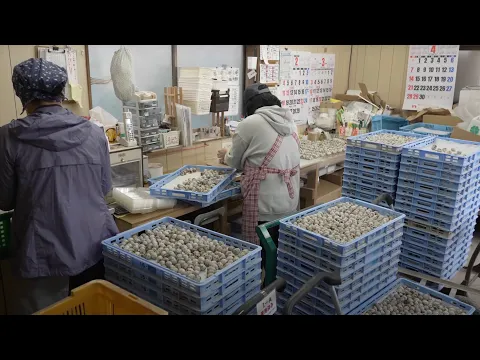

The described routine includes culinary preparations such as “egg over rice” and “fried egg,” reminding us that the entire chain ends in a common gesture: eating.
The point is that, behind a simple recipe, there is an infrastructure that starts with incubation, goes through nutrition and health, enters automated collection, and culminates in packaging and preparation.
When observing the entire process, quails cease to be just “birds that lay small eggs” and become part of a mechanism with clear technical decisions: fermentation in the feed, distribution through pipelines, collection via conveyor, manure reuse, and integration with cultivation. The real impact lies in the sum of the details, not in a single piece of equipment or isolated step.
And perhaps this is the great provocation of the case: it is not just about producing a lot, but about how to produce with less waste, more predictability, and reuse of what would normally be discarded.
In times when efficiency and sustainability are demanded simultaneously, this type of arrangement stands out precisely for trying to respond to both in the same design.
Hamanako Farm demonstrates a model where quails sustain high daily production, while the same operation attempts to reduce waste by transforming manure into fertilizer and returning nutrients to the soil, generating fruits and vegetables in the same circuit.
It is an example of integrated production, where biology, logistics, and microbiology work together to keep the flow functioning.
Would you feel more confident consuming food from a system that fully reuses waste, or does it still generate distrust? And if this closed cycle existed in your city, would you buy quail eggs more often, or would you prefer to keep your distance due to habit, taste, and food culture?