






 Portuguese
  Spanish


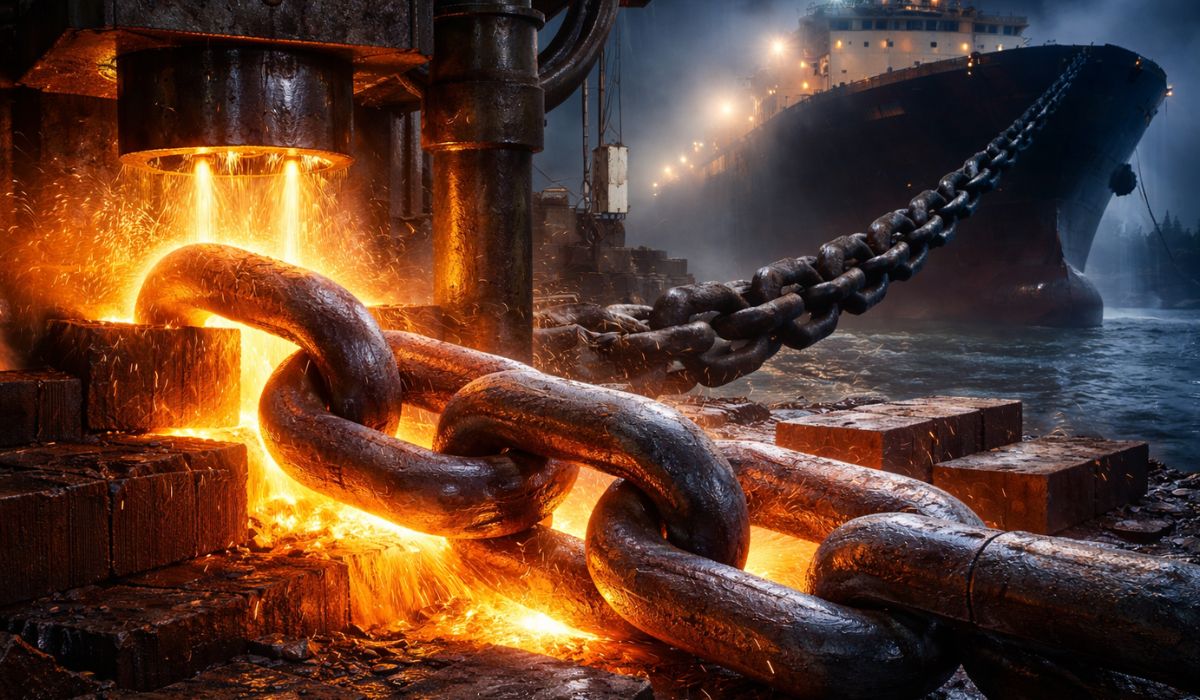

Before reaching the bottom of the sea, an anchor chain crosses intense heat, welding, internal reinforcement, and a sequence of tests that help explain how seemingly simple parts support colossal-scale structures.
At first glance, an anchor chain may seem like just a succession of steel links.
In the shipbuilding industry, however, these parts are part of a system designed to withstand high loads, resist the marine environment, and operate under rigorous technical requirements.
On large ships, the chains undergo heating, shaping, welding, heat treatment, and load testing before being released for use.
-
In the Caucasus Mountains, a Community Preserves a Language So Rare Few Outsiders Can Understand It

-
Slovakia’s Ice Cave Holds Over 110,000 m³ of Frozen Wonders, Boasts Walls Up to 27 Meters Thick, and Was Among the First Electrified Caves Globally

-
Street Cleaner Accidentally Receives $200,000 Transfer, Returns Unexpected Fortune to Rightful Owner
-
Australian Space Agency Investigates Six Mysterious Metal Spheres Found on Queensland Beach, Isolating Area Over Possible Space Debris Risk





The most common model in this type of application is the stud link, recognized by the central bar installed in each link.
This configuration is adopted to increase the strength of the assembly and reduce deformations when the chain works under stress.
In addition, the sections follow standardized measurements in the industry, such as the 27.5-meter sections used in different specifications of the shipbuilding industry.
According to the portal BMC News, the process involves heat of 1,600°F, 6,000-ton presses, chains capable of holding ships of 240,000 tons, and sections that can cost $7,500.
How Steel Becomes a Naval Chain Link
The manufacturing begins with bars or blocks of steel prepared for heating and shaping.
In industrial lines focused on the production of marine chains, the metal undergoes cutting, heating, and bending until it takes on the basic shape of the link.
After that, the ends are joined by electric arc welding, a method associated with the manufacturing of this type of chain.
The next step involves finishing and inspection.
Depending on the grade of the material and the intended application, the link also undergoes heat treatment to achieve the required mechanical properties.
Manufacturers and suppliers in the sector report that chains of grades U2 and U3, widely used in commercial transport, follow standardized requirements, with performance linked to metallurgical control and processing applied after shaping.

The piece in the middle of the link has a structural function
The bar installed in the center of each link is not decorative.
In the stud link pattern, it acts as structural reinforcement and helps reduce the risk of deformation under high load.
For this reason, this design is widely associated with mooring and anchoring chains of commercial ships.
In practice, the presence of this reinforcement helps the link maintain its geometry when the chain absorbs variations in stress caused by wind, currents, and hull movement.
This component is also included in inspection routines.
International technical recommendations also address the clearance of the studs and the verification procedures during inspections.
The set goes beyond the main links
The chain does not operate alone.
The system includes links, connectors, and other pieces responsible for joining the chain to the anchor and the structure of the ship.
These components follow specific manufacturing, inspection, and load testing requirements because any failure compromises the performance of the set.
The technical rules treat this system in an integrated manner.
This includes dimensional control, mechanical properties, and compatibility between the supplied items.
Therefore, manufacturing is not limited to the shape of the link or the heat applied to the steel.
Each piece needs to meet specific requirements to be accepted by shipyards, shipowners, and classification societies.
What tests try to prove before use
Before reaching the customer, the chain undergoes tests that vary according to diameter, material class, and applicable rules.
Among the procedures provided are load testing, rupture tests, and checks related to manufacturing quality.
The IACS tables, an entity that brings together the main classification societies in the sector, establish proof and rupture loads for stud link chains according to diameter and steel grade.
This shows that there is no single universal value for all manufactured chains.
The parameters change according to the specification of the piece.
The BMC News mentions a load application of 2,400 tons in tests.
This number, however, has been kept here as information attributed to the source portal, as the technical references consulted work with variable criteria depending on the diameter, class, and application of the chain.
Who releases this material for commercial use
The certification of these chains is not done directly by the International Maritime Organization.
The IMO establishes the international regulatory framework for navigation, while the technical verification of design, manufacturing, inspection, and acceptance of chains and accessories is usually the responsibility of classification societies and recognized organizations.
This group includes entities such as ABS, Bureau Veritas, DNV, Lloyd’s Register, ClassNK, and RINA.
They are the ones who apply harmonized requirements for ships and equipment.
In practice, this allows a chain produced in a specialized factory to be accepted in international operations, provided it meets the technical and documentary requirements.
The release, therefore, depends on a combination of controlled manufacturing, testing, traceability, and certification.
What the videos show and what the documents confirm
Factory videos help to scale the size of the process.
Intense heat, heavy machinery, steel in transformation, and large parts tend to capture the attention of those watching this type of content.
The channel Quantum Tech HD appears as a visual reference for this process.
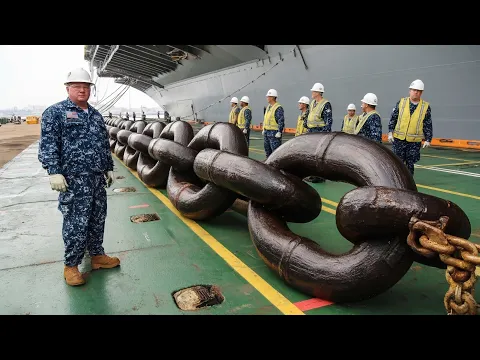

In material published by BMC News, there are also references to liquid asphalt coating based on water, the use of 6,000-ton presses, and a temperature of 1,600°F.
Even with a simple appearance, the anchor chain encompasses a sequence of industrial steps involving metallurgy, standardization, inspection, and certification.
At the end of the operation, what reaches the ship is not just a large steel piece, but a component designed to operate within strict technical margins in one of the most demanding routines of maritime transport.


