





 Portuguese
  English
  Spanish
  4 min of reading
  0 comments


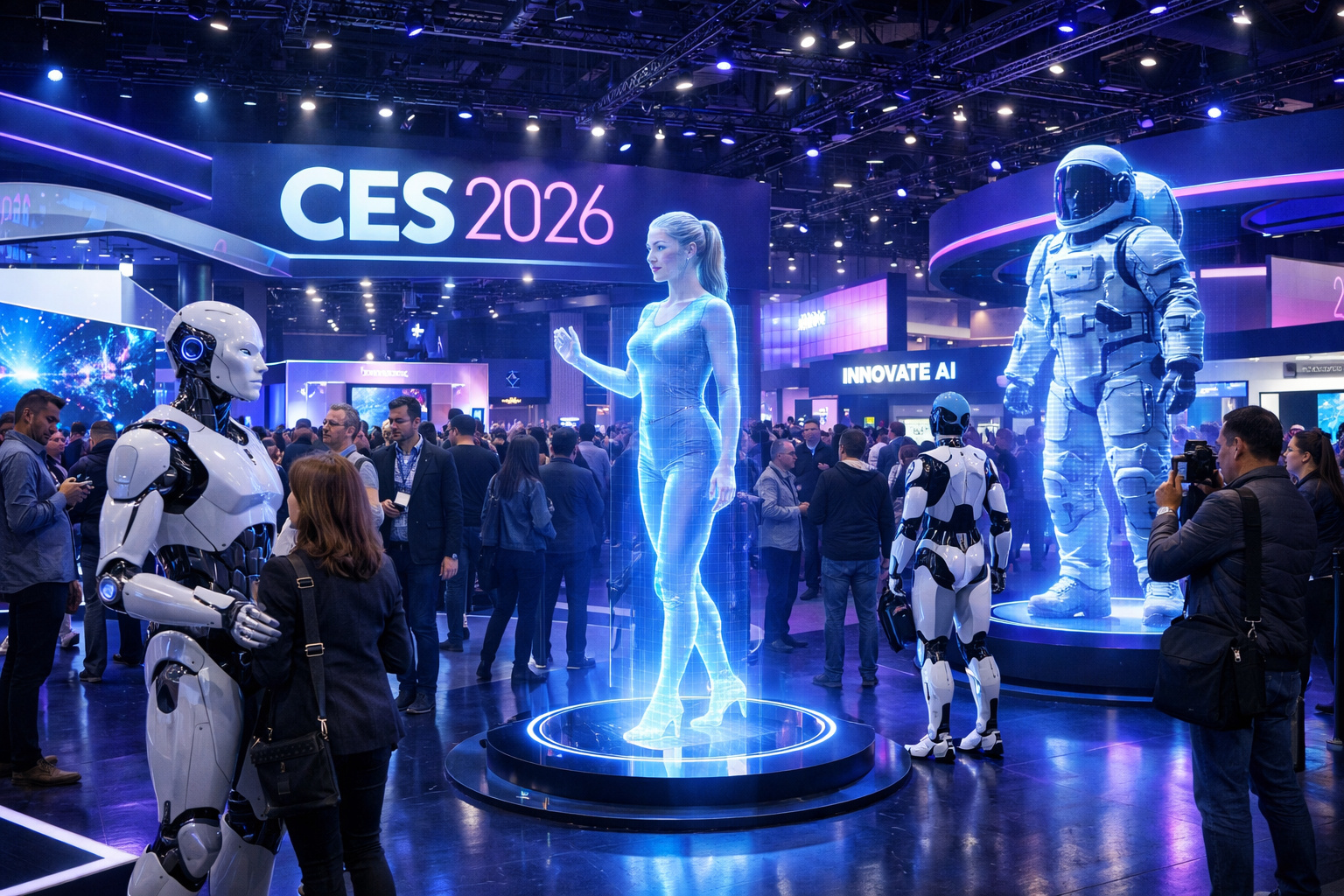
From Personal Robotics To Lifesize Holograms, CES 2026 Reveals Technologies That Seem Like Science Fiction But Are Already Ready To Impact Mobility, Work, Health, And The Daily Lives Of Millions Of People

The CES 2026, the largest technology exhibition in the world, takes place from January 6 to 9 in Las Vegas, once again transforming the city into the global center of innovation. The event occupies over 240,000 square meters of exhibition space, gathers around 4,000 companies from over 150 countries, and is expected to welcome more than 140,000 visitors throughout the week.
The information was disclosed by the Consumer Technology Association (CTA), the organizer of the fair, which highlights CES as the main stage for launching technologies that will shape the coming years. In 2026, the focus is primarily on artificial intelligence, robotics, digital health, advanced mobility, and solutions aimed at longevity and well-being.
In addition, one of the most contested spaces of the event is the CES Innovation Awards, an award that received over 3,600 entries this time — a historical record. Only projects with the highest scores in criteria such as functionality, engineering, and design receive the “Honoree” seal, while the winners of the Best of Innovation receive top recognition at the fair.
-
Tech giant to lay off 8,000 employees, sparking a global warning as it cuts 10% of its team to cut costs.

-
Far beyond the forest, the Amazon functions as a natural humidity generator where giant trees release vapor into the sky and form flying rivers that provide Brazil with rain.

-
Astronomers confirm detection of the interstellar comet Atlas crossing the solar system with unprecedented speed and trajectory

-
Scientists have discovered the switch that melanoma uses to create its own blood vessels and at the same time block the immune cells that should destroy it.


Next, discover 10 unusual inventions from CES 2026 that stand out for their practical impact and award potential.
Robotics, Mobility, And Personal Autonomy Gain Protagonism

First of all, CES 2026 makes it clear that robotics has left the laboratories and has fully entered everyday life. One of the most impressive examples is the Guidi from Glidance. It is a mobility assistance robot that uses artificial intelligence and LiDAR sensors, the same ones used in autonomous cars. Instead of screens or invasive voice commands, it physically guides the user intuitively in complex environments.
Similarly, the Aeon Robot emerges as a direct response to the global labor shortage. This humanoid robot has been developed to perform industrial, logistical, and service tasks, especially in a scenario of accelerated population aging.
Another highlight is the Yarbo Robot, a fully autonomous modular robot for outdoor terrain. It functions like a “smart tractor,” capable of switching modules to mow grass, remove snow, or leaves without constant supervision. For large properties, the proposal is to reduce costs and eliminate repetitive tasks.
Meanwhile, urban mobility gets a futuristic touch with the Moonwalkers X from Shift Robotics. These robotic shoes detect the user’s stride and naturally accelerate walking, allowing movement at running speed. It’s mechanical efficiency applied directly to the feet.
Communication, AI, And Digital Presence Enter Another Dimension
On the other hand, CES 2026 also points to a silent revolution in the way we communicate. The AI Hologram from Holoconnects promises to replace traditional video calls. The system projects people in lifesize, with depth and volume, creating an extremely realistic three-dimensional digital presence. In practice, it’s like “teleporting” someone to a meeting.
Meanwhile, the Skyted Silent Mask solves a modern and recurring problem: privacy during calls. Utilizing aerospace technology, the mask absorbs about 80% of human voice frequencies. This allows for confidential calls in airports or restaurants without bothering anyone — and without being overheard.
At the same time, social robotics also evolves with the Macroact from Maicat. Unlike conventional robots, it uses reinforcement learning to develop a personality based on interactions with the user. Additionally, it recognizes emotions and maps the home environment, creating a nearly biological companionship experience.
Wellness, Sleep, And Environmental Control Enter The Era Of Extreme Personalization
At the same time, CES 2026 shows that health and wellness have become technological priorities. The Mind-Linker from Amorepacific is a wearable device that reads brain waves and automatically adjusts light, scent, and sound in the environment to balance the user’s emotional state. In other words, the smart home reacts to the nervous system, not to voice commands.
In the same vein, the X-Sync from XSync directly affects the circadian rhythm. Sensors precisely adjust light and body temperature to reduce jet lag, improve deep sleep, and accelerate adaptation to new time zones. For frequent travelers, it is a modern biological survival tool.
Finally, the Lotus Ring bets on invisible luxury. The smart ring functions as a universal remote control via infrared and Bluetooth. With simple gestures, the user controls curtains, doors, and lighting, eliminating the smartphone as an intermediary. Control literally becomes fingertip.
Consumer Technology Moves Toward The Invisible — And The Essential
In summary, the unusual inventions from CES 2026 show a clear trend: technology is no longer ostentatious and becomes invisible, integrated, and functional. Artificial intelligence, advanced sensors, and robotics work behind the scenes to enhance autonomy, efficiency, and quality of life.
As emphasized by experts consulted throughout the fair, many of these solutions are not distant prototypes. On the contrary, several are already ready to hit the premium and corporate market as early as 2026.
Which of these innovations from CES 2026 do you really envision using in your daily life, and why?





Be the first to react!