






 Portuguese
  Spanish


The Amazon rainforest moves expressive volumes of water vapor and influences rainfall in different regions of South America, in an invisible process that connects trees, atmosphere, agriculture, and urban supply.
The Amazon participates in one of the main water circulation dynamics in South America.
The forest receives humidity from the Atlantic Ocean, returns part of this water to the atmosphere through evapotranspiration, and contributes to the formation of vapor currents known as flying rivers, which influence the rainfall regime in the Central-West, Southeast, and South of Brazil, as well as areas in neighboring countries.
This atmospheric transport of humidity helps explain the relationship between the forest and distant regions, where urban areas, reservoirs, hydroelectric plants, and agricultural zones are concentrated.
-
A fossil kept for years in a small museum in Montreal concealed 450-million-year-old soft tissue, a discovery that has only happened once before in history.

-
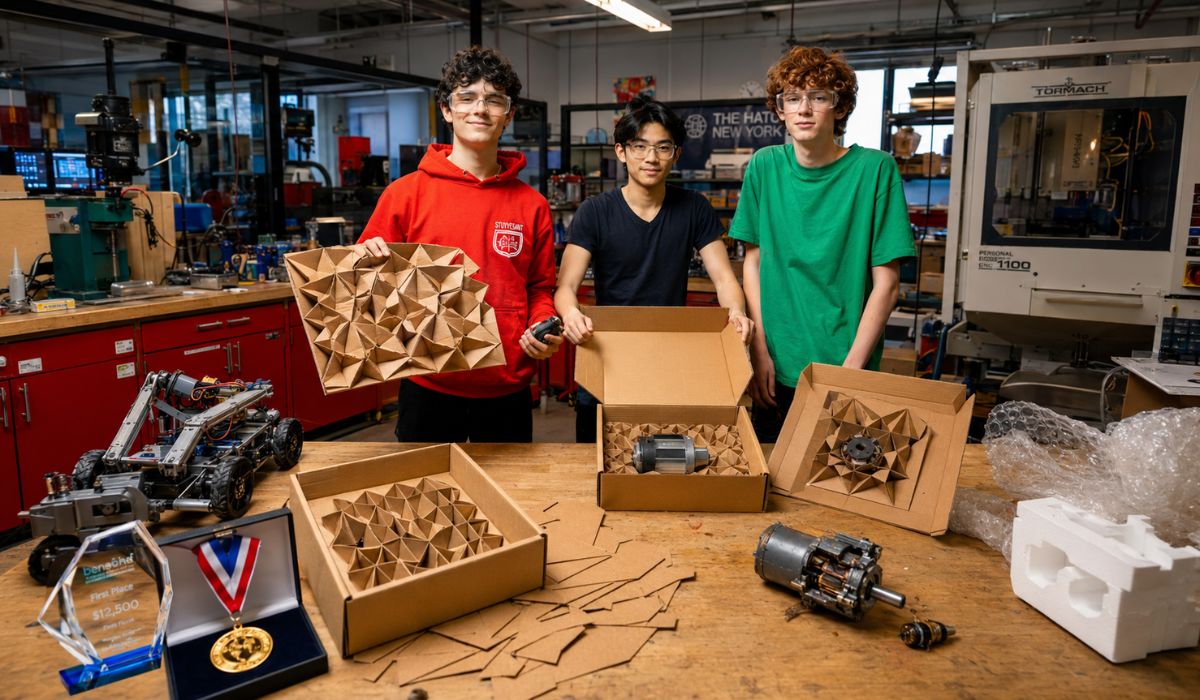
Three teenagers transform cut cardboard into Japanese origami-style packaging that promises to retire styrofoam and bubble wrap, win a $12,500 prize, and target giants like Amazon, FedEx, and Home Depot after a robot motor arrived broken.

-
The large jar blender has a rival: Oster Ultra Power bets on 1,000 W, six stainless steel blades, and two portable cups with leak-proof lids.

-
Tesla injected an additional $250 million into the German factory, doubled the battery cell target, and opened its own production line for startups.



According to researchers who study the Amazonian climate, vegetation does not only act as a rain receiver: it also participates in the redistribution of water that circulates through the continent.
The process begins in the Atlantic.
Trade winds carry humid air towards the interior of South America.
Upon reaching the Amazon, this humidity feeds rainfall over the forest, but part of the water returns to the air after being absorbed by the roots and released by the leaves.
As a result, the forest itself recycles a portion of the rain it receives and maintains a constant flow of vapor in the atmosphere.
How Amazonian trees bring water to the atmosphere
The comparison between trees and natural pumps is used by experts to describe a physical and biological process.
Roots capture water in the soil, the trunk conducts this liquid to the branches, and leaves release vapor through small pores called stomata.
In large trees, this daily flow can reach high volumes.
Researchers cited by the National Institute for Space Research point out that an Amazonian tree with a canopy of about 20 meters can release approximately one thousand liters of water per day into the atmosphere.
Researcher Antonio Donato Nobre has described this mechanism as a “reverse irrigator,” an expression used to explain the forest’s function as a vapor emitter.
When this effect is observed on a regional scale, the volume takes on another dimension.
Estimates released by researchers indicate that the Amazon can move, through evapotranspiration, about 20 trillion liters of water per day.
This number is used in studies and scientific dissemination materials to gauge the importance of the forest in the South American hydrological cycle.
Evapotranspiration combines two processes.
One of them is the evaporation of water present in the soil, rivers, and on the surface of vegetation.
The other is the transpiration of plants, which release vapor after absorbing water through their roots.
In the Amazon, the density of the forest and the depth of the roots increase the vegetation’s participation in this cycle.

The path of flying rivers through Brazil
Flying rivers are not rivers in the literal sense.
They have no banks, riverbed, or visible current.
The expression describes air masses laden with water vapor, transported by winds over large expanses of the atmosphere.
In scientific literature, these currents also appear associated with so-called low-level jets.
After gaining humidity over the Amazon, part of this air moves westward.
The Andes Mountains function as a natural barrier and prevent a large quantity of this mass from freely advancing towards the Pacific.
With the blockage, the flow is diverted to the south and southeast, reaching areas of Bolivia, Paraguay, Argentina, Uruguay, and Brazil.
This displacement contributes to the formation of rainfall in regions that depend on water regularity for supply, agriculture, and energy generation.
Amazonian humidity is not solely responsible for precipitation in these areas, but it is part of a set of atmospheric factors that influence the rain regime in part of the continent.
The connection between the forest and rain in other regions does not occur in isolation.
It depends on temperature, wind circulation, oceanic humidity, the presence of the Andes, and the local conditions of each area.
Even so, research on the topic indicates that Amazonian vegetation plays a relevant role in maintaining this vapor transport.
Amazonian biotic pump and the rain cycle
The term biotic pump is associated with a scientific hypothesis proposed by researchers investigating the relationship between forests, evaporation, condensation, and atmospheric circulation.
Simply put, this idea suggests that dense forests can contribute to attracting moisture from the ocean by maintaining high rates of evapotranspiration and favoring pressure differences in the atmosphere.
In the case of the Amazon, the concept is used to explain how vegetation can influence moisture circulation on a continental scale.
The transpiration of trees releases vapor, this vapor participates in cloud formation, and condensation alters atmospheric conditions related to pressure and air movement.
Experts emphasize, however, that there is a difference between the documented role of the forest in the water cycle and the biotic pump theory as a broader explanation of atmospheric circulation.
The Amazon’s influence on evapotranspiration, humidity, and rainfall is recognized in climate studies, while some aspects of the biotic pump hypothesis remain debated in the scientific community.
This distinction is important to avoid conclusions beyond what studies allow us to affirm.
The Amazon rainforest participates in vapor transport and moisture recycling, but the exact intensity of each mechanism can vary according to the region analyzed, the season, and the climatic conditions of each period.
Amazon rainforest also participates in cloud formation
In addition to releasing vapor, Amazonian vegetation emits volatile organic compounds.
In the atmosphere, these substances can contribute to the formation of particles that act as condensation nuclei.
These nuclei serve as microscopic points where vapor clusters to form cloud droplets.
This process does not replace other meteorological factors but integrates the dynamics of cloud formation and precipitation.
The presence of natural particles, combined with available humidity and adequate temperature and pressure conditions, favors vapor condensation in certain situations.
The forest, therefore, participates in physical, chemical, and biological processes that connect soil, plants, and atmosphere.
Water absorbed by the roots reaches the leaves, passes into the air, circulates with the winds, and can return to the surface as rain in another area of the continent.
The maintenance of this system depends on vegetation cover.
When there is deforestation, fires, or forest fragmentation, the area capable of absorbing water from the soil and releasing it back into the atmosphere decreases.
Researchers point out that this change can reduce moisture recycling and alter the regularity of rainfall at different scales.


Deforestation and impacts on moisture transport
The removal of trees modifies the water cycle.
Without canopy, deep roots, and protected soil, part of the rain tends to run off the surface more quickly.
Infiltration may decrease, soil moisture retention is affected, and the return of vapor to the atmosphere occurs with less intensity.
With less vapor available, the air can become drier during certain periods.
This alteration favors conditions associated with more severe droughts and increases the vegetation’s vulnerability to fire.
Fires, in turn, degrade the forest and further reduce the capacity to maintain the humidity cycle.
According to climate and conservation specialists, the loss of vegetation cover also affects areas outside the Amazon.
The impact is not limited to the deforested area, because atmospheric circulation transports humidity over long distances.
Therefore, changes in the forest can interfere with water systems, crops, and reservoirs located hundreds or thousands of kilometers away.
The relationship between the Amazon and rainfall in other regions has come to be treated by scientists as a topic linked to water security, food production, and energy planning.
Instead of being analyzed merely as an isolated biome, the forest appears in studies as part of a natural infrastructure that influences the climatic functioning of the continent.
This approach does not eliminate the need to consider other climate elements, such as air masses, cold fronts, ocean temperatures, and natural variability.
It reinforces, however, that Amazonian vegetation forms a network of processes that help maintain water circulation in different regions of South America.
When observing clouds over the Central-West, Southeast, or South of Brazil, it is possible that part of that humidity previously passed through the Amazon rainforest.


