Portuguese
  Spanish


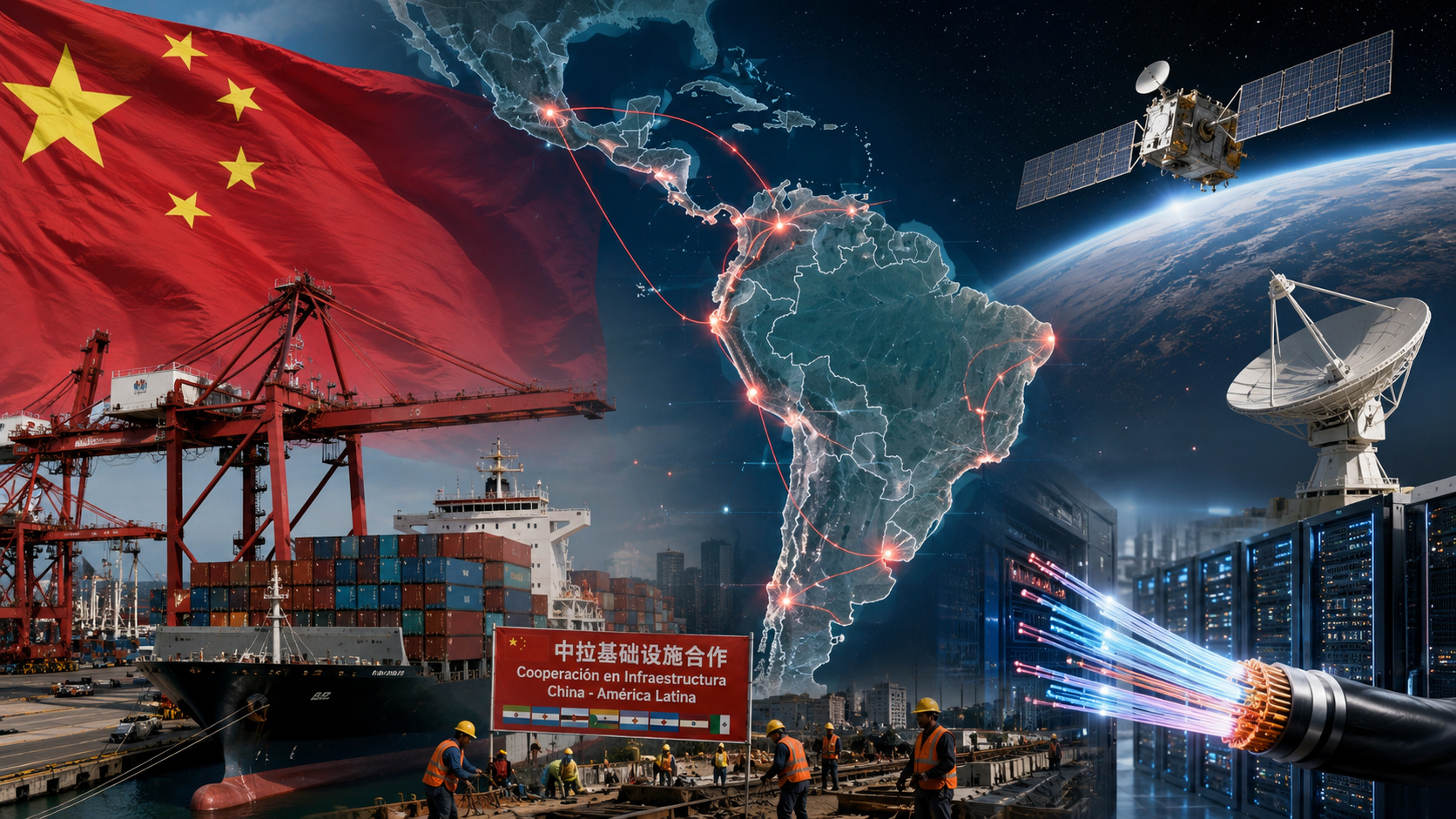

US Report Accuses China of Expanding Strategic Presence in Latin America with Ports, Satellites, Cables, and Space Infrastructure.
The dispute between the United States and China has advanced to a quieter layer of geopolitics: Latin American ports, submarine cables, ground stations, radio telescopes, and scientific infrastructure installed in strategic areas of the continent. On February 26, 2026, the Select Committee on the Chinese Communist Party stated that China maintains at least 11 space facilities linked to the country in Latin America, spread across Argentina, Venezuela, Bolivia, Chile, and Brazil, with possible dual-use for orbital tracking, telecommunications, and intelligence gathering. The accusation heightened the alert in Washington because it places officially civilian structures at the center of the dispute over satellites, data, submarine cables, and critical infrastructure near American territory.
According to the report, these facilities include ground stations, radio telescopes, and satellite laser tracking points, creating a network that, in the committee’s assessment, could strengthen China’s strategic capability in the Western Hemisphere.
US Report States China Built a Silent Strategic Network in Latin America
The document released by the American committee states that China has significantly expanded its technological and space presence in Latin America in recent years.
-
European Parliament Approves Digital Euro, Aiming to Challenge Visa and Mastercard’s Dominance and Transform Payments Across Europe by 2029

-
Israel finds Hezbollah militarized tunnel over 200 meters long under village, with 4 missile launch shafts, 12 chambers, anti-tank missiles, drones, and weapons depots at a depth of 25 meters.

-
Ukraine launches largest drone attack on Moscow since 2022, Russia claims to have intercepted nearly 200 aircraft near the capital, Kapotnya refinery targeted again, and offensive reignites alert about war reaching the Russian energy heart just a few kilometers from the Kremlin.

-
Truck drivers, freight, and fines from 2022 take center stage in politics: Chamber approves MP with amnesty, mandatory tracking by CIOT, million-dollar penalties, and new minimum wage for those who spend more than 24 hours on the road.



According to the report, Beijing has reportedly developed or supported at least 11 space and scientific facilities in the region, including ground stations, radio telescopes, laser tracking centers, and satellite-related infrastructure.


The authors of the document argue that some of these structures could offer strategic capabilities beyond their officially declared scientific functions.
Chinese Space Station in Argentina Becomes a Major Focus of US Concern
One of the most cited cases involves the Chinese station installed in Neuquén, in Argentine Patagonia. The facility has an antenna of approximately 35 meters officially dedicated to space missions and communication with interplanetary probes.
The infrastructure is operated by the Chinese space agency linked to the deep space exploration program.
American officials state that structures of this type can have dual-use, a concept used to define technologies capable of operating simultaneously in civilian and strategic functions.
China Denies Accusations and States Projects Have Exclusively Scientific Purpose
The Chinese government rejects the American accusations and states that the projects have a legitimate civilian and scientific character.
Beijing argues that the facilities are part of the international expansion of space, astronomical, and technological cooperation with Latin American countries.
China also accuses Washington of attempting to politicize scientific initiatives and hinder international partnerships involving advanced technology.
Atacama Desert Becomes One of the Most Sensitive Points in the Global Tech Dispute
Northern Chile has become one of the planet’s most strategic areas for astronomy and space observation due to its extremely clear sky and low atmospheric humidity.
In recent years, Chinese projects involving telescopes and observatories have come under increasing scrutiny from the United States.
In 2026, a Chinese observatory planned for the Atacama ended up under review by the Chilean government following increased diplomatic pressure and questions about the technological scope of the infrastructure.
Submarine Cables Become Central to Washington-Beijing Dispute
The tension doesn’t just involve telescopes and satellites. Submarine internet cables have also taken on a strategic position in the global technological competition.
These structures carry a large part of the world’s financial, military, and commercial data traffic. Controlling or influencing digital routes has come to be seen as a matter of national security.
For this reason, connectivity projects involving China, Latin America, and the Pacific Ocean have begun to receive much greater attention from Western governments.
Chile wants to become a digital hub between South America and Asia via the Pacific
One of the most strategic projects underway involves the new trans-Pacific submarine cable between Chile and Australia.

According to Reuters, the system will be approximately 14,800 km long and aims to directly connect South America to Asia across the Pacific, strengthening Chile as a regional digital platform.
Although the project is not Chinese, it shows how South American digital infrastructure has definitively entered the center of contemporary geopolitical disputes.
Latin American ports have also begun to be analyzed as strategic infrastructure
In addition to space and telecommunications, ports operated or financed by Chinese companies in Latin America have begun to generate increasing concern in Washington.
American authorities fear that officially commercial structures could expand Chinese geopolitical influence over strategic maritime routes, mineral exports, and regional logistics chains.

The discussion gained intensity mainly after the expansion of Chinese investments in global port infrastructure.
Satellites and telecommunications have become critical areas of the new global dispute
The current technological race goes far beyond rockets and space exploration. Navigation systems, telecommunications, satellite internet, and orbital observation have gained gigantic economic and military importance.
Whoever controls space infrastructure possesses strategic advantages in communication, intelligence, climate monitoring, and security.
This explains why seemingly scientific installations have come to be observed with such care by the great powers.
Current dispute mixes science, diplomacy, infrastructure, and global influence
The most complex aspect of the situation is precisely the difficulty of completely separating scientific projects from potential strategic applications.
Telescopes, antennas, satellites, and ground stations have legitimate civilian functions, but some technologies can also offer military or intelligence capabilities depending on operational use.
This transforms practically any major technological infrastructure into a potential object of geopolitical dispute.
Technological cold war silently advances over observatories, deserts, and submarine cables
Unlike traditional military disputes, the new global competition unfolds much less visibly. Instead of tanks or missiles, the focus now involves data, telecommunications, Earth orbit, and scientific infrastructure.
Astronomical observatories, space centers, and submarine cables have come to occupy a role similar to that of strategic military bases of the past. The skies of Latin America, the Andean deserts, and the bottom of the Pacific Ocean have directly entered this new logic of global technological competition.
The case makes it clear how science, technology, and geopolitics are increasingly intertwined. Structures once seen only as academic projects are now also analyzed from a strategic and international security perspective.
While Beijing expands its global technological presence, Washington tries to prevent areas considered critical from escaping its historical regional influence.
Ultimately, telescopes, submarine cables, space antennas, and scientific stations reveal that the new geopolitical race of the 21st century may be happening much more through the invisible infrastructure of information and space than through traditional military confrontations.