






 Portuguese
  Spanish



An Extreme Ecosystem That Put Antarctica on the Map of Hydrothermal Regions and Changed the Way to Understand Life in the Depths
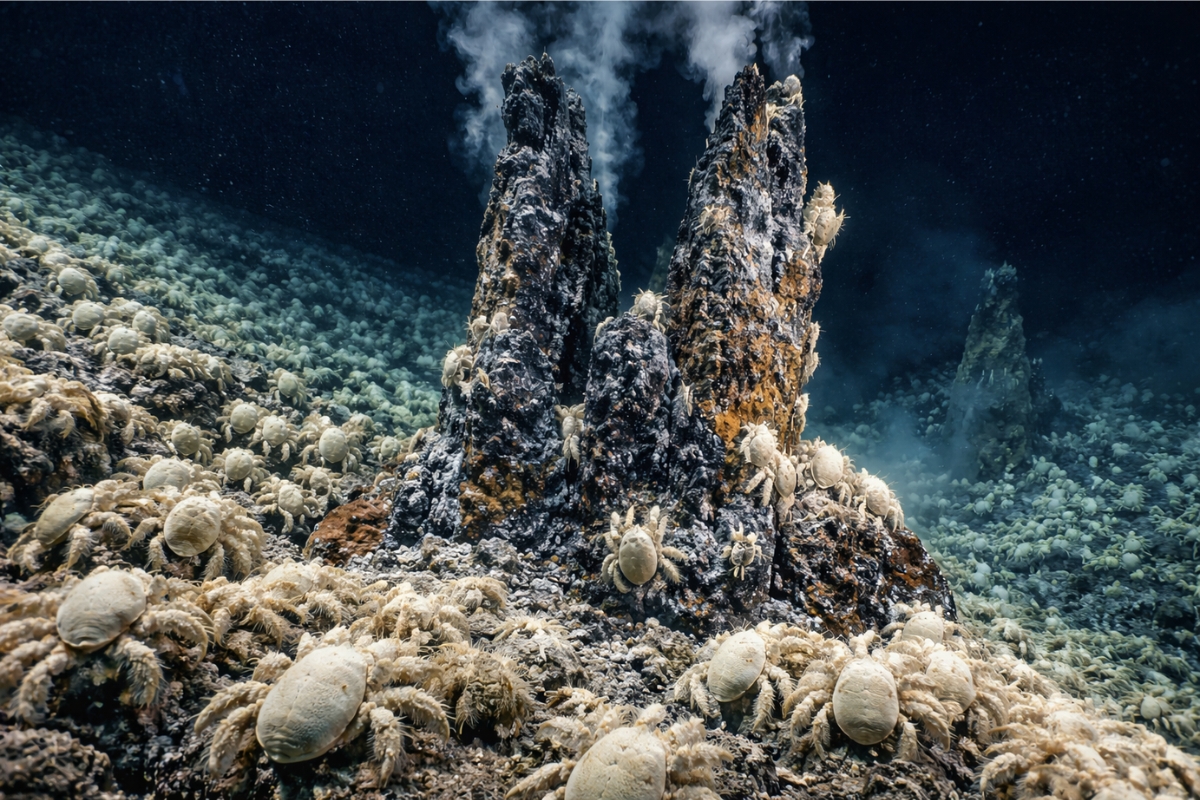
An Antarctic abyssal valley has revealed one of the most unusual ecosystems ever observed on the seafloor. Active hydrothermal vents appear covered by white hairy crabs, creating a scene that defies the pattern seen in other regions.
The environment is located nearly 2.6 km deep and brings together extremes in the same place: bottom water near 0 °C and emissions exceeding 380 °C. Life concentrates where chemical energy is available, not light.
The discovery has also changed the way to organize these habitats on the planet, with Antarctica emerging as a distinct area of hydrothermal vents.
-
14-Year-Old Invents Eco-Friendly Water Pump Using Recycled Materials to Aid Communities Without Water Access

-
Pigeons Trained to Detect Cancerous Changes in Medical Images Astonish Scientific Community

-
Plastic Waste from Beaches and Poor Communities in Kenya Transformed into School Desks, Replacing Wood in Classrooms and Turning Marine Litter into Durable Study Tables

-
Your Old Gmail Address Might Be Obsolete Soon: Google Introduces Feature Changing Account Usage.


The Mission of 2009 and 2010 That Descended to the East Scotia Ridge with Remotely Operated Vehicle
Between 2009 and 2010, an exploration with a remotely operated vehicle traversed the East Scotia Ridge and found active hydrothermal vent fields in the Antarctic sector of the South Atlantic.
The recording of these points showed that the region has enough activity to support complex communities even in an abyssal and polar environment.
What draws attention the most is that the local fauna does not follow the typical pattern observed in other vents on the planet.
The E2 and E9 Fields at 2,600 m and 2,400 m Where Active Black Smokers Emerge

(B) Vent flange in E2, with reflective high-temperature hydrothermal fluid trapped, at 2,621 m.
(C) Microbial mat covering rocks at the periphery of the vent in E2, at 2,604 m.
(D) Active vent in the E9 field, sustaining the new anomuran crab species of the genus Kiwa, at 2,396 m.
(E) Dense concentration of anomuran crabs of the genus Kiwa in E9, with stalked barnacle cf. Vulcanolepas attached to the nearby vent, at 2,397 m.
The main identified points have been named E2 and E9. The E2 field is located at about 2,600 m, while the E9 field appears around 2,400 m deep.
In these areas, black smoker vents release mineral-laden fluids in complete darkness.
Measured temperatures reached 382.8 °C, while the surrounding bottom water was near 0 °C, creating one of the most extreme contrasts in the marine environment.
The Shock of 382.8 °C with Water Near 0 °C Creating Gradients in Centimeters
Around the vents, the mixture of superheated fluid and cold seawater creates temperature and chemical gradients over very short distances.
This type of environment supports highly productive microbial communities capable of sustaining all local life.
The result is an ecosystem concentrated in a narrow band, where just a few meters define who can survive.
Why Hairy Crabs Become “Living Carpets” Over Hydrothermal Vents
Hairy crabs dominate the macrofauna of the East Scotia Ridge and accumulate on and around the vents, forming dense clusters on the seafloor.
The species has been described as Kiwa tyleri, a decapod adapted to live in an environment where the heat from the vents defines the area of survival.
In some places, these concentrations reach thousands of individuals per square meter, creating a rare scene in abyssal environments.
How Crab Hairs Sustain Chemosynthetic Bacteria and Become a Food Base

A central detail of this ecosystem lies in the hairs, the body hairs of the hairy crabs.
These structures serve as a support for cultivating chemosynthetic bacteria, microorganisms that utilize chemical compounds released by the vents.
This relationship helps explain why the crabs stay so close to the vents, where there is enough chemical energy to sustain biological production.
The Reason Why Antarctica Became a New Biogeographic Province of Vents
The fauna of these Antarctic vents is different from other known hydrothermal systems. Some emblematic groups common in other regions are absent in this set.
This difference led to the recognition of a new biogeographic province, separate from the provinces of the Pacific, Atlantic, and Indian Oceans.
In practice, Antarctica has come to be seen as a distinct area on the map of the deep, with life sustained by chemistry and having unique characteristics.
The Southern Ocean as a Natural Barrier Limiting Fauna to Few Meters from the Sources
Outside the heated zone, water near 0 °C acts as a physiological barrier and limits the distribution of animals.
This keeps life concentrated around the vents, with short spatial occupancy highly dependent on heat and chemical compounds.
The isolation of the Southern Ocean also acts as a dispersal filter, making it difficult for typical species from other ocean basins to appear.
The discovery of the East Scotia Ridge shows that the seafloor still holds ecosystems capable of changing the understanding of life on the planet.
With active vents, extreme temperatures, and hairy crabs dominating the scene, Antarctica has firmly entered the map of the most astonishing hydrothermal regions on Earth.


