






 Portuguese
  Spanish


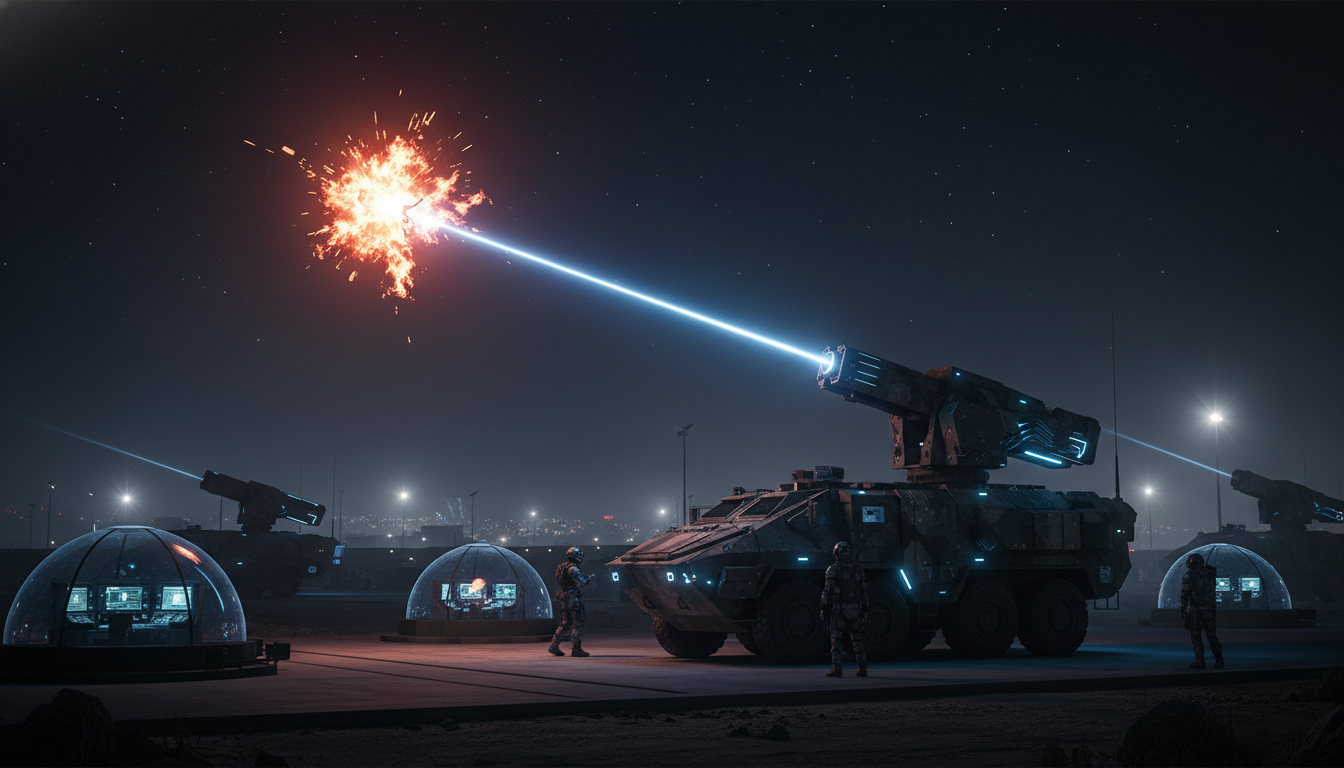
With a cost of $1.50 per shot compared to tens of thousands of dollars for a conventional missile, South Korea’s LRCA Block-I laser is the world’s first mass-produced directed energy weapon — designed to destroy the cheap drones that have changed modern warfare
South Korea will mass-produce a laser that takes down drones for less than R$ 8 per shot. The LRCA Block-I system, developed by Hanwha Aerospace, is a directed energy weapon that neutralizes multicopters and small drones with a 20 kW beam that heats the target to over 700°C in 10 to 20 seconds.
The mass production contract was signed on June 25, 2024. Initial deployment in the South Korean armed forces was scheduled for late 2024, making South Korea the first country in the world to operate mass-produced anti-drone lasers.
“By signing the mass production contract for Block-I, our country has become a leading nation in the deployment of laser weapons in military operations”, stated Lee Dong-seok, head of the Guided Weapons Project Division at DAPA, according to Korea JoongAng Daily.
-
Chile’s Plan for a 20,000 km Undersea Cable to Hong Kong Halted by U.S. Pressure, Highlighting the Silent Data Control Battle in Latin America

-
In Somaliland’s Desert, Greenhouse Uses Sun and Seawater to Grow Lettuce, Cucumbers, and Tomatoes Without Rain: 1-Hectare Project Cools Crops, Desalinates Water, and Converts Brine into Commercial Salt
-
Trump Unveils $400 Million Boeing 747 Donated by Qatar as Temporary Air Force One Amid Boeing Delays, Sparking Debate on National Security, Costs, and Foreign Influence
-
Chinese Company Unveils Robotic Toilet That Comes to You, Featuring Lidar Sensors, Voice Command, Bidet, Hot Air Drying, UV Light, and Self-Cleaning Waste Disposal




The numbers of the anti-drone laser
- Cost per shot: $1.50 (~R$ 8.30)
- Power: 20 kW (fiber optic laser)
- Irradiation time: 10 to 20 seconds
- Temperature at target: above 700°C
- Dimensions: 9m × 3m × 3m (on armored vehicle)
- Total investment: $63 million (87.1 billion won)
- Production contract: ~ $72 million (100 billion won)
- Success rate in tests: 100%
- Manufacturer: Hanwha Aerospace

Why an R$ 8 laser changes the rules of war
Each conventional missile used to take down a drone costs tens of thousands of dollars. Cheap drones, on the other hand, cost between $1,000 and $10,000. The math is simple: defense costs more than attack. That’s why armies in Ukraine and the Middle East face ammunition depletion when combating swarms of cheap drones.
The anti-drone laser reverses this logic. At $1.50 per shot, the cost of defense drops to a fraction of the attacker’s cost. Moreover, the laser relies solely on electrical supply — there is no physical ammunition that can run out.
The system is silent, invisible, and precise. It tracks the drone by radar, directs the beam, and destroys engines, circuits, or batteries without explosion. C4ISRNET details how the threat of North Korean drones motivated the urgency of the program.

Limitations and Counterpoints
The Block-I has a short range, optimized for small drones. In conditions of smoke, fog, or rain, the laser loses effectiveness because the beam disperses. The equipment also requires high energy consumption and bulky cooling systems.
Lee Illwoo, a specialist from Korea Defense Network, questions the viability against multiple simultaneous drones: “High-power microwave weapons would be better when enemy drones are launched in large numbers simultaneously.”
DAPA is already working on the Block-II, a version with greater range and power for larger threats, including aircraft and potentially ballistic missiles. The U.S. plans a competition for anti-drone laser in 2026, but mass production has not yet been confirmed. For details, consult Army Recognition and NDTV.


-

2 people reacted to this.