Portuguese
  Spanish


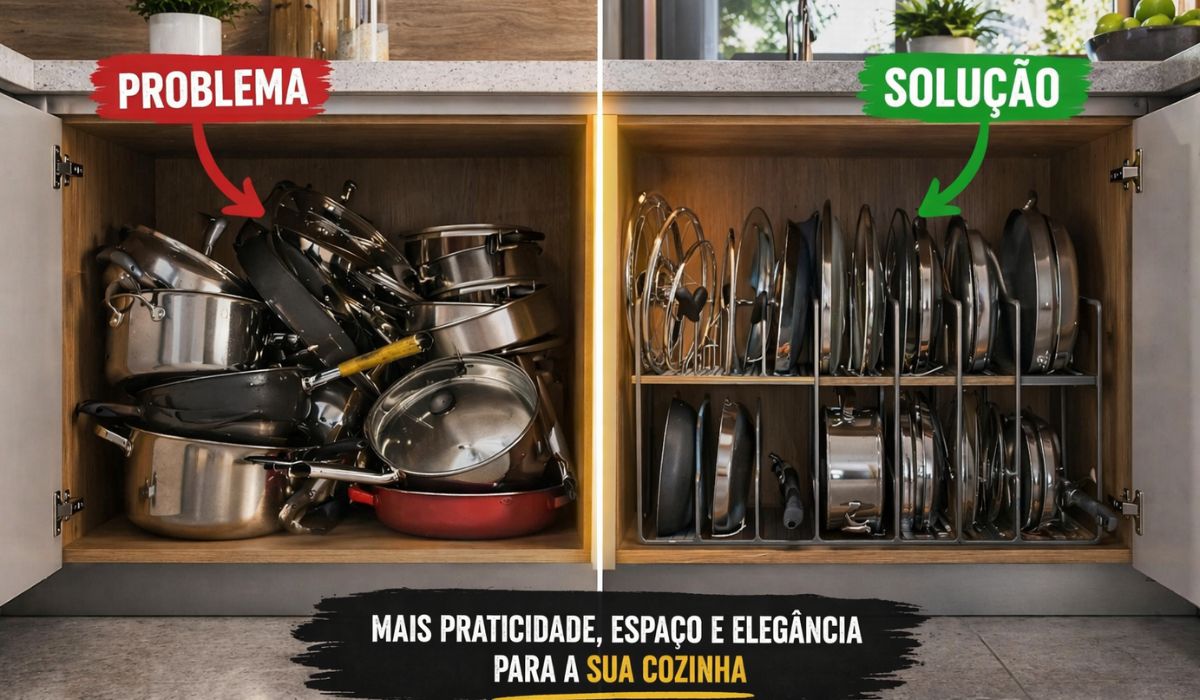

Changes in the interior of cabinets are changing the way to store pots, pans, and lids, with solutions that prioritize access, conservation, and space utilization in kitchens that are increasingly integrated into daily life.
In kitchens where every centimeter counts more, storing pots and pans stacked under the counter is losing ground to solutions that prioritize quick access, less friction between pieces, and better internal utilization of the cabinet.
The change is not limited to aesthetics.
It also accompanies a more intense use of the kitchen, especially in properties with integrated environments, where the preparation area has become more visible in daily life.
-
Mother discovers she may have won £12 million in the lottery but faces an agonizing wait after the shopkeeper threw the ticket in the trash.

-
A couple bought a house in Sheffield and, when removing the carpet from the hallway, found a trapdoor leading to a secret 23 m² basement with a 2-meter ceiling height, a discovery that eliminated the need for an expensive extension and, according to them, added £70,000 to the property’s value.

-
A nurse bought for 20,000 a 1955 house abandoned by a hoarder in Texas, and months later, rain revealed a buried pool in the backyard valued at $160,000, which he restored himself for about $10,000, a fraction of the cost of building a new one.
-
The United Kingdom is transforming dog feces left on trails into gas to light a streetlamp through an unlikely and surprising project that shows how even one of the most rejected wastes in cities can generate energy.




Organization of pots under the counter
For years, stacking was the most common alternative to gather pots, pans, and lids in a single cabinet.
In practice, however, this format usually requires removing several pieces to reach the one at the back.
This type of organization can also increase noise and make it harder to maintain order in daily use.
With the popularization of open kitchens and custom furniture, the interior of cabinets has begun to be treated as part of the functionality of the home.
In this scenario, solutions that allow each item to be stored more independently, rather than concentrating everything in stacks, have gained ground.
The conservation of utensils has also entered this discussion.
Manufacturers and specialized brands recommend avoiding, whenever possible, unprotected stacking, especially on non-stick surfaces and more sensitive finishes, which can suffer wear from continuous contact.
When there is no other alternative, the most common advice is to use dividers between the pieces.
Impact of organization on daily use of the kitchen
The cabinet under the counter usually concentrates the heaviest and bulkiest utensils in the kitchen.
When this space functions poorly, the effect shows in the routine: lids fall over, pans get stuck, larger pots take the place of smaller ones, and access to items becomes more time-consuming.
In compact kitchens, this problem tends to be more noticeable, as there is less room for improvisation.
Therefore, reorganizing this area often has a direct effect on the dynamics of the environment.
The main change appears in practicality, as the most used item becomes visible and accessible.
In addition, reducing friction can contribute to the preservation of utensils.
Another recurring effect is the sense of order, especially in integrated kitchens, where cabinets and drawers are part of the overall perception of the space.
Pot and Pan Organizers
Among the most common solutions are vertical supports, which allow pots, pans, or lids to be stored on the side, with each piece occupying its own space.
In this model, the main benefit is individual removal, without the need to move other items.
Adjustable organizers have also become popular, with movable dividers that adapt to different sizes.
This format usually caters to kitchens that have a variety of pieces, such as deep casseroles, shallow pans, and utensils with less standardized measurements.
Another common alternative is sliding rails installed inside the cabinet.
They make it easier to see the back of the furniture and reduce the need to remove part of the contents to reach a specific item.
In more recent projects, deep drawers with internal dividers serve a similar function and help keep pots and lids stable.
How to Choose a Pot Organizer
The choice of organizer starts with the type of cabinet available.
In modules with traditional doors, vertical and adjustable structures tend to work better, as they make use of the internal height of the niche.
In drawers, internal dividers and supports for lids tend to provide a more efficient result without compromising opening and closing.
Measuring the space before purchase is an important step.
It is not enough to consider only width and depth.
The usable height of the cabinet and the position of the hinges also affect the fit and everyday use.
The material of the pieces should also be part of this evaluation.
In kitchens with a predominance of non-stick pots, conservation specialists recommend systems that reduce direct contact between surfaces.
In sets made of stainless steel or cast iron, the focus usually falls on stability, weight, and the strength of the internal structure.
Still, storage with protection is also mentioned by manufacturers as a way to better preserve the pieces.
Errors when reorganizing the kitchen cabinet
One of the most common mistakes is trying to fit everything in without reviewing what is actually in use.
Disorganized cabinets do not always remain that way just due to a lack of accessories.
In many cases, the problem starts with an excess of similar utensils, with lids that have no corresponding pots, or with damaged pieces that continue to take up space.
Before installing any organizer, emptying the cabinet is often an important step.
Separating by frequency of use helps identify what should stay in front, what can go to the back, and what no longer makes sense to keep in that space.
The logic, in this case, is functional.
Items used almost every day tend to be more accessible, while less frequently used items can be positioned in secondary areas.
This rearrangement also facilitates cleaning and reduces makeshift fits.
How to maintain organization in daily life
Maintaining order depends more on routine than on rigidity.
Separating an area for pots, another for frying pans, and another for lids reduces improvisation and makes it simpler to store utensils after use.
When space is limited, a recurring criterion is to combine frequency of use and size of the pieces.
Some precautions help prevent the cabinet from returning to its previous state.
Among them are drying utensils well before storing, not stacking lids in an unstable manner, and using protectors when stacking is unavoidable.
Manufacturers and conservation specialists cite these resources as measures that can reduce surface wear over time.
There is also a functional aspect that helps explain the change.
In contemporary kitchens, the cabinet under the counter has received more attention in internal planning.
Even when closed, this space influences the routine, as it concentrates frequently used utensils and directly interferes with meal preparation.
In this context, the replacement of stacks of pots with more specific internal divisions reflects a change in use.
Instead of concentrating utensils in a single block, current organization seeks to better distribute the pieces, facilitate access, and reduce contact between them.
The result is a cabinet that is more compatible with kitchens that require practicality and continuous use.