Portuguese
  Spanish


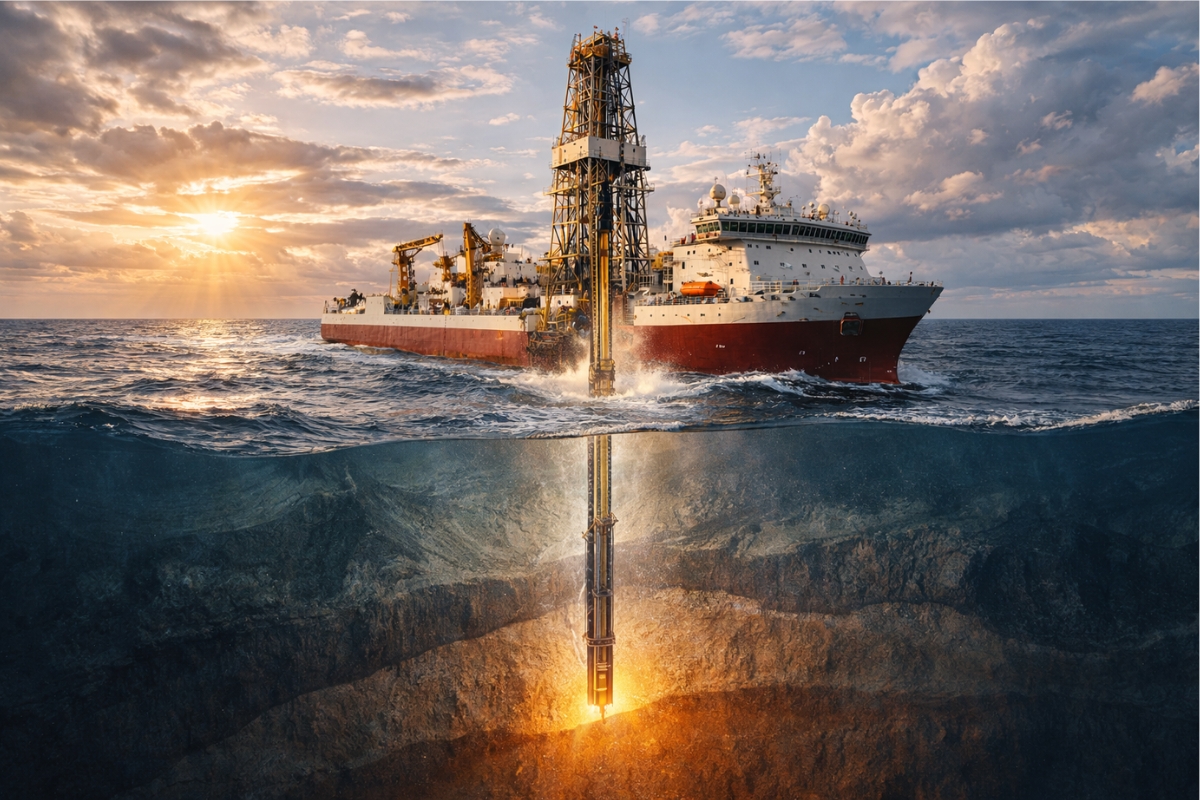


With an autonomy of 120 days, 9 laboratories, and the capacity to operate in deep sea, the Meng Xiang brings China to the center of a scientific mission that also intensifies the global competition for energy, minerals, and influence in the ocean.
The Chinese ship Meng Xiang entered in 2026 at the center of the scientific race for the Earth’s interior. Commissioned in November 2024, it is 179.8 meters long, capable of drilling up to 11 km below the seabed, and gained an operational base in northern China in January 2026 to support the new phase of the project.
The vessel’s goal is to try to reach the boundary that separates the crust from the mantle, something humanity has yet to achieve through direct drilling. The focal point for 2026 is the start of the first planned scientific expeditions, not the confirmation that the mantle has been reached.
The impact goes beyond geology. The Meng Xiang was designed to unite scientific research, exploration of oil and gas, and studies on gas hydrates, transforming the ship into a platform that blends discovery, industry, and strategic projection at sea.
-
Netherlands Reports First Child Euthanasia Case Since Rule Expansion for Minors

-
Brazilian Innovator Survives Homemade Submarine Dive in Paraty Despite Hatch Leak and False Oxygen Alarm

-
China Develops Custom 140-Ton Electric Mining Truck with 770 kWh Swappable Battery, Deploys 290 Units in Xinjiang’s Largest Zinc Mine
-
Meta to Launch Arena, a New Prediction App Targeting 3.56 Billion Users, Competing with Polymarket and Kalshi




179.8 meters, 9 laboratories, and 120 days offshore

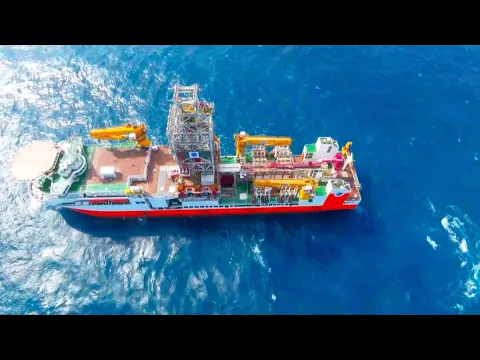
The Meng Xiang is currently the largest scientific ship of its kind built by China. The vessel has a displacement of 42,600 tons, an autonomy of 120 days, a range of 15,000 nautical miles, and space for 180 people including crew and researchers.
The structure was assembled to operate as a true research factory at sea. The ship features 9 laboratories, a hydraulic system with a capacity of 907 tons, 4 drilling modes, and 3 methods for collecting geological samples, which expands the range of scientific and industrial missions on the ocean floor.
Qingdao opened in January 2026 the most current operational phase
The most concrete turning point of this year occurred in Qingdao, in Aoshan Bay. On January 8, 2026, the northern base port of the Meng Xiang officially began operations, a step that reinforces the logistical structure for the continuation of deep-sea campaigns.
This advancement adds to the milestone of November 17, 2024, when the ship was officially incorporated in Guangzhou after sea trials that, according to project officials, exceeded the performance targets set in the ship’s design.

2026 opens the first expeditions, but the mantle still requires years
According to Nature, an international scientific journal dedicated to geoscience research, the first scientific expeditions of Meng Xiang were expected to take place in 2026, while the full-scale drilling plan towards the mantle was designed to happen before 2030, with scenarios in the Pacific or Indian Oceans.
This changes the interpretation of the topic. What is at stake now is not an instant dive to the mantle, but the opening of a long campaign, with multiple entries, new expeditions, and possibly years of work until crossing the oceanic crust.
What can come out of these drillings besides rock
Deep samples promise to deliver direct evidence about the formation of the oceanic crust, the functioning of plate tectonics, ancient marine climates, and even the lower limits of life within the planet. It is this data package that transforms the project into one of the great frontiers of current science.
At the same time, the ship was designed to also operate in the exploration of oil and gas and in the investigation of natural gas hydrates, which enhances the economic and strategic value of the structure beyond academic gain.
South China Sea and Blue Amazon place Brazil in the same race
The Chinese advance gains geopolitical weight because the South China Sea combines territorial dispute with interest in energy resources from the seabed. The official energy analysis of the United States describes the region as an area of contested sovereignty, with disputed island chains and relevant resources at stake.
For Brazil, the message is clear. The Blue Amazon already concentrates about 91% of the oil and 73% of the natural gas produced in the country, while the UN recognized in March 2025 the expansion of 360,000 km² of Brazilian maritime territory on the Equatorial Margin, reinforcing the national right to explore riches in the seabed and subsoil of the sea.
Meng Xiang transforms 2026 into a milestone of real operation for China’s biggest bet in deep ocean drilling. The ship has not yet reached the mantle, but it has already entered the phase that could reposition marine science and access to the oceanic subsoil in the coming decades.
In strategic practice, the movement pressures countries that depend on the sea for energy, sovereignty, and mineral resources. For Brazil, which has expanded its maritime frontier and already extracts a decisive part of its energy wealth from the ocean, the new Chinese phase changes the interpretation of the South Atlantic and the global dispute for the seabed.
Made with information from Nature, an international scientific journal specialized in geosciences.