






 Portuguese
  Spanish


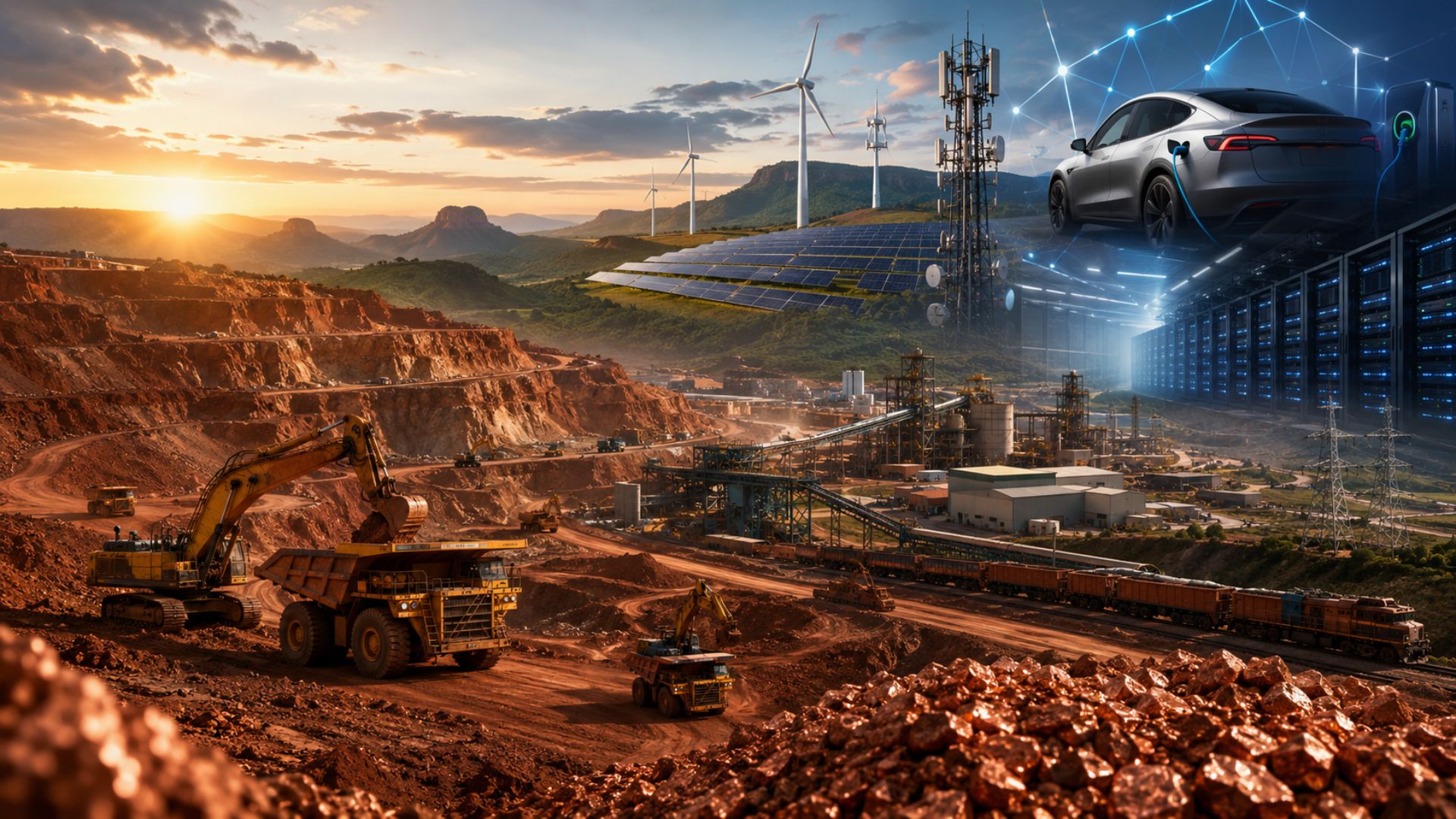

With iron ore still dominant, Vale reorganizes basic metals, separates independent division, and aims to double copper production by 2035 in Carajás. The plan emerges as global demand advances, supply worries analysts, and Mariana and Brumadinho agreements continue to pressure the company’s cash flow in the coming years.
Vale has placed copper at the center of its next growth phase after decades mainly associated with iron ore. According to Exame, the company targets Carajás, in Pará, to expand production by 2035, driven by electrification, data centers, 5G networks, renewable energy, and increased global demand.
The plan comes as the mining company tries to diversify its exposure beyond iron, without abandoning the business that still supports most of the revenue. The strategy involves separating the metals division, concentrating investments in Carajás, and transforming assets that have become less visible within the company’s structure into a potential source of billion-dollar value. The central question is whether copper can replicate, on another scale, the leap that Carajás gave to Vale in the 1980s.
Copper became a protagonist because the electrified world needs more metal

Iron ore is still the operational base of Vale. The company built global scale with integrated mines, railway, and port, especially in the Northern System, which takes production from Carajás to the coast of Maranhão and then to the international market.
-
World’s Largest Pencil Factory, Producing 2 Billion Annually, Operates in a Brazilian University Town with Its Own Sustainable Forest

-
World’s Largest Banknote Printer is a British Private Company Producing Currency for Over 69 Nations
-
Europe’s Largest Hydrogen Truck Fleet Begins Operation with 125 Vehicles Emitting Only Water Vapor

-
Around 60% of the World’s Christmas Decorations Come from Factories Near Yiwu, China’s Largest Wholesale Market with 75,000 Shops


But future growth is increasingly linked to copper. The metal is used in electric cars, motors, electrical grids, data centers, 5G infrastructure, and renewable energy projects. The more the economy electrifies, the more copper ceases to be a supporting player and becomes a critical piece in the technological transition.
Global demand may jump by 2040 and supply does not keep up
The projection cited in the material indicates that global demand for copper could rise from 28 million tons in 2025 to 42 million tons by 2040. This advance creates structural pressure because new mining projects usually require years of mapping, environmental licensing, construction, and operation.
The supply, according to the analysis presented, does not advance at the same pace. The projected deficit could reach millions of tons if new investments do not come into operation. It is in this mismatch between growing consumption and limited production that Vale tries to reposition Carajás.
Carajás concentrates the advantage that Vale wants to turn into scale

Carajás is already decisive for iron ore, but it also appears as the axis of the bet on copper. The region brings together geological knowledge, logistical infrastructure, railway, port, and already installed operations. This reduces some of the obstacles that normally delay completely new mineral projects.
The differential pointed out by the company is in the grade of the deposits. While cited global projects work with lower average grades, Vale claims to operate in areas with about 2% copper in the rock. In mining, a higher grade can mean less material processed to obtain the same metal, which affects cost, margin, and competitiveness.
The goal is to double production by 2035


Vale produced 382 thousand tons of copper in the period mentioned by Exame, with most coming from Carajás. The informed goal is to reach about 700 thousand tons by 2035 and then aim for 1 million tons in the following years.
If this volume were reached today, the company would be among the largest global producers of the metal, according to the analysis presented in the material. The size of the ambition shows that Vale no longer treats copper as a complement, but as a possible second axis of growth.
Separate division took the business out of the shadow of iron ore
For many years, base metals were within Vale’s broad structure and competed for attention with iron ore. The entry into the segment gained strength with the purchase of the Canadian Inco, about 20 years ago, but the company had difficulty extracting all the value from these assets.
The change came with the separation of the metals division into an independent structure, Vale Base Metals. The unit now has its own management, goals, and board. When a business stops competing for priority within a giant operation, the market begins to see value that was previously diluted in the balance sheet.
Analysts see billion-dollar value in Vale Base Metals
The material states that the contribution of the metals division to Vale’s results increased from a range between 10% and 15% to 22%, with expectations to exceed 30% in the long term. This progress helps explain why analysts started to look at Vale Base Metals separately.
In 2024, Saudi Manara Minerals bought 10% of the division for US$ 2.5 billion. Based on this reference, cited analysts assess that VBM alone could be worth almost half of Vale’s market value. This is the most sensitive point of the thesis: an asset that seemed secondary may be carrying significant value within the mining company.
Data centers, 5G, and renewable energy increase the strategic importance of the metal
The demand for copper does not come from a single sector. It appears in electric vehicles, network expansion, digitalization, artificial intelligence, energy transmission, and equipment related to renewable energy. Therefore, the metal has become treated as a strategic input for various chains at the same time.
The data centers reinforce this pressure. The expansion of artificial intelligence requires robust electrical infrastructure, cables, equipment, and transmission networks. The same occurs with 5G and clean generation. When several sectors compete for the same metal at the same time, global demand gains strength and supply becomes a bottleneck.
Iron ore remains strong, but China changes the scenario
Vale still heavily depends on iron ore. The production mentioned in the material shows the company regaining a global leadership position, with 336 million tons in the analyzed period. High-grade ore also remains important in a world seeking to reduce emissions in steelmaking.
Even so, the Chinese scenario demands attention. China remains a significant buyer, but the country’s steel production is undergoing a transition. Vale is not abandoning iron; it is trying to avoid its future depending solely on a cycle that may not grow as before.
Mariana and Brumadinho still weigh on the company’s cash flow
The growth strategy in copper also needs to coexist with commitments inherited from the dam breaches in Mariana and Brumadinho. The material points out that legal agreements related to the disasters continue to pressure the mining company’s cash flow.
This point limits the purely optimistic reading. Investing in Carajás, expanding production, maintaining dividends, and rebuilding relationships with regulators and society requires financial discipline. Copper may open a new front of value, but it does not eliminate the liabilities that still accompany Vale.
Execution will be the real test of the new bet
Getting a copper operation up and running does not happen quickly. The material points out that projects of this type can take 10 to 15 years, considering mapping, licensing, mine opening, infrastructure, and processing.
The advantage of Carajás lies in the fact that Vale already operates in the region. The company can extend the lifespan of mines, take advantage of existing structures, and develop nearby deposits. Even so, the thesis is only confirmed with delivery. On paper, Carajás has grade, logistics, and scale; in practice, the challenge is to transform mineral potential into predictable production.
Vale sees in copper a chance to increase its value at a time when electrification, data centers, 5G, renewable energy, and global demand put pressure on the world’s metal supply. Carajás, which has already changed the company’s history with iron ore, returns to the center of the strategy.
The decisive point is whether the company will be able to execute this expansion without losing financial discipline, without underestimating the liabilities of Mariana and Brumadinho, and without relying solely on favorable projections. Do you think copper can become Vale’s next big story, or will iron ore continue to dictate the company’s fate? Share your opinion.


