Portuguese
  Spanish


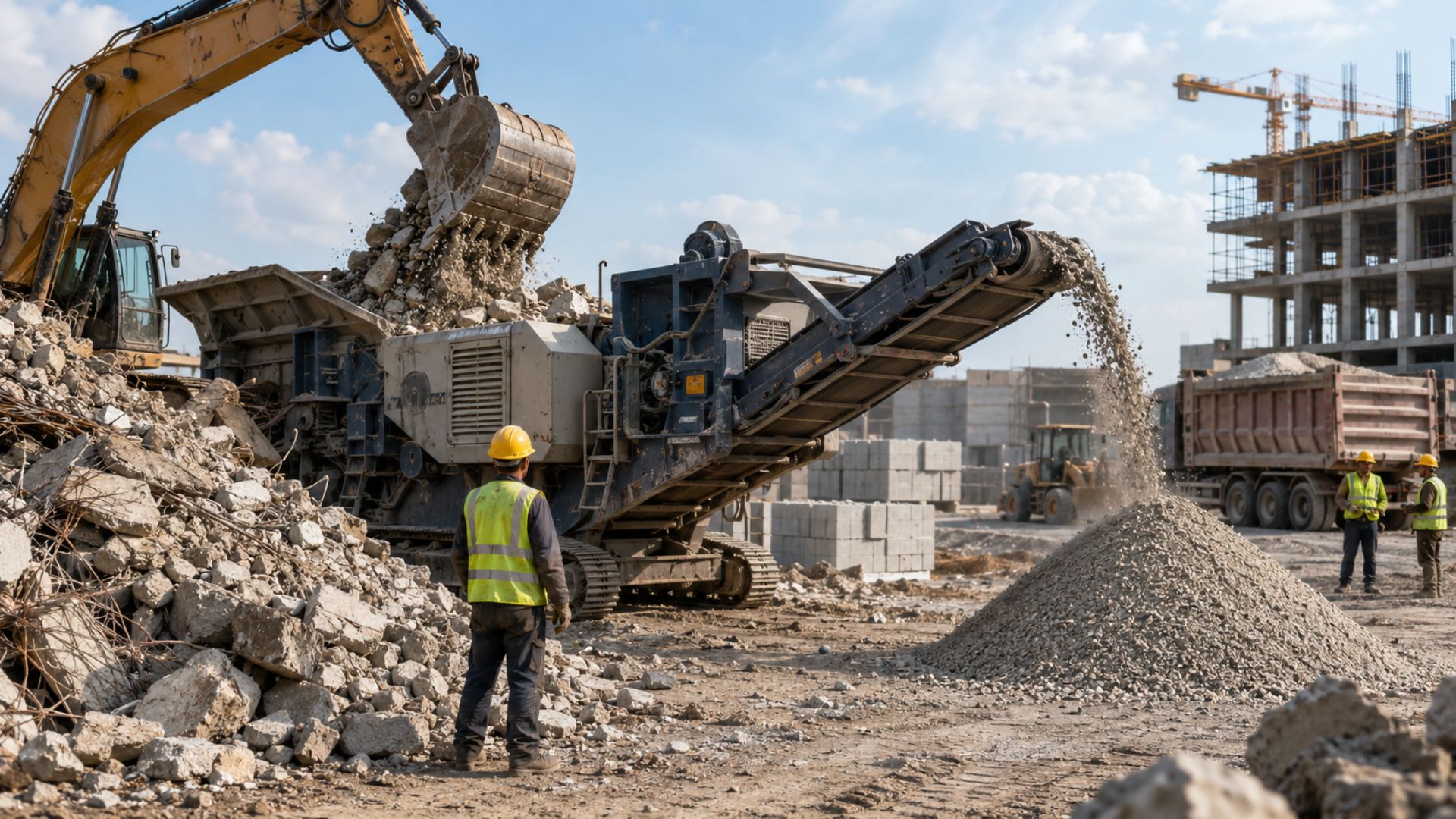


Concrete that was previously discarded can be crushed on-site, become recycled aggregate, and reduce costs with dumpsters, landfills, transportation, and base purchase. The technical survey shows significant monthly savings, sale by ton, and new revenue for construction companies dealing with demolition, paving, and earthmoving.
Concrete discarded in construction sites, demolitions, sidewalks, and parking lots can stop being just a cost for contractors and builders. According to a technical survey updated in October 2025, on-site recycling uses mobile crushing to transform waste into recycled aggregate, which can be reused as base, backfill, drainage, or sold by the ton.
The movement gained momentum because traditional disposal weighs on the budget: there are costs with dumpsters, transportation, landfill fees, and the purchase of new materials. The logic changes when the debris stops leaving the site as a problem and stays on-site as raw material. This is where mobile crushing enters as an operational and financial tool.
How discarded concrete becomes recycled aggregate
The process starts with the fragmentation of concrete in crushing equipment, such as jaw crushers. Then, the material can go through impact crushers, screening, and separation systems to remove contaminants, such as rebar, soil, or mixed waste.
-
While the World Opens New Airports and High-Speed Trains, Brazil Rushes to Complete Projects Stalled for 40 Years

-
Brazil Invests in Massive Waterway to Transport Soybeans by Barge, Reducing Costly Truck Reliance
-
Bridge Rebuilt in Just One Year Reconnects Two Brazilian States
-
Custom Furniture Costs in Brazil Expected to Range from $350 to Over $1,450 per Square Meter by 2026, with Kitchens, Closets, and Laundries Highlighting the Impact of Premium Features


With this treatment, the waste becomes recycled concrete aggregate, also called RCA or ARC. In practice, what could have been sent to a landfill returns to the construction chain as a reusable input. The result can be used in road bases, sidewalks, parking lots, landfills, drainage, and landscaping projects.
Mobile crushing reduces transportation, disposal, and purchase of new material


The main advantage of mobile crushing is the location of operation. Instead of hauling broken concrete to a landfill and then buying gravel or rock for the same project, the construction company can process the waste where it was generated.
This cuts expensive steps. There are fewer trucks on the road, less fuel, less payment for disposal, and a reduced need to buy base material. The savings do not come from a single line in the spreadsheet, but from the sum of several costs that cease to exist simultaneously.
The financial example shows why debris became a margin dispute
The survey cites the case of a paving company that discarded 260 tons of concrete per month. Before recycling, the account involved labor, trailer rental, insurance, fuel, disposal, and purchase of base material, reaching $6,750 monthly.
With a mobile track-mounted crushing unit, the estimated costs dropped to $1,870 per month. The pointed difference was nearly $5,000 monthly. For a construction company that frequently works with demolition, this type of savings can change the margin of several contracts.
Recycled aggregate can also be sold by the ton
Besides reducing internal expenses, crushed concrete can open a second revenue stream. After being crushed and screened, the recycled aggregate can be sold for uses such as road base, landfill, drainage, or landscaping projects.
The survey reports that RCA is usually sold between $5 and $15 per ton, depending on the region and quality. This means the construction can stop paying to get rid of the waste and start earning with the processed material.
The right equipment determines if the operation balances the account
To begin, the construction company needs to assess how much concrete it regularly generates. Companies dealing with paving, earthmoving, demolition, sidewalks, and parking lots tend to have a more constant flow of material.
The choice of equipment also matters. Compact track-mounted crushers can be taken to different sites, while screens, magnets, and conveyor belts help separate grain sizes and remove metals. The cleaner and more standardized the aggregate, the greater its commercial utility tends to be.
Licenses, dust, and noise cannot be ignored

On-site recycling can be profitable, but it should not be treated as improvisation. The survey warns that some regions require licenses for crushing, especially near residential areas or when there is dust and noise generation.
There may also be requirements for storing large volumes of recycled material or operating heavy equipment. Before turning debris into business, the construction company needs to know if the operation is allowed by local regulations. Ignoring this step can result in fines, stoppages, and project delays.
Renting or buying a crusher changes the long-term return
Renting can work for tests or one-off projects, but the survey indicates that many clients pay more to rent similar machines than they would in monthly purchase installments. The cited comparison indicates an average rental of about $12,000 per month for a medium-sized mobile crusher.
On the other hand, financed purchase of mobile equipment appears in a lower monthly range, depending on the model and business conditions. The real decision is not just between renting or buying, but between continuing to pay for disposal or controlling your own material.
Sustainability comes into play because it reduces landfill and extraction
Concrete recycling also has a direct environmental effect. Each ton reused prevents an equivalent volume from going to landfill and reduces the demand for virgin aggregates extracted from quarries.
This point matters for companies that need to meet environmental targets, compete for contracts with sustainable requirements, or reduce emissions associated with transportation. The competitive advantage appears when economy and sustainability stop being separate discourses and start operating on the same spreadsheet.
Discarded concrete can turn into money when the construction company understands waste as material, not as a problem. Mobile crushing allows reducing transportation, dumpster, landfill, and base purchase costs, as well as creating sellable recycled aggregate by the ton.
But the business only makes sense with regular volume, adequate equipment, quality control, and local authorization. Do you think Brazilian construction companies should crush concrete on-site or do the machine costs still limit this shift? Share your opinion.