Portuguese
  Spanish


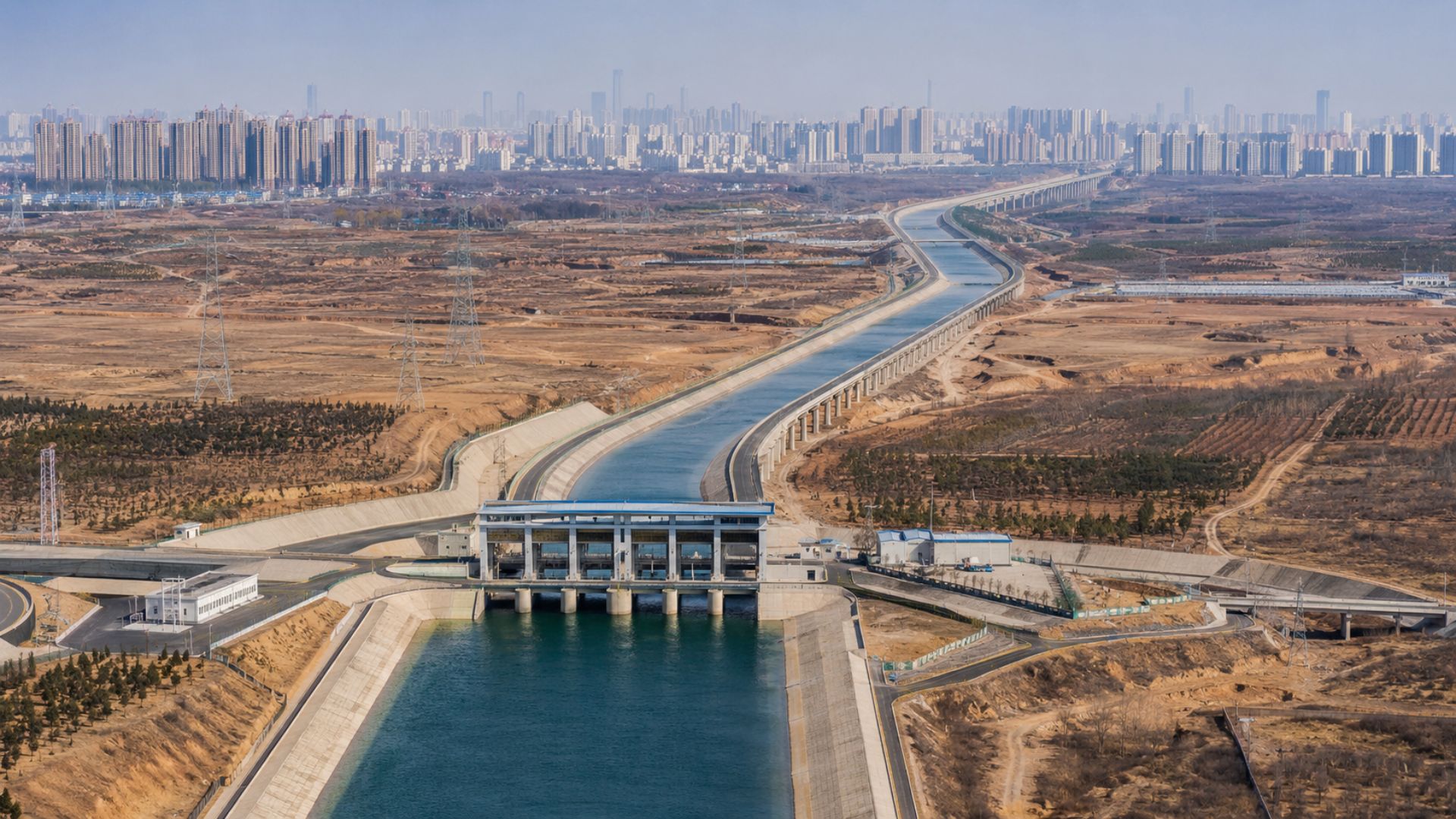


China attempts to bring water from the humid south to the dry north with the South-North Water Transfer Project, an undertaking estimated at over US$ 70 billion, 3,000 kilometers of infrastructure and routes that supply Beijing and Tianjin, while the western route remains stalled due to environmental and geopolitical risks.
China has put into operation one of the most ambitious water projects on the planet to address water shortages in northern cities, especially in urban and industrial areas that have grown dependent on strained aquifers. The initiative began to materialize in 2003, after an idea advocated since 1952, and operates through routes, canals, tunnels, and pumping stations that transfer water from the wetter south to dry regions.
The reason is straightforward: northern China concentrates population, factories, agriculture, and megacities that consume water at an unsustainable rate. To try to balance this equation, the country has started moving water over thousands of kilometers, including beneath the Yellow River, in a project that has already displaced more than 330,000 people. The question remains whether engineering of this magnitude can overcome a crisis that also depends on climate, politics, and rivers that cross borders.
China decided to move water because the north grew faster than its water sources

The South-North Water Transfer Project was born from an ancient disparity within Chinese territory. The south has more voluminous rivers, heavy rains, and episodes of flooding. The north, on the other hand, comprises dry areas, populous cities, and industrial hubs that have spent years extracting groundwater beyond the natural replenishment rate.
-
While the World Opens New Airports and High-Speed Trains, Brazil Rushes to Complete Projects Stalled for 40 Years

-
Brazil Invests in Massive Waterway to Transport Soybeans by Barge, Reducing Costly Truck Reliance
-
Bridge Rebuilt in Just One Year Reconnects Two Brazilian States
-
Custom Furniture Costs in Brazil Expected to Range from $350 to Over $1,450 per Square Meter by 2026, with Kitchens, Closets, and Laundries Highlighting the Impact of Premium Features


In some regions near Beijing, the groundwater level is said to have dropped several meters per year, according to the material used as a basis. This forced wells to become increasingly deeper. When a city needs to fetch water more than a kilometer below the ground, the problem has ceased to be occasional and has become structural.
The megaproject was designed in three routes to connect the humid south to the dry north

The Chinese solution was to divide the system into three major routes: eastern route, central route, and western route. The general idea is simple to explain but difficult to execute: capture water in more supplied regions and transport it to areas where urban, agricultural, and industrial demand pressures the supply.
The scale is the point that makes the project unusual. The system was planned to transport more than 44.8 billion cubic meters of water per year. This is not a local work, but an attempt to redesign the circulation of water within an entire country.
The eastern route uses ancient canals, modern pumps, and tunnels under the Yellow River


The eastern route follows part of the ancient Grand Canal, a historic route with over two millennia of origin. But the modern work was not just a reopening of the canal. It required excavations, modernization, tunnels, and 23 large pumping stations to push the water northward.
One of the most impressive sections passes beneath the Yellow River. The engineering had to create space for a flow of water to cross below another major river. It is an almost invisible scene to those looking at the surface, but central to understanding the scale of the intervention.
Pollution became an obstacle even before the water reached its destination
The eastern route also faced a critical problem: water quality. As part of the route crossed areas with a history of industrial and agricultural pollution, it was not enough to just move water. It was necessary to treat, monitor, and reduce the risk of carrying contamination to other regions.
This point explains why the work cannot be seen only as an engineering feat. Moving polluted water also moves the problem. Therefore, treatment became an essential part of the system, especially in areas where local communities were wary of the impacts on fish, lakes, and economic activities.
The central route brings water to Beijing using gravity instead of pumps
The central route is described as the main line of the project. It draws water from the Danjiangkou reservoir, on the Han River, and sends the resource to Beijing. The most relevant technical detail is that engineers raised the dam level to allow the water to flow by gravity over more than 1,200 kilometers.
This choice reduces the dependence on pumping along the route, but does not eliminate social costs. To make room for the reservoir and the canal, about 330,000 people had to leave their areas. The water that reaches the big cities also carries a human cost that is difficult to erase.
Beijing has come to rely on a significant portion of the transferred water
The system already supplies major centers like Beijing and Tianjin. In the case of Beijing, the material states that about one-third of the water received by the city comes from the central route. This helps explain why the project has become strategic for the Chinese government.
Supporters point to gains such as cleaner water, reduced dependence on contaminated aquifers, and recovery of lakes and underground reserves. Even so, the benefits do not reach everyone equally. There are communities that see the water pass through the channels without receiving the same water security as the served metropolises.
The western route is the most controversial part and has not yet materialized
The western route would be the most ambitious stage of the project. It would carry water from mountain rivers in western China to the Yellow River and then north. The problem is that this region involves fragile areas of the Tibetan plateau, earthquake-prone zones, and rivers connected to neighboring countries.
The controversy increases because rivers like the Mekong and the Brahmaputra also support populations outside China. Excessive water withdrawal in the upper course could generate tensions with India, Vietnam, Cambodia, and other countries affected by downstream flows. The project ceases to be solely Chinese when the river crosses borders.
The billion-dollar cost reignites the question about simpler alternatives
The project is said to have consumed more than $70 billion on the eastern and central routes. Critics argue that part of this money could have been invested in solutions like water recycling, desalination, leak reduction, and urban network repairs.
Supporters respond that smaller measures would not solve the scale of the Chinese water crisis alone. This is the core of the debate: when the thirst of megacities surpasses a certain limit, cheap solutions may seem insufficient, but megaprojects also create new risks.
Climate change may make the equation even more unstable
The greatest long-term challenge lies in the climate. If southern China becomes drier, if glaciers melt rapidly, and if rivers like the Yangtze experience reduced flow, there will be less water available to send north. In this scenario, the system may face pressure precisely at the source.
Engineering has managed to open channels, erect dams, drill tunnels, and build pumping stations. But no work fully controls the future availability of water. China may have solved part of the technical problem, but the final decision still depends on nature.
China has turned its water crisis into a national-scale megaproject, capable of moving water over thousands of kilometers and supplying cities that could not indefinitely rely on aquifers. The system shows technical capability, but also exposes social costs, environmental risks, geopolitical tensions, and climate uncertainties.
The big question is whether the country should advance with the western route or reinforce less aggressive alternatives before altering rivers in sensitive regions. Do you think moving entire rivers is a necessary solution for dry megacities or too great a risk for the future? Share your opinion.