






 Portuguese
  Spanish


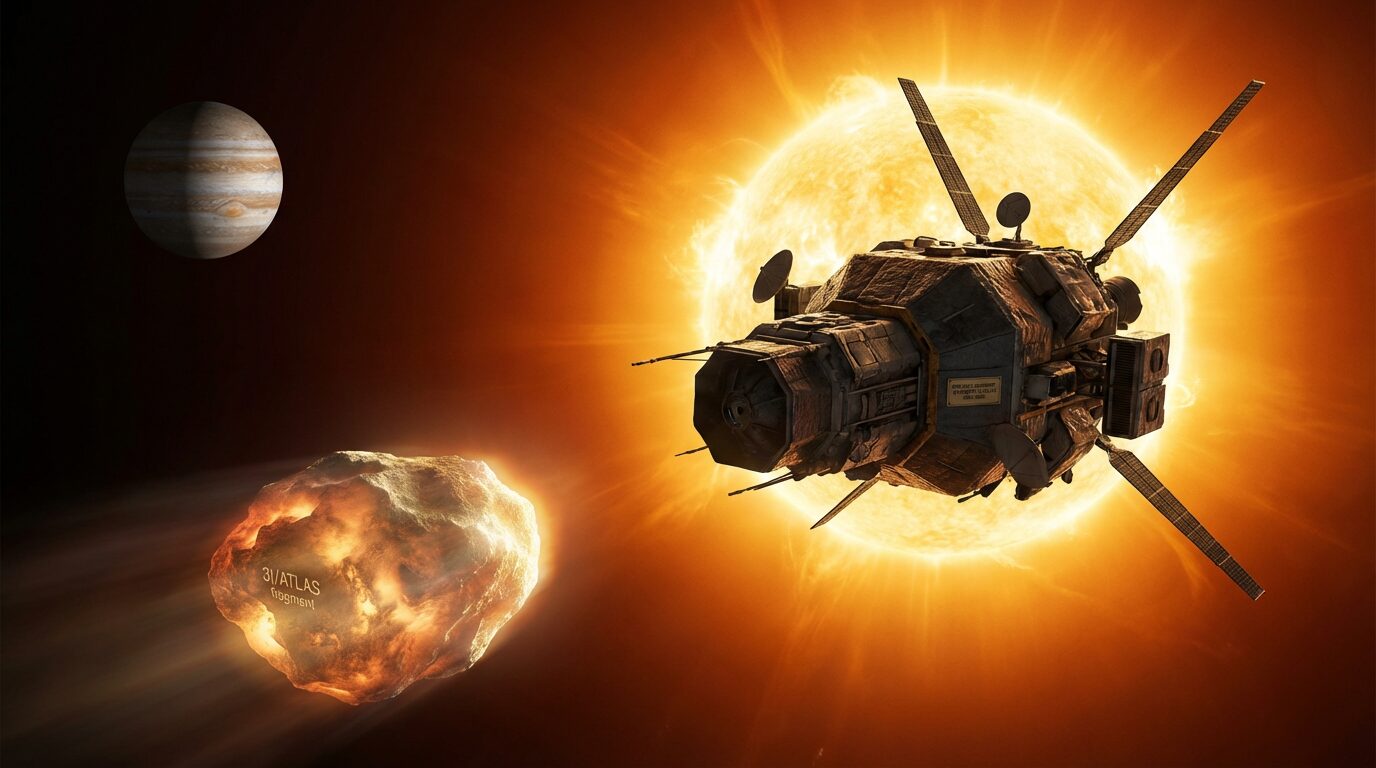


Study Proposal Indicates That Only a Flyby Would Be Viable to Reach the Interstellar Object 3I/ATLAS, with Launch Window in 2035 and Arrival Decades Later
A space mission proposal is studying the interception of the interstellar object 3I/ATLAS, the third visitor from outside the Solar System that has been identified. According to CNN Brazil, the analysis indicates that a direct mission is infeasible due to the high speed and unusual orbit of the target.
The most realistic scenario considered is a flyby, in which the spacecraft would quickly pass by 3I/ATLAS to collect data. According to the study cited by CNN Brazil, this strategy would require gravitational assistance and a critical moment engine burn.
The proposed route involves the Oberth solar maneuver, with launch from Earth, flyby at Jupiter, and a dive toward the Sun to take advantage of maximum acceleration effect. Even so, the timelines are long and put science in a race against time for travel.
-
How to Unclog Showerhead Holes Blocked by Limescale and Hard Water Without Replacing or Hiring a Technician

-
Award-Winning Korean Electric Scooter Concept Folds to Briefcase Size, Eases Transport Challenges

-
YouTuber Discovers Surreal Collection in 400-Year-Old Italian Fortress Near Florence: 419 Anvils, Giant Walruses, Ancient Church, and WWII Tunnels
-
Creative Uses for Toilet Paper Rolls That Will Change Your Perspective


What Is 3I/ATLAS and Why Does It Challenge Probes
3I/ATLAS is described as the third interstellar object ever detected, which makes it a rare opportunity to study material coming from another star. According to CNN Brazil, the orbital profile and speed make conventional coupling or chasing impossible.
In practical terms, any encounter would have to be brief and precise, with the probe passing the object at high speed to record images, spectra, and particles, which requires calibrated instruments and millimetric observation windows.
How the Oberth Solar Maneuver Would Work with Support from Jupiter
To reach 3I/ATLAS, researchers are evaluating a classic sequence of orbital dynamics: launch from Earth, gravitational assistance at Jupiter, and trajectory redirection toward the Sun. At the point of closest approach to the star, the engines would be fired intensely to take advantage of the so-called Oberth effect.
This burn at perihelion extracts more energy per unit of fuel, converting the already high speed into an additional boost. The goal is to “push” the probe onto a trajectory that intercepts the object, even if the encounter is only a quick flyby.
According to the study referred to by CNN Brazil, the most efficient launch window would be in 2035. The heliocentric geometry from the thrust near the Sun is essential to overcome the relative speed difference between the probe and 3I/ATLAS.
This architecture, however, does not eliminate the need to time the pass by Jupiter and the Sun with great precision. Any deviation in timing or flyby angle could turn the mission into a lost encounter.
Long Timelines, Technical Limits, and Thermal Shield
Even with the Oberth maneuver, the study calculates a flight time of between 35 and 50 years. In practice, interception would only occur between 2070 and 2085, considering the most efficient trajectory solution.
Mission durations of less than three decades are considered impractical for this route, according to CNN Brazil. This imposes reliability challenges for hardware, team continuity, and sustained funding for many years.
There is also the issue of the extreme environment during the close pass to the Sun. The spacecraft would need a robust thermal shield capable of withstanding extremely high temperatures, which pressures mass budget and material selection.
Scientific Capacity and Mass Constraints
The study emphasizes that the mass available for instruments would be limited, a direct effect of the thermal shield and the requirement for propellant for the burn at perihelion. This imposes tough choices about which sensors to carry.
Nevertheless, the authors defend the viability and scientific relevance of the effort. Even a compact set of instruments could capture unprecedented data about the composition, structure, and activity of an interstellar object in accelerated passage.
In such a flyby, cameras, spectrometers, and dust and gas detectors could operate in short, but critical, windows, maximizing the science obtained. Planning automatic sequences and redundancy would be central to success.
Recent Images and Who is Behind the Observations
According to CNN Brazil, new images of 3I/ATLAS were obtained by the Nordic Optical Telescope on November 11, 2025, credited to David Jewitt and Jane Luu. These records help refine the trajectory and characterize the brightness of the object.
Accurate observational data are essential to calculate encounter windows and error margins. A more faithful portrait of the orbit and activity of 3I/ATLAS could reduce uncertainties and increase the chances of a productive flyby.
Why the Mission May Be Worth It for Science
Interstellar objects carry clues about the formation of planetary systems beyond our own. A close pass by a visitor like 3I/ATLAS can reveal chemistry, surface texture, and dust behavior in rarely accessible conditions.
According to CNN Brazil, despite the extended timelines and thermal risks, the community views the proposal as an audacious yet plausible step. If realized, the mission would open a unique window to compare material from another stellar origin with that of comets and asteroids in the Solar System.
What do you think of a mission that could launch in 2035 and only meet its target between 2070 and 2085? Is it worth challenging decades of waiting for a flyby that could transform our understanding of interstellar objects? Leave your comment and say if the scientific return justifies the risks and the long timelines.







Seria bom para a ciência
Para mí que si es muy buen propósito para nuestro futuro… Claro que ya no existiremos para ese tiempo, pero siempre va a existir nuevas generaciones para que comprendan en ese tiempo como es saber del más allá de los sistemas intergaláctico o interestelares…
No sabemos si en 2032 o más adelante no somos impactados por un meteorito , ah pero en 2085 nos llegan unos datos de un cometa que ……y acá 8000 millones se cagan de hambre , me la soban