






 Portuguese
  Spanish


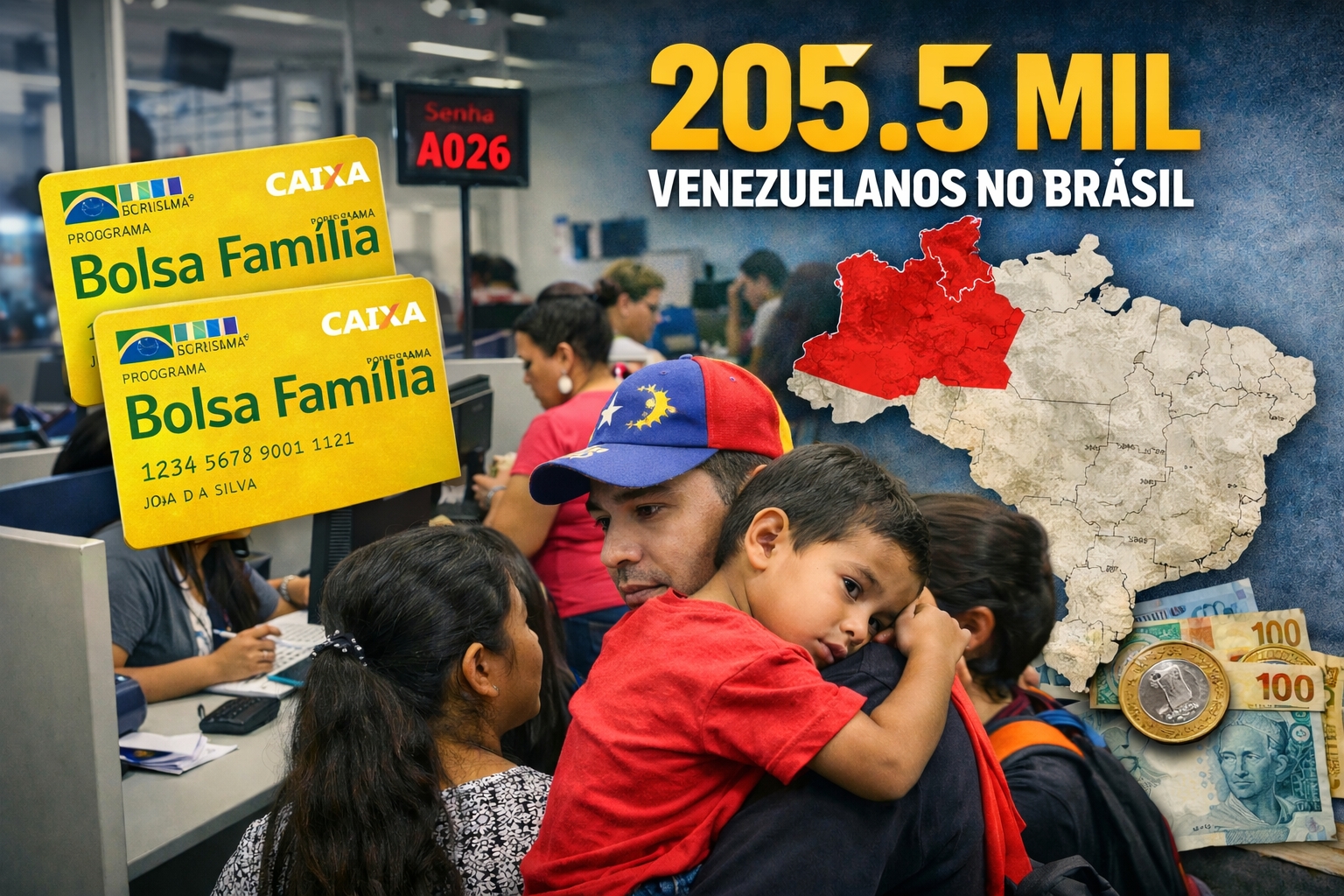


In Brazil, 205,587 Venezuelans Started Receiving Bolsa Família in September 2025 to Face Vulnerability in the Neighboring Country, Causing Pressure on the Government’s Budget and on the Pockets of Brazilians.
The migration crisis related to Venezuela, present since 2014, has quickly changed the profile of foreigners served by Bolsa Família in Brazil.
Data from the Ministry of Development and Social Assistance, Family and Hunger Combat (MDS) shows a significant escalation over recent years, with a strong concentration in the Northern region of the country.
The most striking detail is the speed of growth: from just over 1,000 beneficiaries at the end of 2017 to over 205,000 in 2025, even with a recent decline between 2024 and 2025.
-
Hurry: Wikipedia pays up to R$ 2,500 for those who write about Minas Gerais, contest entries end on July 10, 2026, and even beginners can “earn,” with prizes starting at R$ 200.

-
A city with 8,000 inhabitants will receive R$ 25 billion to host the largest single-stage pulp mill in the world, with a production of 3.5 million tons per year and a cost of R$ 45 million.
-
He left India for Oman in 1976, entered through the door of luxury finishes, and took Sobha to the premium real estate market in the Middle East.

-
China wants to impress the world once again with a mega canal featuring giant locks, deep waters, and space for the largest ships, in a project aimed at shortening journeys, reducing queues, and rivaling the Panama Canal in global trade.



Leap from 2017 to 2025 Increased the Total of Venezuelans in Bolsa Família to Over 205 Thousand
According to the MDS, the number of Venezuelans served by Bolsa Família increased from 1,076 at the end of 2017 to 205,587 in September 2025, a volume more than 190 times greater.
Another survey describes the same movement over eight years, citing the increase from 1,062 at the end of 2017 to 205,000 in September 2025.
According to the MDS, in 2021 the total reached 54,477 and more than doubled by 2023, when it reached 185,633 people.
No data from 2022 were available on the MDS platform consulted for the information.
Decline Between 2024 and 2025 Appeared in the Data and Changed the Rhythm of Growth
Despite the accumulated growth, there was a decrease between 2024 and 2025, from 218,777 to 205,587, according to the figures presented in the survey.
This trend occurs alongside a reduction in the rate of new migrant arrivals, and experts indicate a trend towards stabilizing the total number of beneficiaries, focusing on professional qualification and integration into the job market to reduce dependency on the program.
North Leads in Concentration in 2025, and Roraima Tops the List with 56,669 People
The survey indicates that, in 2025, most Venezuelan immigrant beneficiaries lived in the Northern region, representing 46% of the total.
Next comes the Southern region, with 32%.
Among the states with the largest number of Venezuelans in the program are Roraima (56,669), Paraná (30,889), and Amazonas (30,231).
Another noted fact is that São Paulo appears as one of the main hubs, with approximately 26,000 Venezuelans registered in federal social programs.
Operation Welcome, CPF, and Unified Registration Opened Path for Access to the Benefit
The growth accompanied the increase in migratory flow, especially from 2018 onwards, when Northern states such as Roraima and Amazonas began to experience constant pressure on public services and shelter structures.
With the implementation of Operation Welcome, there was progress in migratory regularization, issuance of CPF, and registration in the Unified Registration, necessary requirements for access to the social program.
Rules are the Same as for Brazilians, Income of Up to R$ 218 per Person and Average Benefit of R$ 780
According to the MDS, the participation of people born outside Brazil in Bolsa Família has been possible since the program’s inception in 2003.
The ministry states that there are no legal impediments for foreigners residing in the country to form beneficiary families, as provided for in the Federal Constitution of 1988.
In a statement, the ministry declared that all families registered in the Unified Registration, regardless of nationality and legal status (migrant or refugee), undergo monthly eligibility analysis for entry into the program.
The access criteria follow the same rules applied to Brazilians, with a per capita family income of up to R$ 218 per month.
The average benefit received by these families is approximately R$ 780 per month, and most live in social vulnerability, with the presence of children, adolescents, or elderly people.
The program requires conditionalities, such as a minimum school attendance of 60% and an updated vaccination schedule.
Venezuelans Are Already the Majority Among Foreigners in Bolsa Família, and the Estimated Cost Reaches R$ 1.5 Billion per Year
Data from the MDS indicates that Venezuelans account for 61% of the 331,000 foreigners from 211 nationalities currently included in Bolsa Família.
The fiscal impact of providing services to foreigners in the program is estimated at around R$ 1.5 billion per year, a topic that enters discussions about public budget and migration policies.
Meanwhile, the 2022 Demographic Census, released by the Brazilian Institute of Geography and Statistics (IBGE) in 2025, indicated that Venezuela has become the leading country of origin for foreigners in Brazil, surpassing Portugal.
In total, 271,514 Venezuelans were living in the country in 2022, a number nearly 94 times greater than recorded 12 years earlier.
The Venezuelan Rockmillis Basante, founder of the Brotherhood Without Borders, states that Bolsa Família is essential for immigrants who arrive in extreme vulnerability, not speaking the language, knowing no one, and without a home.
According to her, the benefit is offered to immigrants in the same way as to Brazilians, with the same process and waiting time.
At the same time, Basante believes that Bolsa Família should be an emergency aid and not continuous, with a deeper assessment of the necessary time, alongside tools for immigrants to grow and contribute to the country.
She reports that she received the benefit when she arrived in Brazil in 2018, after leaving Venezuela for political reasons, and now states that she no longer needs Bolsa Família to live.
And you, what do you think about this scenario: should Bolsa Família serve immigrants under the same rules as Brazilians when there is proven vulnerability, or should it have a limited timeframe and stricter evaluation? With numbers already exceeding 205,000 Venezuelans in 2025, the discussion involves solidarity, public budget, and integration into the job market. Share your opinion.






Só faltava essa.
Tanto o povo brasileiro quanto o povo Venezuelano, querem trabalho e dignidade não uma miséria dada pelo governo, porque não criam o bolsa trabalhador, te garanto que iriam ser preenchidas as vagas de trabalhos abertas no Brasil, o Lula fala que o salario é baixo pago pelas empresas, oque falar do valor pago do bolsa família, que na verdade é pago por quem trabalha. O governo quer um povo **** e ignorante para manipular. Com certeza uma pelarte realmente precise do bolsa família, mas tem tanta gente que pode trabalhar, não assina carteira e não vai se aposentar, isso que o nosso governo quer. Caiam na realidade a chance de mudança é neste ano!
O Bolsa família nada mais é do que uma compra de voto desse governo **** e ****, isso é uma maneira desses participantes não quererem melhorar de vida, não pactuo com essa forma de ajuda, pois trabalho existe de um dia pra outro, basta querer.