






 Portuguese
  Spanish


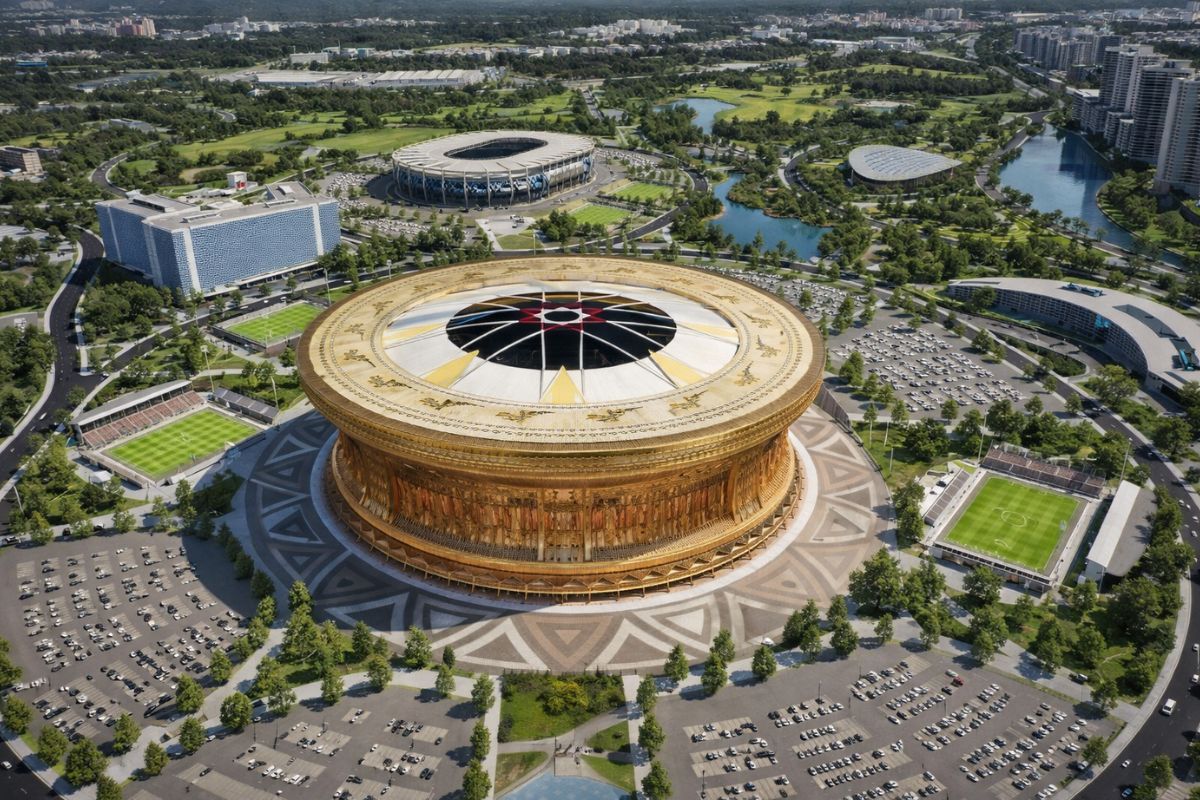


The Trong Dong Stadium Began Construction in December 2025 and, with Completion Scheduled for August 2028, Aims to Surpass Capacity and Ambition Records: 135 Thousand Seats, Investment of R$ 185 Billion, Symbolic Design and a Planned Operation for Sports, Shows and International Large-Scale Fairs.
The Trong Dong Stadium, designed in Vietnam, enters the global competition with a proposal that combines monumental engineering, cultural identity, and economic strategy. The estimated capacity of 135 thousand seats places the arena above current major venues and changes the reference for size in the sector.
With construction started in December 2025 and delivery scheduled for August 2028, the project is initiated with a clear goal of repositioning the country in the international events circuit. The plan is not limited to football: the complex was designed to host high-volume sports, musical, and corporate programming year-round.
A Stadium to Break the Current Scale

The most immediate comparison helps to size what is being proposed. The new Vietnamese stadium was designed to accommodate almost two Maracanãs in capacity, given that the main venue in Rio de Janeiro has 78,838 seats.
-
Nearly Every Cable Car Worldwide, from Alpine Ski Lifts to South American Air Metros, Traces Back to the World’s Largest Cable Car Manufacturer, an Austrian Company Founded in 1893

-
Toxic Waste from Brazilian Cassava Processing Transformed into Patented Eco-Friendly Bricks, Passing National Standards and Promising Lower Costs
-
Brazil’s Busiest Port to Triple Soybean Loading Speed with $1.1 Billion Investment in Paraná Terminal, Reaching 8,000 Tons per Hour

-
Cost of Installing Subflooring in 2026: The Importance of Proper Slope to Prevent Water Damage and Costly Repairs


In practical terms, this alters everything from circulation design to security logic, access, and public operation.
In the ranking of packed arenas, the change is also objective: with 135 thousand seats, the Trong Dong surpasses the mark of Rungrado 1st of May in North Korea, which has 114 thousand. This difference is not symbolic; it redefines the ceiling of the potential audience for large mass events in a single facility.
Money, Deadlines and Execution: What Is Already Defined

The announced investment for the stadium is more than 925 trillion Vietnamese dong, approximately R$ 185 billion.
In projects of this magnitude, the budget serves as an indicator of ambition and, at the same time, complexity: it involves main construction, supporting infrastructure, mobility, and territorial integration.
The official schedule establishes two already public milestones: start in December 2025 and completion in August 2028.
This means a short window for a project of extraordinary dimension, which requires rigorous compatibility between civil engineering, special installations, and continuous operation systems for events of multiple formats.
Symbolic Architecture and Multifunctional Operation
The concept of the stadium was inspired by the Dong Son bronze drum, an artifact traditionally regarded as sacred in Vietnam.
The choice is not just aesthetic: it connects the arena’s design to values such as community, strength, and longevity, creating an architectural signature that deviates from the generic model of “standard international arena”.
Functionally, the project includes a retractable roof and multi-use configuration, with the flexibility for sports, shows, festivals, and exhibitions.
This combination increases occupancy potential throughout the calendar and reduces dependence on a single modality. In practice, a stadium with this versatility tends to operate as a permanent events platform, rather than as a structure for occasional use.
9 Thousand Hectares Complex and Events City Logic
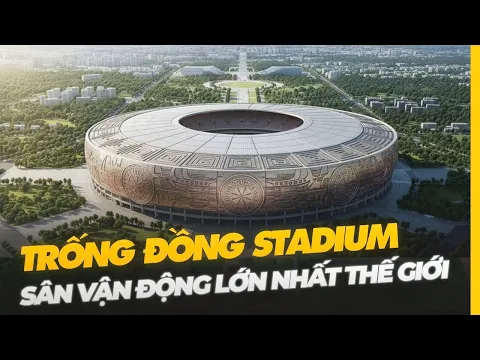

The Trong Dong was not designed as an isolated facility. The stadium integrates a sports complex of about 9 thousand hectares, equivalent to 90 million square meters.
On an urban scale, this number points to a complete functional territory, with technical areas, logistical flows, and dedicated connections for large volumes of people.
The proposal also draws references from internationally visible arenas, such as Wembley, Bird’s Nest, and Lusail. More than replicating forms, the strategy is to combine global technical standards with local identity.
This balance helps to explain why the project has been positioned as a long-term piece in the Vietnamese agenda for attracting large international events.
The new stadium in Vietnam concentrates four vectors rarely combined in the same project: record scale, billion-dollar investment, cultural symbolism, and multipurpose operation. If the schedule is met by August 2028, the arena is expected to become a landmark for international repositioning, impacting beyond sports.
List of the Largest Stadiums
In addition to sporting events, the space was planned to host large events such as shows, festivals, and exhibitions, within Vietnam’s strategy to position itself as a host of large international events.
- Trong Dong Stadium – Vietnam (under construction)
- Rungrado 1st of May Stadium – North Korea
- Narendra Modi Stadium – India
- Flush Stadium – USA
- Beaver Stadium – USA
- Ohio Stadium – USA
- Kyle Field – USA
- Melbourne Cricket Ground – Australia
- Camp Nou – Spain
- FNB Stadium – South Africa
Considering what this model represents, what factor weighs most for you in a project of this size: audience capacity, architecture with cultural identity, economic return of the complex or long-term urban legacy?


