





 Portuguese
  English
  Spanish
  5 min of reading
  0 comments


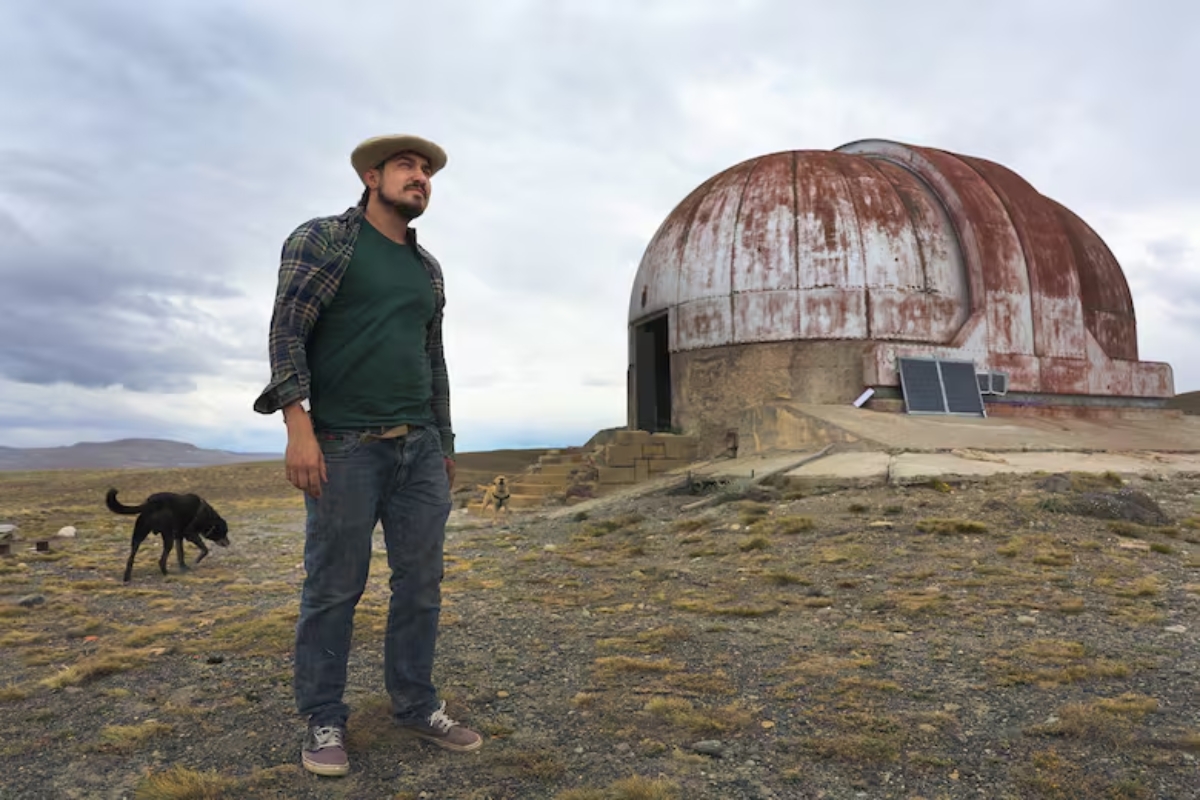
The Structure of the Old Complex Remains Open to Visitors, While Javier Soto Maintains the Site and Cares for His Uncle’s Tomb 100 Kilometers from El Calafate
Javier Soto is 35 years old and chose to live in isolation at an abandoned observatory in the steppe of Santa Cruz, Patagonia. The location is next to Route 40, near the La Leona river, and about 100 kilometers from El Calafate, in an area where human presence is already rare by itself.
The metallic dome, marked by time and constant wind, has become a point that draws attention from those passing by on the road. The curiosity of tourists and travelers blends with the contrast between the arid landscape and the almost space-like appearance of the building, which still holds part of the history of astronomy in the region.
The decision to stay there came with a clear objective. In addition to seeking introspection and a routine far from urban life, Soto took on the mission of caring for the tomb of his uncle, the Mapuche lonco Ramón Epulef, who lived in the area for decades and died in 2023.
-
About 150 workers are driving, one by one, 4,585 BYD electric cars off a 220-meter ship at the Port of Itajaí. The 48-hour mega-operation is the largest shipment from the Chinese automaker in Santa Catarina this year.

-
Samara left the city, built a small power plant on her property, and now lives surrounded by waterfalls, her own energy, sustainable recycling, and preserved nature in the Serra da Mantiqueira.
-
The end of Japan? Population is disappearing, country loses more than 3 million inhabitants in just five years and birth rate falls for the tenth consecutive year, raising alarm about demographic collapse and lack of workers.
-
China surprises the world by inaugurating a new era: the country will create a “digital ID” for 28,000 humanoid robots from 100 manufacturers, while machines capable of cooking, doing laundry, and caring for the elderly begin free domestic testing in 2027.


Life Just a Few Meters from the La Leona River and the Limits of Glacial Water
The La Leona river flows about 500 meters from the observatory, but the water is not suitable for drinking due to its high concentration of minerals. Even so, it is used daily for cooking and cleaning, while potable water must come from far away, in gallons brought from El Calafate, 100 kilometers away.
Logistics becomes part of survival, and the distance increases the burden of each trip back and forth. At times, help also comes from travelers and tourists who already know of his presence in the area and leave supplies, reducing the dependence on constant trips.
The Purpose of Caring for the Tomb of Mapuche Lonco Ramón Epulef
The tomb is located on top of a hill, before the river, at a point that Soto treats as a sacred place. The mission to care for this space is directly connected to his uncle’s history, who arrived in the area in 1998, built a life there, and raised animals, keeping the area livable even with the harsh climate.
Ramón Epulef was known as a tamer and gaucho of the steppe, respected in the region. His memory also involves the origin of the Epulef family, linked to territories in Chubut, which reinforces the cultural and emotional bond that keeps Soto at the observatory.
The Creation of the Southern Astronomical Station and the Dream of Mapping the Southern Sky

The history of the observatory begins in 1934, when engineer Félix Aguilar was managing the La Plata Observatory and sought a point to study the sky of the southern hemisphere, then little mapped. The proposal was to install a Southern Astronomical Station to observe stars near the south pole.
The chosen site was the La Leona area, considered extreme from the beginning. The region had few urban references, and the nearest village was El Calafate, founded in 1927, which left the station in a scenario of isolation that impacted any operational plans.
The Epic of Construction and the Steps Until the Building Was Completed in 1951
The construction required improvised solutions and hard labor, with bricks made and fired on-site. The lack of manpower, transportation difficulties, and the harshness of the weather, with strong winds, ice, and snow in winter, made everything slower and more expensive in effort.
The works were approved in 1940, and the land was transferred to the University of La Plata in 1946. Construction began in 1950, and by 1951, the telescope building was already complete, along with supportive structures such as stables and a house for astronomers, even without the power plant and water pump building which were left out due to lack of budget.
The Telescope That Didn’t Work and the Start of Observations in 1965

The equipment phase also faced problems. A telescope arrived and didn’t work, which delayed the goal of continuous observation. The inauguration only took place in 1960, after attempts to make instruments feasible, including the idea of installing a Repsold Meridian Circle, an astrometric instrument designed in 1853 in Germany.
To fulfill the inauguration, a telescope was borrowed from the Lick Observatory of the University of California, which arrived by sea after months of travel. The equipment had been unused for three decades and needed to be disassembled and taken to La Plata for calibration, which further prolonged the effective start of work.
Only in December 1965 did the Félix Aguilar Austral Observatory begin mapping the sky. The practical result was limited by environmental factors, such as the proximity of the river causing diffuse images and the constant presence of clouds, with only 80 nights considered clear per year, reducing the cataloging pace to about 200 stars per month.
Isolation, Closure in 1973, and Reconstruction Starting in 1998
Operation required resilience from those living there. There was a lack of medical care, radio, and mobility, and mail arrived every 15 days, which made the routine heavier even for trained teams. By the end of the 1960s, a pickup was donated to the astronomer, but isolation remained a permanent challenge.
Five astronomers took turns until the closure in 1973, when the telescope returned to La Plata and the building was abandoned. Over time, the weather and vandalism turned the astronomer’s home and other structures into ruins, until Ramón Epulef rebuilt the space starting in 1998, preserving the dome and making the house habitable.
In 2009, a project was introduced in the Culture, Science and Technology Commission of the Chamber of Deputies to declare the observatory as a National Historical Monument, with no news of progress. Following his uncle’s death in 2023, the family continued to care for the area, and Soto remained on-site to protect the heritage and memory linked to this occupation.
His presence also changed the dynamics of those passing by Route 40. The gates are opened daily for tourists to approach, and curiosity has increased, but the vulnerability of the site remains evident, especially after the fire that occurred last October in the house where astronomers lived, which had been restored by his uncle.
Connection to the world happens through a Starlink antenna, supported by three solar panels that allow cellphone use for a few hours a day. Between the solitude of the steppe and the movement of visitors, he continues with two dogs, basic food supplies, and the idea of recovering calm and darkness, keeping alive a point of Argentine astronomical history amidst the Patagonia winds.
The content was prepared based on information published by Leandro Vasco in the Argentine digital media LA NACION.








-

1 person reacted to this.