Portuguese
  Spanish


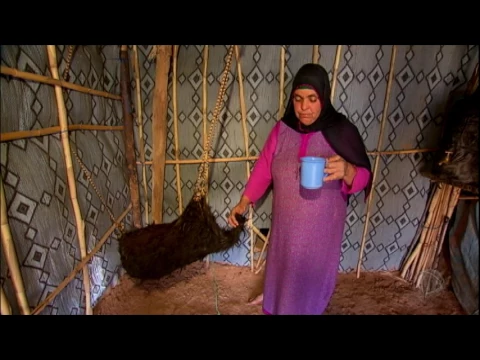
Living In Cloth Tents And Straw Houses, Berber Families Live Isolated In The Desert By Choice, Without Luxury Or Bathroom, Storing Water And Milk In Traditional Goat Skin Containers.
They live isolated in the desert, far from any major city, in a routine that dispenses with modern comfort but preserves tradition, silence, and freedom. At first glance, the scene seems like extreme poverty, but for these nomadic families, it is a chosen way of life, organized around a small main tent, two straw houses, and an endless horizon of sand.
While many people dream of larger apartments and high-tech bathrooms, these families live isolated in the desert with the bare minimum: a tent, rugs on the floor, a simple stove, and an improvised oven. The simplicity is apparent but hides a deep choice of values, where time, peace, and tradition weigh more than any urban luxury.
Simple Tents, Intense Routine
The first signs of human life appear from afar: a small cloth tent and two straw houses break the monotony of the desert.
-
Brazilian Town Known for Its Steady Winds Impresses with Cutting-Edge Hospitals, Clean Air, and Peaceful Living Just Three Hours from São Paulo

-
Animal Thought Extinct for 130 Years Reappears in Brazil, Exciting Scientists with Rare Comeback
-
German Sailor Found Mummified on His Boat in the Philippines, Leaving Scientists Puzzled by an Unbelievable Detail
-
Brazilian Couple Trades Motorhome for “Houseboat” Adventure on Historic Welsh Canal with Unique Challenges


The Berber people almost always follow the same pattern. At the center of it all is the main tent, where the family spends most of the day.
There, they roll out several rugs, prepare tea, rest, and on many days, also sleep. When the heat intensifies, it’s to this tent they run, seeking a bit of shade and airflow.
The home is simple, but it fulfills everything it needs to for those who live isolated in the desert and depend more on the climate than on concrete walls.
Next to it is the area that functions as a kitchen. There is no counter, cabinet, or appliance. Just a small oven and a tiny stove, enough to prepare tea, warm bread, and cook whatever is available.
The fire is carefully controlled, and each flame lit is a reminder that the desert does not forgive excesses.
Bathroom Is The Desert Itself

Amid this daily life, there is one detail that always shocks visitors: there is no bathroom. No closed room, no toilet, no sink.
When someone needs to, they simply step away from the tent and choose any spot in the desert.
For those who grew up surrounded by walls, tiles, and plumbing, the idea may seem unthinkable. But for families that live isolated in the desert, the land itself is the bathroom.
The notion of intimacy is different, shaped by open space, the distance between people, and the fact that there are no neighbors peeking through the window of the next building.
This absence of a bathroom does not signify neglect but rather a radical adaptation to the environment. The desert is vast, the circulation of people is small, and the use of space is diffuse, following a logic that roughly anticipates a balance with the surroundings.
Cold Water In Goat Skin
If the bathroom is the desert, water also follows its own logic. The family does not leave their most precious resource simply in plastic bottles or ordinary jugs.
Instead, the water that the family drinks is stored in a part of a goat, a kind of pouch made from the animal’s skin, still with fur.
This same container serves both to store water and to hold milk. The skin acts as a natural insulator, helping to keep the contents a bit cooler, enough to withstand the intense heat of the desert.
In a place where every degree less makes a difference, this detail is a matter of comfort and survival.
For those who live isolated in the desert, using goat skin is neither exotic nor curious. It is simply the most efficient way to conserve what is essential, utilizing everything the animal provides, without waste.
It is ancestral technology, tested by generations, surviving side by side with smartphones and social networks that never reach there.
Fátima, Nomad By Choice

In this setting, Fátima becomes the voice of a type of life that seems impossible for many. She does not see herself as a victim of fate or trapped by a lack of resources. On the contrary: Fátima is a nomad by choice.
She says she has never set foot in a major city. Not due to lack of opportunity, but because she does not feel the need. There, in that vastness of sand, she claims to be much happier.
The routine can be harsh, the heat can be extreme, work is constant, but the feeling of belonging outweighs the difficulties.
Hearing her words, it becomes clear that there is a difference between those pushed to the margins and those who chose to live on the margins.
The families that live isolated in the desert like Fátima are not fleeing the city; they are affirming another way of living, where the clock is the sun and comfort is defined by different criteria.
At the time of farewell, the cultural shock is evident. There, greetings are subdued, with little physical contact. But the visitor, bringing with them Brazilian customs, insists on a hug. Two worlds meet for a few seconds, and then each returns to their own rhythm.
When The Millionaire Dreams Of The Desert
The choice for the desert is not exclusive to those born and raised there. Soon after leaving Fátima’s tent, Lalafa appears, regarded as one of the most powerful men in the kingdom, a successful businessman, owner of a large hotel chain in the south of the country.
He knows luxury up close. He lives surrounded by comfort, services, technology, everything that money can buy.
Still, when he talks about the future, he does not dream of more suites, more trips, or more grand works. He confidently states: in the future, I want to live in the desert.
His family was nomadic. The memory of a simple life, on the move, marked him. Apparently, the more he achieves in the city, the more he feels the call of that origin. At first glance, it seems difficult, he admits. But, according to him, it’s not.
Lalafa’s speech highlights a powerful contrast: while many struggle to escape simplicity, he aims to return to it.
And, deep down, he draws closer to the families that live isolated in the desert by choice, gradually abandoning excess to rediscover a way of life that does not fit into profit spreadsheets.
Life Choice Among The Sand
Between the cloth tent, the straw houses, the bathroom that is the desert itself, the water stored in goat skin, and the dreams of Fátima and Lalafa, an inevitable question arises.
What is, after all, true comfort: an apartment full of things or a life with fewer objects and more horizon?
These families that live isolated in the desert show that it is possible to say no to luxury and still consider themselves fulfilled.
The decision to remain nomadic, without a bathroom, without a big city, without a showcase, is a silent declaration of autonomy in a world that pushes everyone in the opposite direction.
The information in this article was inspired by a report aired by the Câmera Record channel on YouTube.
And you, would you be able to give up the comfort of the city to live isolated in the desert by choice, like these families?