






 Portuguese
  Spanish


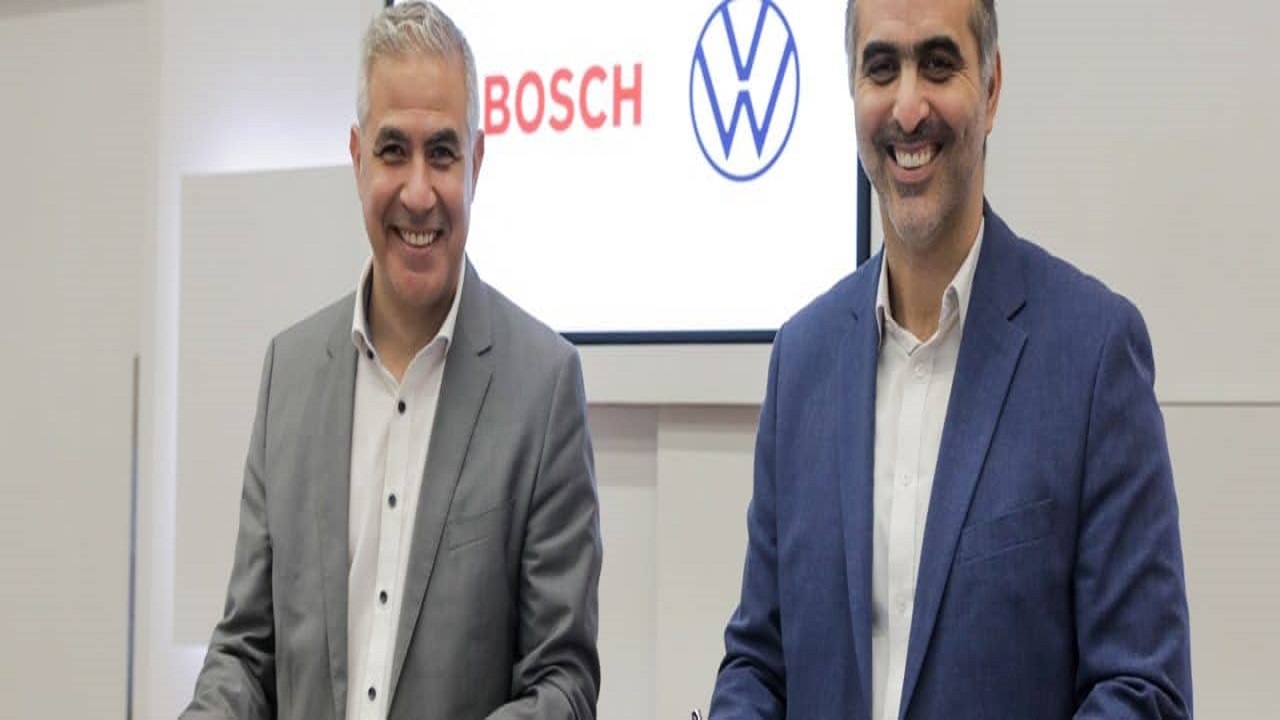

Bosch and Volkswagen Signed an Agreement to Develop Projects Focused on Clean, Safe, Connected, and Advanced Mobility in Latin America.
Volkswagen do Brasil and Bosch established a new partnership on Thursday (9) with the aim of developing projects related to driver assistance and powertrain systems in Latin America. Thus, the two companies hope to expand innovations for emerging markets that contribute to lower carbon emissions and energy efficiency in mobility, as well as road safety.
Bosch and VW Projects Aim to Improve Biocombustible-Powered Combustion Engines
Gastón Díaz Pérez, president of Bosch for the continent, and Pablo di Si, executive of Volkswagen in Latin America, formalized the partnership during an event at Bosch’s headquarters in Campinas (SP). The projects in Latin America integrate solutions for enhancing performance and efficiency of combustion engines powered by biobased fuels, such as ethanol, for instance, aimed at reducing pollutant emissions.
According to Di Si, in a statement to the press, everyone is focused and immersed in bringing consistent and innovative projects to Volkswagen that significantly contribute to the Way To Zero strategy in the region, across all areas of the company.
-
2027 Toyota Corolla Cross Unveiled: New Design, Enhanced Fuel Efficiency, Reduced Maintenance Costs, Advanced Technology, Connected Services, and Up to 10-Year Warranty

-
Fiat Cronos Precision 2018: Affordable Sedan with Spacious Trunk and Reliable Maintenance
-
Volkswagen to Cut Production by 1 Million Cars by 2030, Reducing Jobs and Platforms, Focusing on More Profitable Models

-
Toyota Launches First 100% Electric Car in Brazil: bZ4X with 343 HP, All-Wheel Drive, 361 km Range, Priced at $419,990 BRL, Limited to 99 Units



The executive also states that having a partner like Bosch for the project in Latin America not only brings expertise to achieve the goals of decarbonization and energy efficiency but also takes safety and technology to another level.
Volkswagen and Bosch Focus on Traffic Scenarios in Latin America
According to the companies, another focus will be the combination of electric-hybrid solutions with biobased fuel systems. The partnership aims to encourage energy generation through connectivity, something Volkswagen implements with the “Abasteça Consciente” feature available in the German automaker’s app. Regarding safety, the companies will work to improve sensors and identify characteristics of traffic scenarios in Latin America to adapt driving assistance and braking systems.
The intent is to refine energy recovery and fuel economy. According to Díaz Pérez, also in a statement, the partnership with Volkswagen aligns with the company’s purpose of technology for life, making mobility safer, cleaner, more economical, and connected.
The partnership will unite innovation and technology, strengthening the companies’ commitment to vehicle safety and decarbonization in Latin America.
Bosch and Volkswagen Form Other Partnerships
Earlier this year, Volkswagen announced that it will have a dedicated company for the development of batteries for electric cars and also said that this will be done in partnership with Bosch.
The goal is to combine efforts to develop a project unit and explore the possibilities of industrial-scale solutions for battery production in Europe, that is, to install a super factory of batteries to meet the continent’s demands.
At the time, Volkswagen Group’s Board Member Thomas Schmall stated that Europe has everything to become a global powerhouse in the production and commercialization of batteries for electric vehicles. The estimate is that annual capacity could reach 700 GWh by the next decade.
According to the president of Bosch’s Executive Board, Rolf Najork, his company has many prerequisites to contribute to the partnership and mentioned the more than 135 years of experience the company has in the sector, and this is what he intends to offer to the Volkswagen Group to bring the project of the super factory to fruition by the end of this year at the latest.








