Portuguese
  Spanish


Archaeologists in Germany investigate a structure almost 2,400 years old found during urban excavations in Aschaffenburg. The find combines oak wood, organized stones, and rare preservation below the level of the Main River.
Workers were engaged in a modern flood control project in Germany when the ground revealed something unexpected. At about 8 meters deep, in Aschaffenburg, Bavaria, a wood and stone structure preserved for almost 2,400 years emerged.
What seemed to be just the construction of a rainwater containment basin next to the Main River turned into a rare discovery from the Iron Age. The wood found at the site was identified as oak and dated to the 4th century BC.
The case was officially confirmed on May 20, 2026, when the Bayerisches Landesamt für Denkmalpflege reported that wood analyses pointed to the 4th century BC. The next day, May 21, 2026, the Aschaffenburg city hall announced the discovery, emphasizing that excavation and analysis work is ongoing.
-
Orphaned Youth Turns Dismissed Idea into Global Prestige with Innovative Wristwatch

-
English Skills Boost Career Opportunities in the Oil and Gas Industry

-
Brazil Secures Second Place at WorldSkills 2024 in Lyon, with 64 Young Professionals and 8 Medals, Including Gold from a Rio de Janeiro Hairdresser

-
3,000 Military Personnel from 10 Countries, Including US and Chinese Marines, Train Together in Brazil’s Savanna: Operation Formosa Becomes Largest Naval Ground Exercise Before First Cancellation Since 1988



Flood control project opened the ground and revealed an Iron Age secret
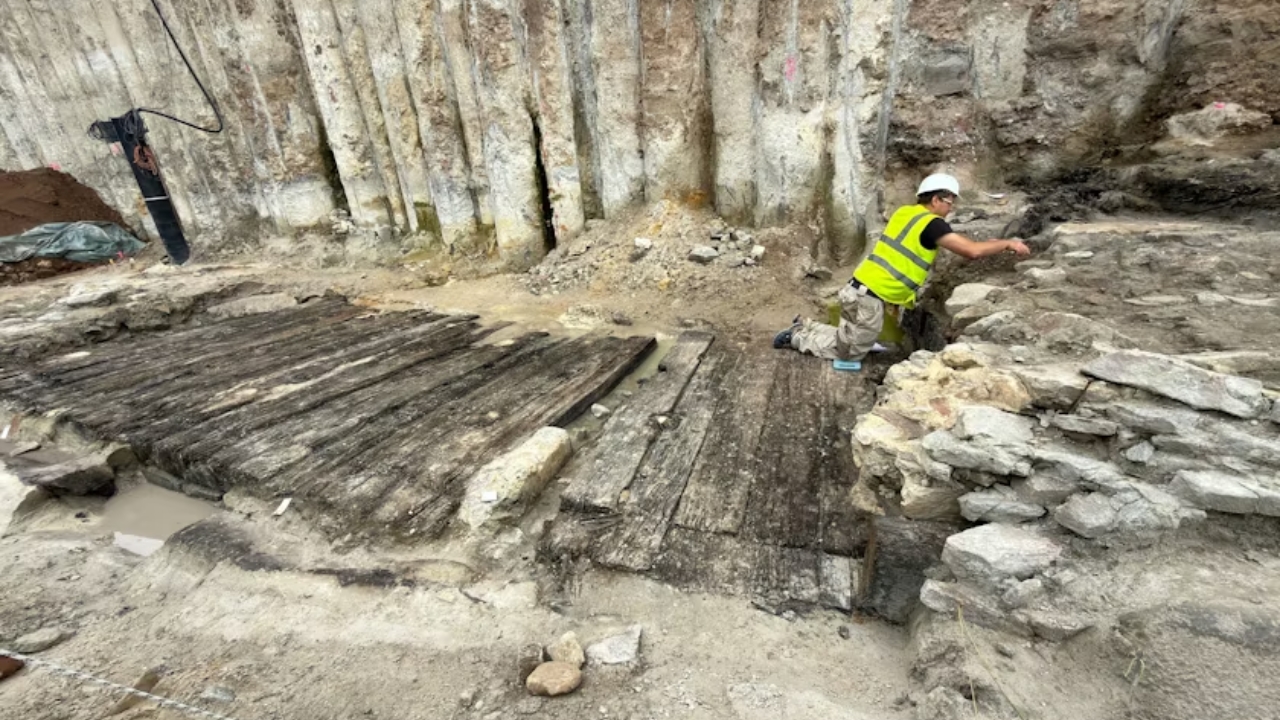
The discovery was reported in March 2026 by the City of Aschaffenburg to the Bayerisches Landesamt für Denkmalpflege, the Bavarian state heritage office known by the acronym BLfD, after wood remains appeared during the construction of an urban structure used to control excess water during periods of heavy rain.
As machines and workers advanced on the terrain, remnants of darkened wood, organized stones, and elements that did not seem to be part of the natural landscape began to appear. What was buried there had shape, organization, and clear signs of human intervention.
Initially, the excellent state of preservation confused the experts. The wood seemed so well-preserved that the first hypothesis was of a much more recent construction. But scientific tests completely changed the story.
Oak wood revealed a date that surprised archaeologists
The age of the structure was confirmed through dendrochronology, a technique that analyzes the growth rings of wood. This method allows for the comparison of ancient samples with known regional sequences and achieves quite precise dating.
The result placed the find in the 4th century BC, during the Iron Age. This means that the structure was built about 2,400 years ago by a community that already mastered construction techniques with heavy wood, stone, and adaptation to the riverside terrain.
This detail makes the case even more impressive. It is not an isolated object lost in the mud. The discovery points to a planned work, made in a strategic area by the river, possibly linked to the use of the riverbank, circulation of people, transportation, or activities not yet identified.
Structure was preserved like a time capsule beneath the city
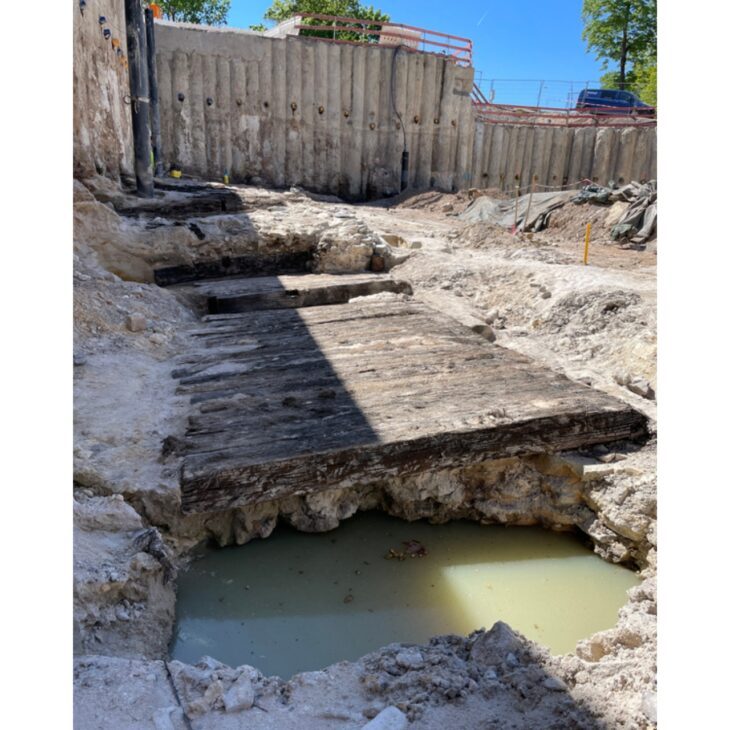
One of the most fascinating points is the conservation of the wood. Under normal conditions, organic materials disappear over the centuries. However, the remains were buried in moist soil, below the level of the Main River, in an environment with little oxygen.
This combination created a kind of natural time capsule. The lack of air slowed decomposition and allowed the logs to remain preserved for over two millennia, still able to reveal information to researchers.
While Aschaffenburg grew on the surface, with streets, bridges, buildings, and modern works, that construction remained hidden underground. Now, an excavation made to solve current problems has opened a direct window to a period before Roman rule in much of Europe.
Wood and stone construction may change the history of Aschaffenburg
The structure found combines large oak pieces with stone elements. The revealed part extends for almost 30 meters, indicating a robust, organized construction very different from a simple accumulation of abandoned logs.
Archaeologists have not yet confirmed the exact function of the structure. Even so, its location by the river raises important hypotheses. It may be related to a bank structure, a circulation area, an installation linked to river transport, or some type of representative construction.
The find gains even more significance because Aschaffenburg had already revealed signs of ancient occupation. Objects such as a fibula with an animal head, a gold ring, and other traces indicated the presence of groups associated with the La Tène culture, linked to the European Celtic world.
Dry stone wall increased the mystery of the discovery
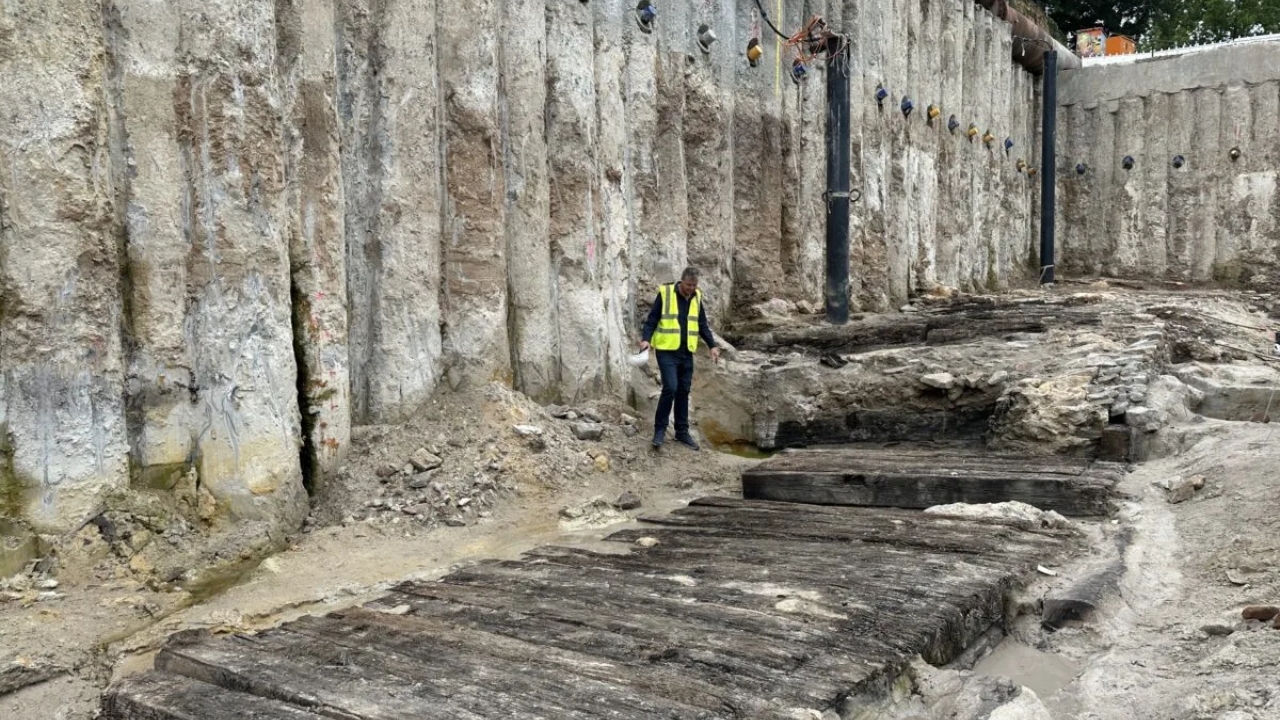
Among the most intriguing details is a dry stone wall facing the river side. This type of construction draws attention because stone structures from this period are considered rare in the region.
In the Iron Age, stone walls usually appear in contexts of greater importance, often associated with fortified areas or prominent works. This does not allow us to state that the structure was a fortress, but it shows that it had a technical level above what was expected.
Therefore, the big question remains open: who built that structure on the banks of the Main and what was its true function?
Discovery reinforces the hypothesis of an ancient Celtic center beneath the city
The new structure reinforces the possibility that the region of present-day Aschaffenburg may have housed an important Iron Age center. Previously, this hypothesis was mainly supported by isolated objects. Now, the wooden and stone construction offers much more powerful physical evidence.
It is still too early to assert that the site was a Celtic port or a commercial installation. The most accurate statement is that researchers have found an Iron Age riverside structure, with its function still under study.
Even so, the impact of the discovery is enormous. A structure built to protect the modern city against heavy rains ended up revealing a construction buried since a time when the map of Europe was completely different.
A deep excavation that transformed a common construction into a historical find
The excavation takes place between 8 and 10 meters deep, which makes the work more complex. Each piece needs to be documented carefully, as removing the wood can alter the conditions that allowed its preservation for so many centuries.
In the end, the scene gathers all the elements of a perfect story to impress: workers, a flood control project, a deep excavation, oak wood, ancient stone, and a 2,400-year-old structure hidden beneath a German city.
Now, archaeologists are trying to answer what that construction was doing on the banks of the Main River. And each new fragment removed from the mud can reveal a part of a story that has remained silent since the Iron Age.