Portuguese
  Spanish


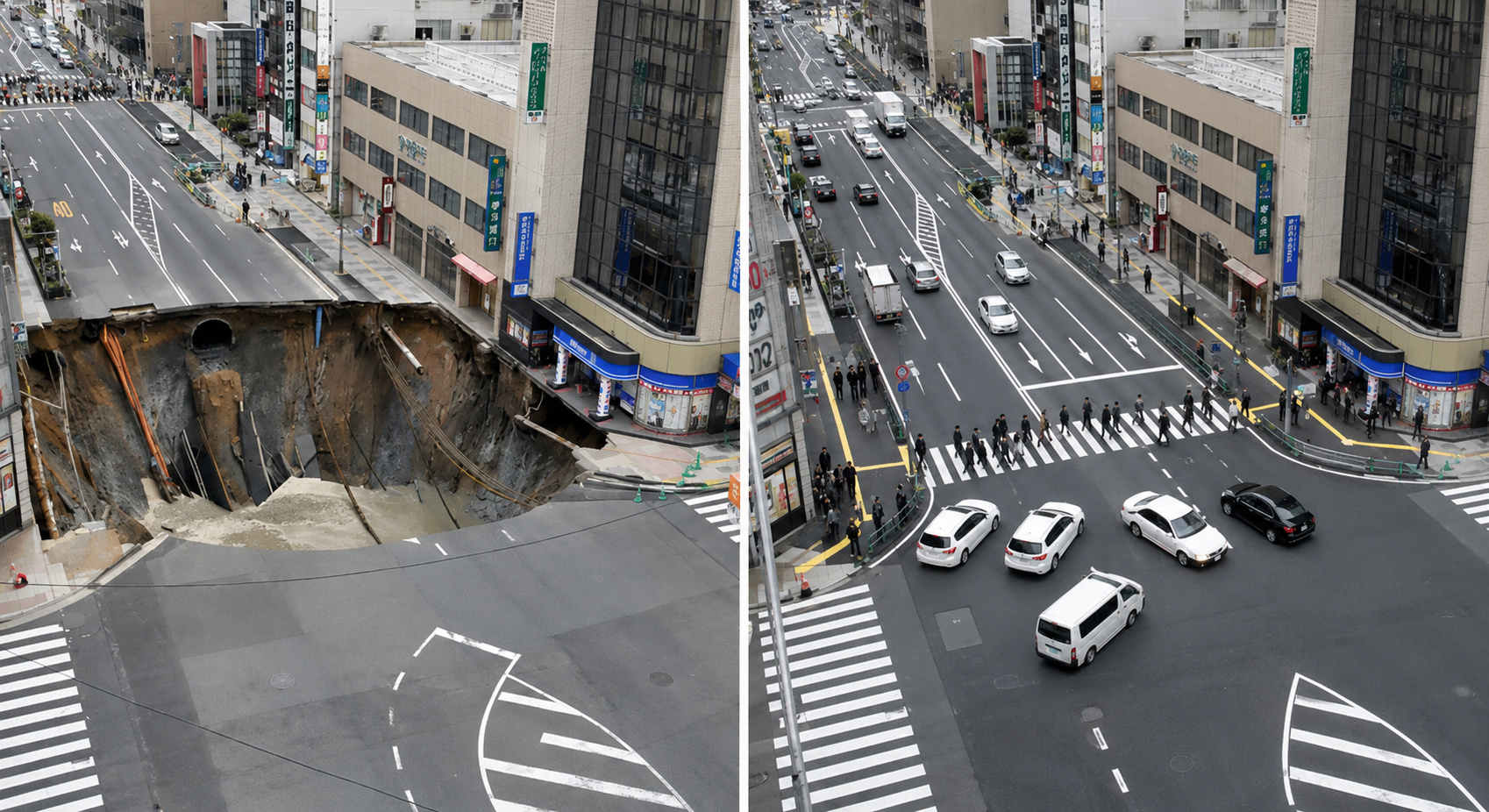


Japan rebuilt in just 7 days a street destroyed by a giant 20-meter crater in Fukuoka.
On November 8, 2016, residents of Fukuoka, Japan, witnessed one of the most impressive urban scenes ever recorded in the country: a huge crater opened around 5 am on a five-lane avenue near Hakata station, one of the busiest areas in the city. According to The Guardian, on November 15, 2016, the collapse swallowed part of the road, traffic lights, poles, and underground infrastructure, forcing authorities to isolate the area and start an emergency repair operation.
The hole was described by international media as a crater approximately 30 meters wide and about 65 feet deep, equivalent to almost 20 meters, while Wired reported, on November 18, 2016, that the affected area reached about 8,700 square feet of urban road, approximately 808 m². The collapse disrupted power, water, and other services for hundreds of homes, affected phone signals, and raised suspicions of a connection with underground metro expansion works in the area.
What made the episode world news, however, was not just the size of the crater, but the speed of the recovery. On November 15, 2016, just a week after the collapse, the avenue was reopened to pedestrians and vehicles, after teams filled the hole, repaired pipes, underground networks, poles, traffic lights, and resurfaced the road.
-
The Little-Known Story of a Home-Built Airplane That Promised Freedom but Faced Safety Issues After Numerous Accidents

-
He Didn’t Build a Plane, But Spent Decades Trying to Make Bicycles Fly with Wings and Pedals; Remaining Models Tell This Unusual Story in Germany
-
Roraima Security Secretary Poses as Doctor to Expose Technician Charging $600 for Free Public Health MRI in Brazil; Technician Confessed

-
To Protect Its Beaches, the Netherlands Deposits 21.5 Million Cubic Meters of Sand into the Ocean, Letting Nature Reinforce Dunes and Shoreline




Giant crater opened suddenly near Hakata station in Fukuoka
The incident occurred in the early hours of November 8, 2016, near Hakata station, one of the main railway and commercial centers of Fukuoka.


Images recorded at the site showed a huge opening swallowing multiple lanes of the avenue, poles, traffic lights, and part of the underground urban infrastructure.
The scale of the collapse quickly drew international attention because the hole seemed large enough to swallow entire buildings.
Hole reached about 20 meters deep and destroyed underground infrastructure
According to Japanese authorities and international media, the crater reached approximately 20 meters deep and about 30 meters wide.
The collapse affected water, gas, electricity, and telecommunications networks. Part of the region was left without basic services immediately after the incident. The area also experienced a complete traffic interruption due to the structural risk around the crater.
Initial investigations pointed to a connection between the collapse and underground works related to the expansion of the city’s subway line. According to reports published at the time, excavations below the surface may have caused soil instability, leading to the sudden collapse of the avenue.
The case raised concern because the affected region was in one of the busiest urban areas of Fukuoka.
Teams worked day and night to rebuild the destroyed street
After the collapse, Japanese authorities initiated an intensive urban recovery operation. Heavy machinery, trucks, and technical teams began working almost non-stop to stabilize the soil, fill the crater, and rebuild the damaged underground infrastructure.
The accelerated pace was impressive because similar projects in many countries usually take weeks or even months to complete.

According to information released at the time, thousands of cubic meters of material were used in the process of filling the enormous hole.
The work involved soil compaction, reconstruction of the avenue’s structural base, and complete recovery of the asphalt surface. Additionally, teams needed to reinstall essential underground systems before reopening the traffic.
Water, electricity, gas, and telecommunications were restored in a few days
One of the most impressive aspects of the operation was precisely the speed of urban infrastructure recovery. Water, electricity, gas, and telecommunications services were quickly reconnected after stabilization works.
This required simultaneous coordination between multiple companies and public agencies working at the site at the same time. The fact that turned the case into a global symbol of urban efficiency was the reopening of the avenue in just seven days.
Just over a week after the formation of the giant crater, traffic was already returning to normal in the reconstructed area.
Images of the before and after were impressive because the area seemed practically restored to its state before the collapse.
Japanese government issued public apologies for the incident
Even with the speed of the recovery, Japanese authorities treated the case as a serious infrastructure failure. The mayor of Fukuoka made a public apology to the population for the inconvenience caused by the collapse of the avenue.
The episode also led to revisions in the monitoring procedures of the subway’s underground works. The ultra-fast recovery became an international topic soon after videos and photos began circulating on social media.
Many users compared the Japanese reconstruction timeline with prolonged urban works in other countries. The speed of the repair ended up turning the case into one of the most cited examples of efficient urban emergency response.
Japanese engineering used intense monitoring to prevent new collapses
During the work, technical teams continuously monitored ground movement around the crater. The goal was to prevent new landslides while heavy machinery worked on filling and reconstructing the avenue.

This monitoring was essential to allow the teams to advance rapidly without increasing structural risks. The proximity to Hakata station further increased the pressure for a quick solution.
The region experiences intense traffic flow, commerce, hotels, and railway passengers daily. Keeping the avenue closed for a long time would have caused significant economic and logistical impact on the city.
Case showed Japanese capacity for rapid mobilization in urban infrastructure
The episode ended up becoming a global example of emergency urban coordination. The combination of planning, specialized labor, available equipment, and integration between public and private companies allowed for a drastic acceleration of the repair.
In many countries, a crater of this size could keep an avenue closed for months. The case impressed not only because of the size of the hole but mainly due to the contrast between extreme destruction and accelerated recovery.
In a few days, a completely destroyed avenue was back to functioning normally after receiving a new structural base, rebuilt underground networks, and repaved surfaces.
The transformation was so rapid that comparative images began circulating as an extreme example of efficiency in urban engineering.