Portuguese
  Spanish


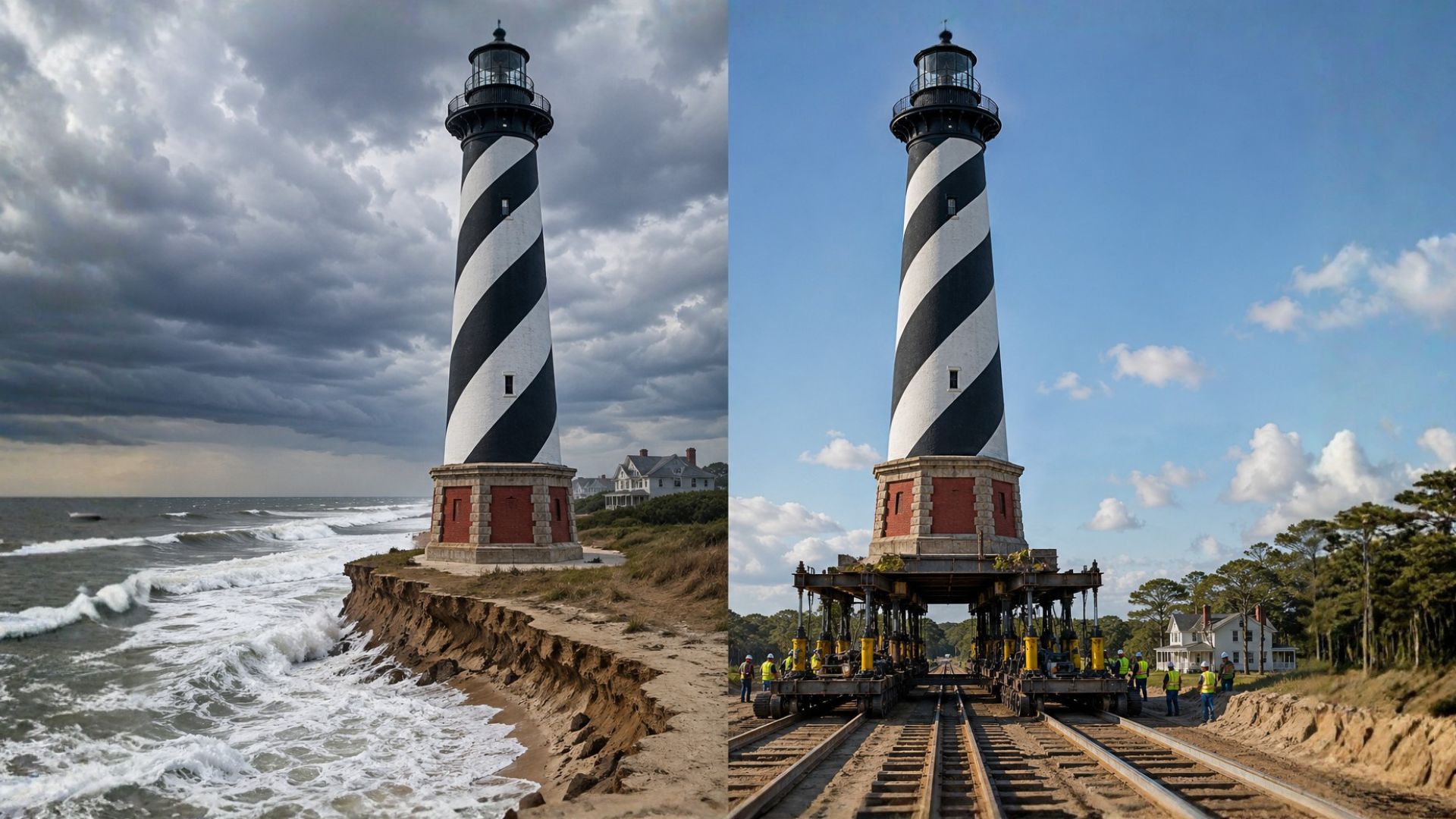


Historic structure threatened by the sea required an unusual engineering solution for preservation in the United States, with the complete relocation of a century-old lighthouse without disassembly, use of real-time monitoring technology, and planning that took years until final execution in a few weeks.
The Cape Hatteras Lighthouse, one of the best-known lighthouses on the US coast, was relocated in 1999 to escape coastal erosion that threatened its permanence in its original position in North Carolina, in a move considered unprecedented for a structure of this size.
During the operation, the brick tower traveled 2,900 feet, about 884 meters, over 23 days, in a gradual process that required constant precision and continuous technical monitoring to avoid any structural compromise along the way.
Under the administration of the National Park Service, the structure weighed 4,830 tons and was moved between June 17 and July 9, 1999, a period during which specialized teams monitored each stage with measurement and control instruments.
-
Japanese Fisherman Spends 18 Hours Alone at Sea in a Portable Floating Shelter, Launches Limited Edition Model via Crowdfunding

-
73-Year-Old Chemical Engineer Turns Luxury Shoe, Bag, and Jacket Restoration into Family Business in São Paulo, Showcasing the Timeless Value of Craftsmanship

-
Japanese Botanist’s Miyawaki Method Grows Native Forests in Small Spaces in Just Years, Not Decades

-
800-Year-Old Cliffside Temple in Greece Amazes with Secret Cave, Drawbridge, and Stunning Views




The relocation aimed to move the lighthouse away from the encroaching sea and reposition it approximately 1,500 feet from the coast, a distance similar to that recorded when the construction was completed in the 19th century, before the intensification of erosion.
Coastal erosion threatened the Cape Hatteras Lighthouse

Over decades, the strip of sand separating the lighthouse from the ocean was progressively reduced, a result of the natural dynamics of a barrier island subject to intense currents, storms, and constant changes in the Atlantic coastline.
Initially located in a position considered safe, the lighthouse began to face an increasingly critical scenario as the sea advanced and reduced the distance between the structure and the water, raising the risk of irreversible damage.
Given this situation, maintaining the structure in its original location ceased to be a viable option, leading authorities and engineers to consider less conventional alternatives capable of ensuring the preservation of the historical heritage.
In this context, the decision to move the lighthouse broke with the traditional idea of conservation, which prioritizes absolute permanence at the point of origin, by adopting relocation as a strategy to protect the integrity of the structure.
Engineering used tracks, sensors, and hydraulic jacks
Before the relocation began, it was necessary to separate the lighthouse from its original foundation and support it on a system composed of steel beams, metal tracks, rollers, and hydraulic jacks, creating a mobile base capable of supporting thousands of tons.
Unlike continuous movement, the advance occurred in segments, with displacements of about five feet at a time, followed by equipment adjustments to maintain the alignment and stability of the tower.

This method significantly reduced the risks of tilting, excessive vibration, or cracks in the masonry, ensuring that the structure remained intact throughout the journey to the previously defined new point.
To enhance control, the operation relied on 60 automatic sensors, responsible for monitoring load transfer, tilt, vibration, and possible changes in the structural axis throughout each stage of the relocation.
At the top of the lighthouse, a weather station recorded conditions such as wind speed and temperature, factors that directly influenced operational decisions and the continuation or temporary interruption of movements.
Thus, the image of a century-old lighthouse sliding on tracks depended, in practice, on a precise combination of mechanical force, real-time monitoring, and constant analysis of environmental and structural conditions.
Historic US lighthouse transferred with auxiliary structures
Built in 1870, the Cape Hatteras Lighthouse remains recognized as the tallest brick lighthouse in the United States, with an official height of 198.49 feet, a measurement that considers the base of the foundation to the top of the structure.
Beyond its practical function in navigation, its black and white spiral painting became a characteristic visual element of the region, facilitating identification during the day and reinforcing its historical and cultural relevance.
As part of the Cape Hatteras Light Station, the lighthouse is part of a broader complex linked to navigation in an area marked by sandbanks and a history of shipwrecks along the coast.
Not only the main tower was moved during the project, as keepers’ houses, cisterns, and the oil house were also transferred, preserving the original spatial organization of the historic complex.
At the new location, the foundation was carefully prepared to receive the structure’s weight again, with a reinforced base capable of ensuring stability in the sandy soil characteristic of the coastal region.

As a result, the lighthouse could be re-seated in a position considered safer, significantly reducing direct exposure to the effects of erosion that threatened its previous location.
Location change surpassed containment works
Although interventions to contain erosion were attempted throughout the 20th century, the results were not sufficient to prevent the sea’s advance over that stretch of the barrier island, which maintained a constant risk to the structure.
Given the limitation of these measures, the transfer began to be considered a more effective and lasting alternative to ensure the preservation of the lighthouse without relying exclusively on coastal containment works.
Although the displacement itself lasted only 23 days, the entire project involved years of technical studies, public debates, route definition, ground preparation, and assembly of the transport system.
This detailed planning allowed a fixed construction to be transformed into a movable structure, without compromising its architectural identity or its historical function within the Cape Hatteras landscape.
With the relocation completed, the lighthouse remained preserved and continued to be integrated into the region’s original environment, maintaining its historical and symbolic role without the need for reconstruction or demolition.