Portuguese
  Spanish


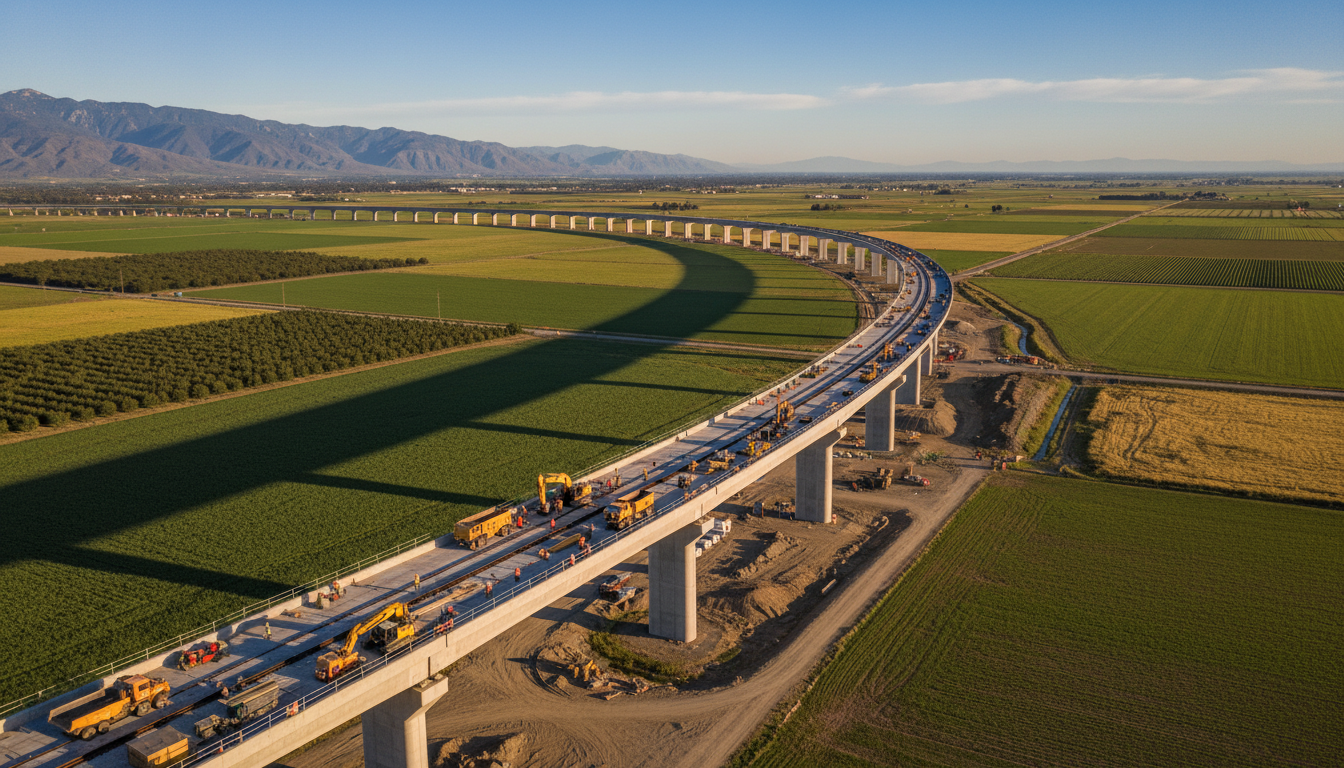


While in Brazil the high-speed train between São Paulo and Rio never got off the ground, California already has 130 kilometers of viaduct ready, 16,700 jobs created, and tracks being installed in 2026
Brazil first announced the São Paulo–Rio high-speed train in 2007. Almost 20 years later, not a single meter of track has been installed, no station built, no valid contract.
In California, the scenario is radically different. According to the California High-Speed Rail Authority, 130 kilometers of guideway (elevated viaduct structure) are already ready and cleared to receive tracks. 67% of the initial segment is completed.
The project is the largest transportation megaproject under construction in North America. And in 2026, workers began installing the first tracks.
-
Brazil to Convert 80 Public Properties into 11,000 Affordable Homes Across 44 Cities to Address Housing Shortage

-
Brazilian Company Develops Wall Panels from Recycled Refrigerator Foam with Comparable Thermal and Acoustic Performance

-
Brazil’s São Paulo Region Unveils Latin America’s Largest Timber Shopping Mall, Built in 7 Months, Capturing Carbon and Preventing 900 Tons of Emissions
-
Danish Island Uses Seaweed for Durable, Centuries-Old Roofing Solution


The difference between the two countries is not technical, not financial, and not geographical. It is a matter of decision.
1,350 kilometers of high-speed train at 350 km/h between Los Angeles and San Francisco
The complete plan foresees 1,350 kilometers of high-speed rail connecting Los Angeles to San Francisco with trains traveling up to 350 km/h. The journey, which currently takes 6 hours by car, will be reduced to less than 3 hours.
The segment currently under construction is the Central Valley segment, spanning 119 miles (191 km) between Madera and Bakersfield. Of this total, 80 miles (130 km) are already completed and ready for tracks.
Throughout the project, 58 civil structures (viaducts, bridges, underpasses) have already been completed, with another 30 underway and only 4 not yet started.
The accumulated investment has generated US$ 25 billion in economic impact in the state.

16,700 jobs and a transformed region
California’s Central Valley is one of the state’s poorest regions. Historically agricultural, with above-average unemployment and few industrial opportunities.
The high-speed train changed that. Construction has already created 16,700 direct jobs — most filled by residents of the region itself.
These include welders, crane operators, civil engineers, drivers, electricians. People who previously relied on seasonal agricultural work now have stable employment on a project that will last more than a decade.
In March 2026, the rail authority inaugurated the Cesar Chavez Boulevard underpass in Fresno, which reconnects the city center to the Southwest neighborhood — divided by tracks for decades.
The high-speed train is not just transportation. It is urban reintegration.
2026: the year the tracks began to appear
The Southern Railhead, a 150-acre facility in the southern Central Valley, is already complete. It is the logistics hub that receives, stores, and distributes track materials — steel rails, sleepers, fastenings.
The tender for the track and signaling system (Track and Systems) has already been published. The first track installations on the viaduct began in 2026.
When completed, the Madera-Bakersfield segment will be the first high-speed railway in the United States to operate with trains exceeding 300 km/h.
Extension plans are already underway: the segment will be expanded to 171 miles (275 km) from Merced to Bakersfield, with civil works completion expected by the end of 2026.

Not perfect: delays, costs, and the most difficult segment ahead
The project is not without problems. The original budget was US$ 33 billion. Today, estimates exceed US$ 100 billion for the full LA-SF segment.
The schedule also slipped. The initial forecast was to open in 2029. Now, the first operational segment (Merced-Bakersfield) is expected after 2030.
The most challenging segment — crossing the Tehachapi Mountains between Bakersfield and Los Angeles — will require tunnels tens of kilometers long through rock and an active seismic zone.
Critics point out that the cost per kilometer is one of the highest in the world. Proponents argue that the 16,700 jobs, the US$ 25 billion in economic impact, and the 130 km of already completed viaduct prove that the decision to start was worthwhile.