Portuguese
  Spanish


New technology targets energy density close to gasoline, but still depends on technical advances before reaching vehicles
CATL has placed the lithium-air battery at the center of its long-term strategy and reignited one of the biggest promises of the electric car industry. The technology is seen as a possible answer to the weight of current batteries, the limitation of range, and the delay in recharging.
The proposal draws attention for a number that is hard to ignore. In theoretical limit, this type of battery can reach 12,000 Wh/kg of energy density, a level close to gasoline, generally estimated at around 13,000 Wh/kg. In practice, this means trying to pack much more energy into a much lighter set.
According to information from Mecânica Online, which highlighted the speech of Wu Kai, CATL’s chief scientist, during the Energizing the Nation 2026 forum. The Chinese company has started to treat lithium-air as one of the most ambitious bets for the next generation of batteries.
-
Brazil Unveils Innovative Monitoring System to Prevent Abandonment of Public Works, Boosting Efficiency and Reducing Waste in Infrastructure Projects

-
AI Video Generator Automatically Creates Subtitles and Animated Captions

-
São Paulo Unveils Latin America’s Largest Underground Reservoir, Holding 900 Million Liters, in the Greater São Paulo Area

-
Chinese Teen Wins Gold in Germany for Invention Turning Air Moisture into Underground Irrigation in Drought-Stricken Areas





The advancement, however, does not yet represent a battery ready to equip electric cars at dealerships. Lithium-air remains in advanced research phase, with important challenges of durability, chemical stability, safety, and mass production.
How the lithium-air battery works that promises more energy with less weight
The lithium-air battery works differently from the lithium-ion batteries used today in electric vehicles. In current cells, materials such as nickel, cobalt, manganese, iron, or phosphate help form the structure that stores and releases energy.
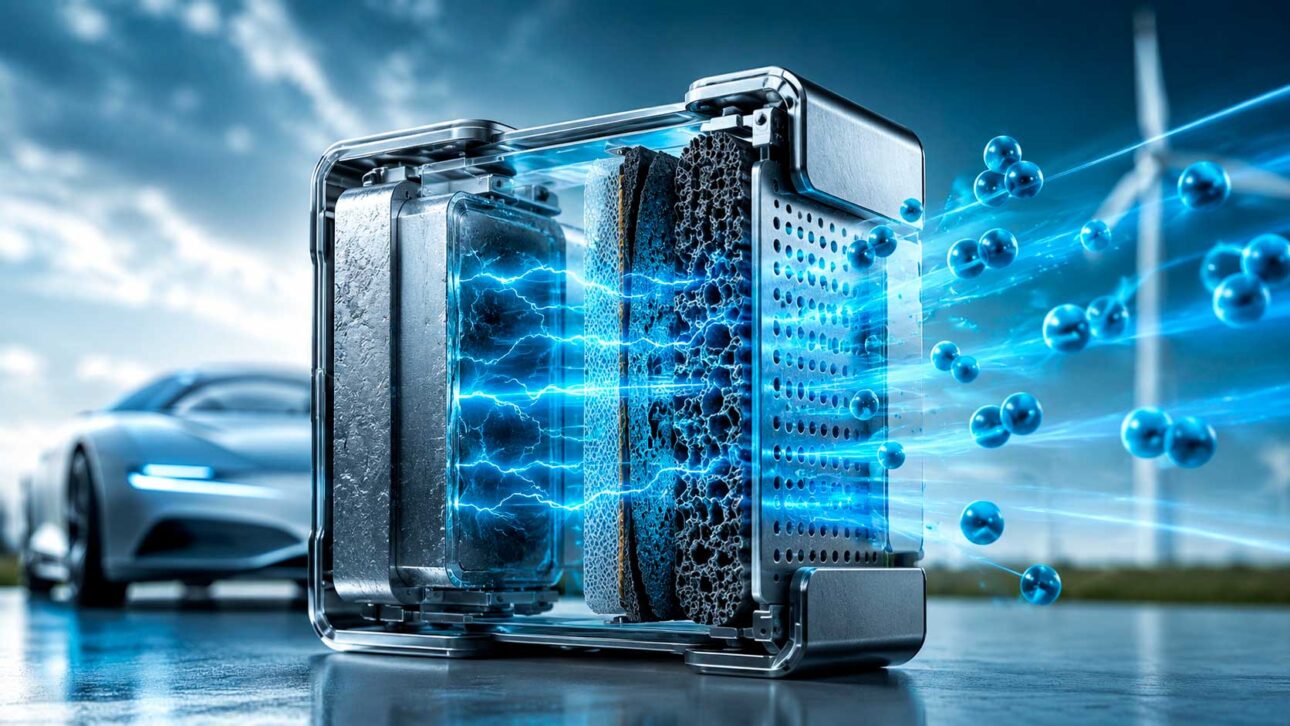
In the lithium-air model, the idea is to reduce part of this weight by using metallic lithium in the anode and oxygen from the air as a reagent in the cathode. Therefore, this technology is often called a “breathable” battery, as it uses external oxygen in part of the chemical process.
This change is important because the weight of the battery pack is one of the major limits of electric cars. The more energy the vehicle needs to store, the larger the battery tends to be, which increases weight, cost, and cooling complexity.
With a much higher energy density, a car could theoretically travel farther without carrying a gigantic battery. This is where the projection of range exceeding 1,600 km per charge comes from, a number that would place electric vehicles on another level of use on highways, commercial fleets, and long trips.
The number is impressive, but the difference between theory and reality is still large
The most important point for the reader to understand is that the 12,000 Wh/kg represents a theoretical limit, not a performance already available in a commercial product. It is a chemical and physical goal that shows the system’s potential, but it does not mean that a battery of this level is ready to be mass-produced.
In the most advanced laboratory tests, recent lithium-air prototypes are already cited with a density above 1,200 Wh/kg, which still easily surpasses conventional lithium-ion batteries. Current models used in electric cars usually fall within a much lower range, often in the hundreds of Wh/kg.
The United States Department of Energy recorded that a solid-state lithium-air battery design, developed with the participation of Argonne National Laboratory and the Illinois Institute of Technology, can reach 1,200 Wh/kg with new advancements and has been tested for at least 1,000 cycles in an experimental cell.
Even this promising result does not eliminate all bottlenecks. A laboratory cell is different from an automotive battery pack, which needs to withstand vibration, heat, cold, fast recharges, accidents, industrial cost, and years of daily use.
Why the technology can be decisive for electric cars and even for trucks
Range anxiety is still one of the main barriers for some consumers considering buying an electric car. Although current models already meet urban use well, long trips still depend on charging infrastructure, planning, and available time.
A battery with more energy per kilogram could directly reduce this problem. Instead of simply installing larger batteries, manufacturers could deliver more range with less weight, better efficiency, and possible internal space gain.
This type of advancement also interests segments that require a lot of energy, such as electric trucks, intercity buses, heavy machinery, and even future applications in regional aviation. In these cases, the battery’s weight has a much greater impact on economic and operational accounts.
The global race for better batteries is happening in a market that is already growing rapidly. The International Energy Agency recorded that global demand for batteries for electric vehicles reached 1.2 TWh in 2025, almost 30% above 2024, with China accounting for the largest share of the expansion.
The biggest challenge is in the real air-sensitive chemistry
Despite the name lithium-air, using oxygen from the environment is not as simple as it seems. Real air contains moisture, carbon dioxide, and other impurities that can hinder the chemical reactions inside the cell.
This is one of the reasons why the technology has been studied for decades but has not yet become commercial. The battery needs to “breathe” without degrading quickly, maintaining efficiency, safety, and recharge capacity for hundreds or thousands of cycles.
Another critical point is in the catalysts and the electrolyte, which need to allow reversible reactions with high stability. If the battery loses capacity too quickly, the energy density gain no longer compensates for the cost and complexity.
Therefore, CATL’s bet should be read as a long-term strategic signal. The company is showing where it believes the next technological leap may be, but without indicating that the replacement of current batteries will occur immediately.
CATL targets lithium-air while strengthening sodium and energy storage
CATL is not only betting on a distant technology. In the short term, the company continues to advance in lithium-ion batteries, sodium-ion batteries, and energy storage systems for power grids.
Sodium batteries, for example, are seen as a lower-cost alternative for entry-level vehicles and stationary applications. They do not have the same density as the best lithium batteries but can reduce dependence on more expensive minerals and help in markets where price is decisive.
At the same time, energy storage has become a strategic front for the company. CATL expects this segment to represent half of its global sales by 2030, while today it accounts for about a quarter of the revenue.
This movement is directly related to solar and wind energy. As these sources vary throughout the day, large batteries become essential to store energy when there is excess and deliver electricity when the grid needs it.
Battery dispute has become an industrial war between China, Korea, Japan, Europe, and the USA
The investment in lithium-air should also be seen within an industrial competition. Whoever masters lighter, cheaper, safer, and more durable batteries will have an advantage in electric cars, buses, trucks, energy systems, and even industrial equipment.
CATL already holds a leading global position. Data from SNE Research reproduced by CnEVPost indicate that the company captured 40.1% of the global market for electric vehicle batteries between January and April 2026, followed by BYD with 14.2%.
The Chinese strength in this sector pressures competitors from South Korea, Japan, Europe, and the United States. The competition is not only technological but also involves the mineral supply chain, factories, recycling, patents, and agreements with automakers.
For consumers, the result of this race could appear in cars with more range, lower prices, and faster recharges. For countries, the issue is broader because it involves industrial sovereignty and dependence on foreign suppliers.
The promise is great, but the 1,600 km electric car still has no date to become reality
CATL’s lithium-air battery should be treated as one of the most promising technologies in electromobility, but also as a bet still far from everyday use. The potential is enormous, but the industry needs to prove it can turn laboratory performance into reliable production.
If the bottlenecks are overcome, the technology could reduce one of the main criticisms of electric cars. A range above 1,600 km would change the perception of those who still see electric vehicles as limited for long trips.
But the path to that point involves chemical stability, protection against air impurities, thermal control, cost, safety, and lifespan. Without resolving these issues, the lithium-air battery will continue to be a powerful promise, but restricted to laboratories.
The big question now is whether CATL will be able to replicate in lithium-air what it has already done in other battery fronts. The company has scale, capital, market, and global influence, but the technology still needs to overcome a barrier that science has been trying to surpass since the 1970s.
Will the advancement of lithium-air batteries finally put an end to the range anxiety of electric cars, or is this promise still too far from Brazilian reality? Leave your comment and say whether you would buy an electric vehicle expecting 1,600 km of range or if you would still trust combustion models more.